


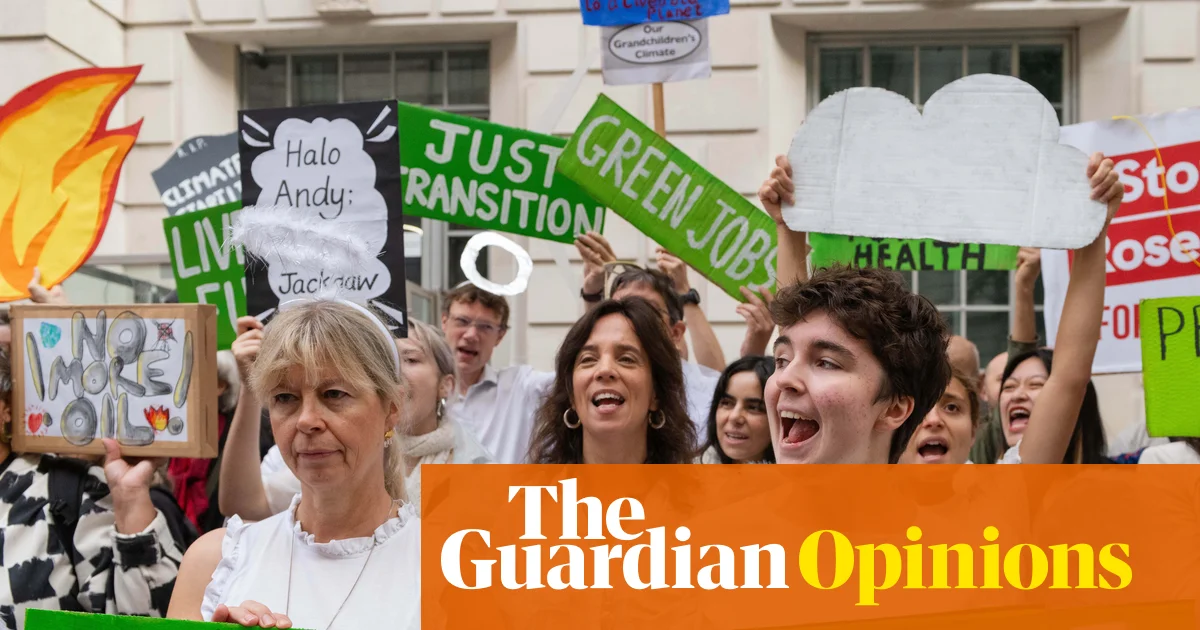
The future of Green politics is under constant discussion after the Holborn and St Pancras byelection, but a much heavier clash – in meaning, symbolism and portent – happened earlier this summer, in King’s Lynn and West Norfolk. The council declared a climate emergency in 2021, along with hundreds of others, and while it was under Conservative control. It is now controlled by independents, and a Reform UK councillor, Austen Moore, moved to scrap the declaration.
It was the end of June, and the meeting had to be called off, because of the extreme heat in the King’s Lynn council chamber. A lot of people paused to grimly remark on that irony, but not Moore, who simply rescheduled the motion for the following week, where it was voted down (by 33 to seven). A local scientist and member of Extinction Rebellion liveblogged that debate, adding helpful maps, such as how much of the county was already below the annual flood level – most of it, including King’s Lynn itself. If this all sounds like a cheerful take home, numerous other Reform-led councils have had the same debate and Reform has prevailed. Their arguments can be terrifyingly illiterate. In Kent, councillor Linden Kemkaran asserted that climate change is fine because the world was warmer in Roman times, and as “carbon dioxide … is a trace gas essential for life on Earth”, to try to cut carbon emissions would itself be dangerous.
If you’re waiting for reality to knock some sense into politics, you will wait too long. There is no heatwave, no flood, no El Niño, no omnicrisis, that will divert rightwing populism from its crusade against action on climate.
The question isn’t what the Green party alone could do to create an eco-populist wave of equal volume. A party that could single-handedly represent the 68% of people who want action on climate change doesn’t exist in modern British politics. The question is, how do you turn that strength of feeling into something more concrete, so it isn’t constantly being ram-raided by unshameable, unscientific chancers? Environmentalists in every party, leaders of every party (apart from the Conservatives, who seem hellbent on chasing Reform, despite the stated values of their supporters), need to find the language and ideas that turn passion for the environment into impetus.
In their recent report, Caroline Lucas and the green philosopher Rupert Read make the case for “eco-popularism” rather than eco-populism: a way of thinking that doesn’t try to hotwire its way into people’s emotional circuitry with invigorating binaries, but, rather, describes actions that would genuinely change lives for the better, and therefore be popular.
Rightwing populists have a set of arguments against climate action that are taking hold more generally and are self-fulfilling: the more they’re repeated, the more they win at local level, the more people come to believe that these views are generally held. Those narratives are that climate action of any sort – be it ultra-low emission zones, 15-minute cities or, most importantly, net zero – is too expensive at this time; that net zero itself is a luxury belief of the comfortable elite who don’t care about ordinary people’s living conditions (Lucas and Read paraphrase from a Nigel Farage column last year).
This so-called “Manichean” framing, the noble masses betrayed by a corrupt elite, is dog obvious, but to point to Farage and say “you, the guy in receipt of £5m from a non-domiciled crypto billionaire, you’re representing the masses against the elites?” is tempting but fruitless. No case for climate action will take hold unless it addresses the conditions that populists exploit – the cost of living, of course, but also the sense of precariousness and active fear of the future that climate events intensify.
A prime minister freezing bus fares or taking the VAT off heating doesn’t address those brute realities and deep anxieties: if anything, it shores up a sense that central government is no longer capable of building the resilience and adaptation a chaotic world demands. People need to know there’s a plan for cheaper, greener energy, food security and extreme weather events. Local, tangible actions should be supported, broadcast and celebrated, in political debate and in the media; a discussion held in abstract terms of global patterns and borderless looming disaster doesn’t just foster despair. It plays back into the hands of populists, whose incredibly proximal enemies – small boats, asylum seekers – and standing street armies create the opposite impression, of agency and might. It doesn’t matter that it’s specious and vindictive – it matters that it lands and there is no answering call to arms. One of the many paradoxes of the climate debate is that the far right talks as though disaster is not real, but acts as though it’s imminent. The left does the opposite, talking of catastrophe but acting as if there’s time to lose.
Without a change of direction, even those of us who are constitutionally not susceptible to rightwing populism will still give in to its echo, which is hopelessness. Coherence is desperately needed: to promise defence spending at the expense of heat pumps, or high-quality jobs with the downside of new fossil-fuel exploration, is simply to reinforce a sense of impotence, nationally and individually.
after newsletter promotion
King’s Lynn and West Norfolk’s debate in July had an interesting pivot from Reform: they had started to magpie the language of “resilience building”, in place of climate action. But they didn’t mean it to describe peat and wildlife restoration, or food cooperatives, or retrofitted housing, or community-owned wind power. They weren’t interested in solar panels or sustainable drainage or civic infrastructure. It was the broadest possible false promise: spend less on climate, therefore less has been spent, therefore your community is more resilient. Councillors from all the other parties united to defeat them, and politics national and local can learn from that unity; but no party can afford to wait for an opponent to unite against.
-
Zoe Williams is a Guardian columnist
-
Do you have an opinion on the issues raised in this article? If you would like to submit a response of up to 300 words by email to be considered for publication in our letters section, please click here.
