


In May 1981, I watched on with fascination from a former French colony, Ivory Coast, as France elected François Mitterrand as president, seeming to give the country’s Socialist Party a mandate to break with the constraints of liberal capitalism and remake the economy along more generous and equitable lines.
Fresh out of school and fired up by idealism, I was cheered by the premise behind the Socialists’ agenda for change: that a rich Western country could afford to reject capitalist orthodoxy and boldly reimagine its social and economic compact. In its first months in office, Mitterrand’s team raised wages, lowered the retirement age, shortened the workweek, and extended vacations, among other reforms. To make this work, the government took control of banks and nationalized some of France’s leading industrial companies.
In May 1981, I watched on with fascination from a former French colony, Ivory Coast, as France elected François Mitterrand as president, seeming to give the country’s Socialist Party a mandate to break with the constraints of liberal capitalism and remake the economy along more generous and equitable lines.
Fresh out of school and fired up by idealism, I was cheered by the premise behind the Socialists’ agenda for change: that a rich Western country could afford to reject capitalist orthodoxy and boldly reimagine its social and economic compact. In its first months in office, Mitterrand’s team raised wages, lowered the retirement age, shortened the workweek, and extended vacations, among other reforms. To make this work, the government took control of banks and nationalized some of France’s leading industrial companies.
Yet this moment of stirring can-do by the state gave way, just a year later, to an abrupt U-turn. In July 1982, Mitterrand ordered a cut in public spending, raised taxes, froze prices, and restored the finance ministry’s traditional role of controlling inflation, as opposed to loosening the money supply to fund expansive social programs.
I am reaching back four decades not out of nostalgia but to provide context for the social and political drama that is sweeping France today. A proper grasp of the past is key to understanding the present, and many of the lessons from this moment in history apply not only to France but to a growing number of Western countries whose economies are increasingly wracked by crisis and their politics swept up in populism.
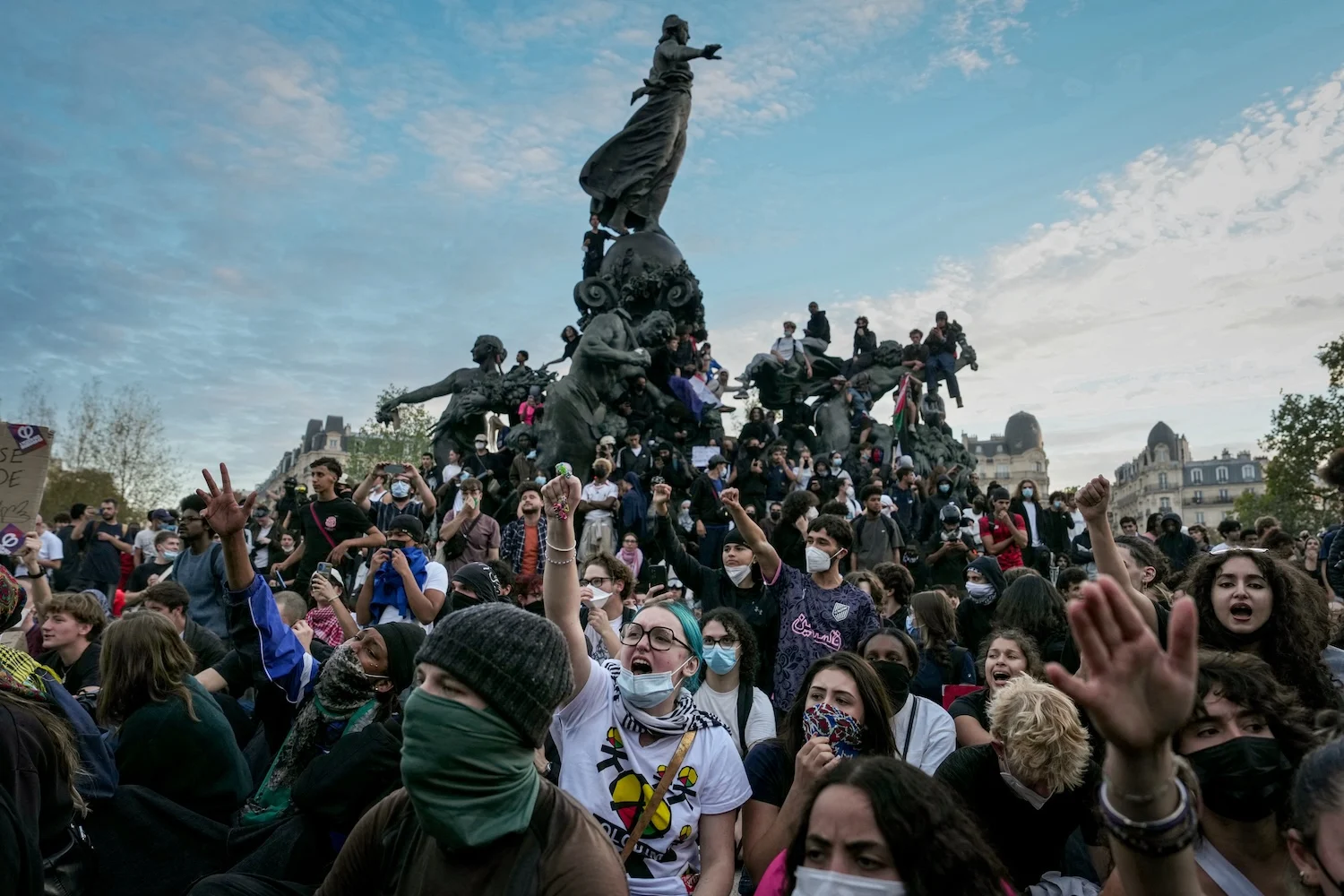
Since late September, the streets of Paris and other cities across France have become the scene of some of the largest French protests in recent memory—led, remarkably, by high school students. Their grievances began with complaints about what they see as underinvestment in education, as evidenced by run-down public schools and growing educational inequality.
As the students have clashed with police, their protests have been joined by many other French citizens who have expressed not just sympathy with their cause but a broader disenchantment about their country’s seeming inability to deliver on the promises of prosperity, rock-solid social benefits, and opportunity that are implicit in a broadly embraced French exceptionalism.
On one level, France’s problems—like those of, say, Britain and Germany—reflect an inability to adjust to tough new psychological and economic realities in the 21st century. The postwar compact that underwrote European prosperity rested on conditions that no longer exist. After World War II, European countries benefited strongly from their linkages to the world’s undisputed economic powerhouse, the United States. As the latter’s share of global GDP and industrialization swelled, it buoyed European economies through partnerships, investments, and relatively open markets. Europe’s demographics were favorable, too, profiting from both a postwar fertility rebound and high levels of immigration.
All of this has now changed. The United States remains the world’s largest economy, but it has entered a slow growth era, as measured both by GDP and productivity growth. Meanwhile, Westerners are having fewer and fewer children, with profound consequences for the health of the West’s relatively strong social security systems. Paradoxically, Europe’s sense of declining social prospects has fueled anti-immigrant politics, precluding the replenishment of tax-paying rolls that would come from embracing the influx and assimilation of young, ambitious, and generally hardworking newcomers from abroad.
Mitterrand was stopped in his tracks decades ago by the threat of financial markets, by the prospect that the wealthy would flee taxation by emigrating, and by pressure on the French franc. One can debate the philosophy behind his proposed national reforms, but they never had a chance. As rich as it might have felt, France simply didn’t have the means to break with the rest of the capitalist world in creating an island paradise unto itself.
Today, the country’s choices and its prospects look even dimmer. France’s current president, the deeply unpopular centrist Emmanuel Macron, has never offered up anything like the sweepingly generous reforms of Mitterrand. As he nears the end of his second and final term, one can speak of his goals in near retrospect. They have centered on holding the line as much as possible on the dwindling welfare state while preserving France’s cherished image of itself as a great middle power, if not a great power outright.
Macron, though, is constrained not only by the same realities that Mitterrand faced but by one of the highest levels of public debt in the industrialized world. France’s public debt recently rose to 119 percent of GDP, the third-highest ratio in the European Union. Europe is also much more integrated than it was 40 years ago, meaning that France’s range of potential actions, fiscal and otherwise, is limited by EU policies, starting with the fact that the country no longer has its own currency.
Meanwhile, in addition to its own slower growth, the United States under President Donald Trump has become an unsympathetic and some would say nearly hostile power. France and the rest of Europe are also squeezed by a China that has a highly unbalanced economy. Although China has rapidly become the world’s leading industrial country this century, its leaders have not figured out how to counteract its own seriously decelerating growth except by creating ever larger trade surpluses that threaten the survival of industry in Europe and elsewhere.
As all of this happens, by pursuing invasion and continuous war in Ukraine and threatening borderland NATO countries, Vladimir Putin’s Russia seems intent on destroying Europe as vengeance for the failure of its own perennial ambitions for greatness.
The choices before France appear unusually grim. On the one hand, the protesters and many on the French left long for a return to state generosity. On the other, the leading opposition party, led by the right-wing populist Marine Le Pen, promises revival through even more unworkable means: greatly reduced immigration, austerity, and a much-weakened EU, which—as Mitterrand understood—is France’s best hope for maintaining its prosperity and standing in the world.
What this means, at its core, is that France faces a genuine historical dilemma for which neither its political traditions nor its institutions have found an answer. Long gone today are the times when a national leader like Mitterrand would even propose an agenda of bold progressive change. Today, its real crisis is less about the choice of leaders than about the reality that the conditions that made its social model attractive have dissolved, and no political movement left or right has yet to reckon honestly with that fact.
