


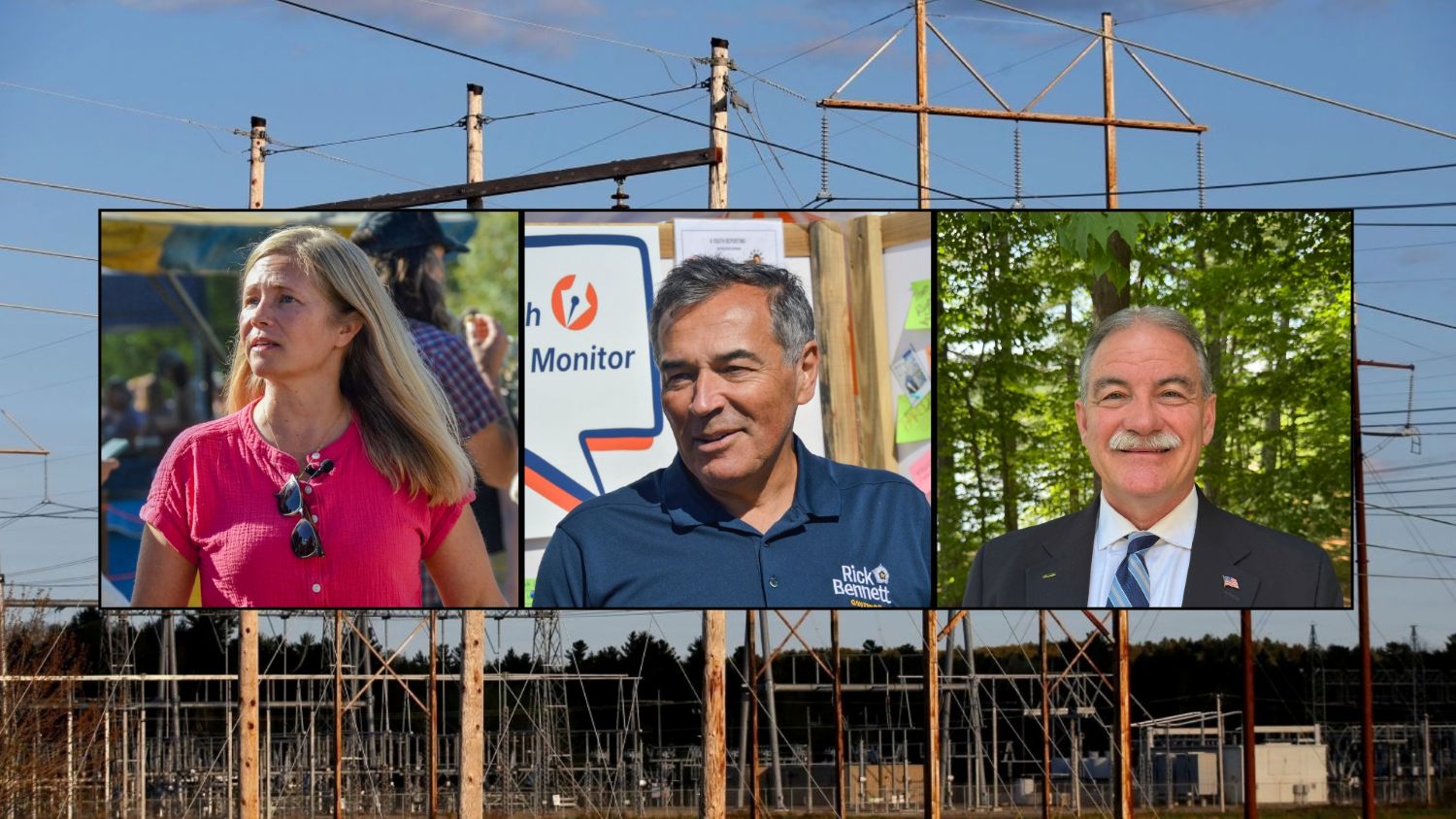
As Mainers prepare to choose a new governor in November, climate and energy issues may not be top of mind for every voter—but they are having big effects on residents’ lives.
The average cost of heating oil recently soared to a record high of more than $6 per gallon, promising an expensive winter ahead for the half of Maine households heated by oil-powered boilers and furnaces. The cost of electricity has also risen steeply, at the third-highest rate in the nation over the past 10 years.
At the same time, the effects of climate change are harming the state. Boom-and-bust rain and drought cycles are making farming more difficult. Rising temperatures are putting pressure on many plants and animals, including economically important species such as lobster. Sea level rise and worsening storms are eating away the coastline and damaging infrastructure.
All three candidates running for governor agree that energy affordability is a priority. And all acknowledge the reality of climate change. But they disagree on whether these problems can be tackled together.
Democrat Hannah Pingree and independent Rick Bennett think energy affordability and climate action can go hand in hand. In a September interview with The Maine Monitor, Pingree said she would continue the work of the Maine Climate Council, which created a plan to meet clean energy and greenhouse gas emissions goals set by the state Legislature. Bennett said he also supports transitioning the state to clean energy.
Republican Bobby Charles said that the state government should focus squarely on affordability, and embrace both renewable energy and fossil fuels, including supporting new natural gas pipelines.
Maine is the only state, alongside Washington, D.C., that is currently ahead of pace to meet its 2030 goal of cutting greenhouse gas emissions by 45 percent, though some other states have more ambitious goals.
Much of Maine’s success so far has been thanks to the rapid uptake of heat pumps, an energy efficiency and electrification solution encouraged by rebates and embraced across party lines.
As the federal government stepped back from climate action during the first Trump administration, state governments stepped up to fill some of that gap, said Anthony Moffa, a law professor at the University of Maine who studies climate policy. Maine in particular has been a leader in that regard, he said.
The state Legislature established the Maine Climate Council in 2019, and the group created a climate action plan called “Maine Won’t Wait.” This comprehensive plan has been “a model document” for other states, according to Moffa.
Maine’s goals have ramped up over time, with the latest update in 2025 requiring the state to source 100 percent of its electricity from renewables or other low-emissions sources such as nuclear power by 2040.
The governor plays a crucial role in pushing forward this change, Moffa said. While the Legislature can set goals, the governor is the one who empowers state agencies to create policies and programs that actually implement the law.
Hannah Pingree
Much of the climate-focused work that happened during the administration of Gov. Janet Mills was led by Pingree, who was director of the Governor’s Office of Policy Innovation and the Future from 2019 to 2025. As part of that job, Pingree served as co-chair of the Maine Climate Council, overseeing two iterations of the state’s climate action plan.
“I would continue that work,” Pingree said. “To not do that is going to put lives at risk. It’s going to put public safety at risk and really risk the future of our economy.”
Pingree wants Maine to procure more clean energy through projects such as the Northern Maine Renewable Energy Program, which aims to develop utility-scale renewable energy projects and transmission infrastructure in Aroostook County.
Locals have raised concerns about these projects, and Pingree added that the governor should work with the Maine Department of Energy Resources, the Public Utilities Commission and the Office of the Public Advocate “to ensure that actual community voices are heard, there is public benefit and there is public savings.”
As the supply of clean energy grows, Pingree wants Maine to use less oil and gas, which largely come to the state from other countries.
“We have no energy independence,” she said, and “no control over these international prices of energy.”
That’s become apparent as first the war between Russia and Ukraine and now between the United States and Iran have disrupted the supply of natural gas and oil.
Roughly half of Maine residents’ electricity bills are for this supply side of the equation. The other half pays for transmission and distribution. To help control those costs, Pingree wants the Public Utilities Commission to oppose what she calls “excessive rate hikes” from electric utilities. She also wants to incentivize more people to weatherize their homes, reducing the amount of electricity they need to use in the first place.
Although Pingree played a pivotal role in the Mills administration’s climate policy, she disagrees with Mills on some key issues. Pingree supports Wabanaki sovereignty, which is a priority not just for the Wabanaki themselves but also for many of Maine’s environmental advocacy groups. She also supports a moratorium on large-scale data center development.
Pingree has been endorsed by the Maine Conservation Voters Action Fund.
“It is more important than ever that Maine people elect leaders who will put the protection of our environment and clean energy future at the center of their agenda, while also looking to make our energy more affordable,” said Maureen Drouin, the group’s executive director. Electing Pingree is “one of the most important things that we can do for the future we want to leave our kids,” she said.
Rick Bennett
Bennett and Pingree hold many of the same positions on energy.
“We need to go to a clean energy future,” Bennett said in an interview with The Maine Monitor. “We’re seeing the development of wind and solar, hydro, and other means of electricity. Those should be a benefit for Maine ratepayers. There’s really no reason why we can’t have both.”
One unique idea that Bennett has is to create what he calls a “generation authority,” a new government body that would address the demand from other states for renewable energy generated in Maine and ensure that Maine benefits from any new energy development.
“We need to look after Maine ratepayers first,” he said. “As we’re meeting the demands of our neighbors in Connecticut and Massachusetts, as governor, I will make sure that Maine ratepayers are getting the best deal for that.”
Bennett also supports continuing on the path laid out in the Maine climate action plan, though he called out transportation as the area of the economy lagging behind and needing better planning and more achievable goals.
He said he supports a data center moratorium “until we can get some ground rules” on when and where the facilities might be beneficial, and what sort of approval process makes sense.
This story is funded by readers like you.
Our nonprofit newsroom provides award-winning climate coverage free of charge and advertising. We rely on donations from readers like you to keep going. Please donate now to support our work.
But overall, Bennett wants to encourage industrial activity and development in the state, including through energy policies that offer special rates to manufacturers, by expanding tax credits for forest products companies producing biofuels, and by attracting new businesses to what he called “underutilized” areas of the electric grid where mills have closed.
In the Maine Conservation Voters scorecard system tracking state legislators’ votes on environmental issues, Bennett has a current score of 85 percent, earning him a place on the group’s “honor roll.”
Bobby Charles
Charles said in an interview with The Maine Monitor that affordability is “the number one issue” he would focus on as governor.
“The energy costs in this state are really incomprehensibly high,” he said, adding that expensive energy is the “elephant in the room” driving up the cost of everything else.
He believes that the Mills administration’s climate-oriented energy policies, especially incentive programs for more solar and wind generation such as net energy billing, have raised the cost of electricity in recent years.
While Charles acknowledged climate change as a problem, in his view, Maine’s greenhouse gas emissions are just a drop in the bucket of global carbon pollution.
“What we do in this state is not going to change whether greenhouse gases do or don’t have an effect on the world,” he said.
He called for an “all of the above” approach to the forms of energy the state generates and uses, including nuclear, hydropower and fossil fuels.
He wants to maintain the four Kennebec River hydropower dams recently sold by Brookfield Energy to The Nature Conservancy, keeping them around to generate electricity rather than taking them down to help migratory fish.
And he plans to pressure other states to allow the construction of the Constitution pipeline from Pennsylvania to New York and the expansion of the Iroquois pipeline from Canada into New York. According to Charles, these pipelines would also increase New England’s natural gas supply.
Charles also believes that the Public Utilities Commission has become too political, and wants to appoint engineers and economists as commissioners.
Diverging from both Pingree and Bennett, Charles said he’s “agnostic” on the issue of large-scale data center development in the state.
Maine’s Unique Energy Landscape
Like the candidates, energy experts agree that the state’s high power costs need to be brought down, but they disagree on how the next governor should do so.
Jeff Marks, the executive director of the sustainability-oriented business network ClimateWork Maine, believes ensuring affordable and reliable energy into the future means investing in clean energy now. Marks previously served as deputy director of the former Maine Energy Office, now the Department of Energy Resources, from 2010 to 2012 under Democratic Gov. John Baldacci and Republican Gov. Paul LePage.
Marks described the race for Maine’s next governor as “a true Goldilocks campaign.” His impression of the three candidates and how they are being received by the public is that many view Pingree’s climate and energy policies as too strong, Charles’ policies as too weak, and Bennett’s as just right.
“Given our current state of the climate and environment, I think we’re in desperate need of either too strong or just right,” he said, invoking the recent United Nations announcement that the world will soon pass 1.5 degrees Celsius of global warming, the limit that countries agreed a decade ago to work toward.
According to a fellow veteran of the state energy office, Patrick Woodcock, “The next governor is really going to be limited unless we address our electricity pricing.”
Woodcock is now president and CEO of the Maine State Chamber of Commerce but served as director of the former Maine Energy Office from 2013 to 2016 under LePage.
“The increase in electricity pricing has regrettably undermined the value proposition for finding supplements to heating oil and diversifying the Maine energy resource mix,” he said.
These high prices are undermining businesses’ confidence in their future in Maine, especially given the state’s high energy needs and constrained supply in the winter, Woodcock added.
He believes the state should not tip the scales in favor of any particular form of energy, saying, “We should be open-minded and really allow a lot of resources to compete.”
Woodcock is not against Maine leading the way on certain climate-related issues. He pointed to the state’s widespread adoption of heat pumps as a success story that other states have followed. On the other hand, he called Maine’s solar incentives “overly generous” and a “cautionary tale.”
His experience working on energy policy for a previous governor showed him that the state government has “a unique set of circumstances” to balance, he said, including a relatively large manufacturing sector, a significant low-income population, cold winters and high oil consumption, as well as a desire to be an environmental leader.
The next governor will need to create an energy policy that addresses all those concerns and constituencies, Woodcock said.
The general election will take place on Nov. 3. Absentee voting begins on Oct. 5.
This story was originally published by The Maine Monitor, a nonprofit and nonpartisan news organization. To get regular coverage from the Monitor, sign up for a free Monitor newsletter here.
Matt Junker contributed reporting.
About This Story
Perhaps you noticed: This story, like all the news we publish, is free to read. That’s because Inside Climate News is a 501c3 nonprofit organization. We do not charge a subscription fee, lock our news behind a paywall, or clutter our website with ads. We make our news on climate and the environment freely available to you and anyone who wants it.
That’s not all. We also share our news for free with scores of other media organizations around the country. Many of them can’t afford to do environmental journalism of their own. We’ve built bureaus from coast to coast to report local stories, collaborate with local newsrooms and co-publish articles so that this vital work is shared as widely as possible.
Two of us launched ICN in 2007. Six years later we earned a Pulitzer Prize for National Reporting, and now we run the oldest and largest dedicated climate newsroom in the nation. We tell the story in all its complexity. We hold polluters accountable. We expose environmental injustice. We debunk misinformation. We scrutinize solutions and inspire action.
Donations from readers like you fund every aspect of what we do. If you don’t already, will you support our ongoing work, our reporting on the biggest crisis facing our planet, and help us reach even more readers in more places?
Please take a moment to make a tax-deductible donation. Every one of them makes a difference.
Thank you,
