


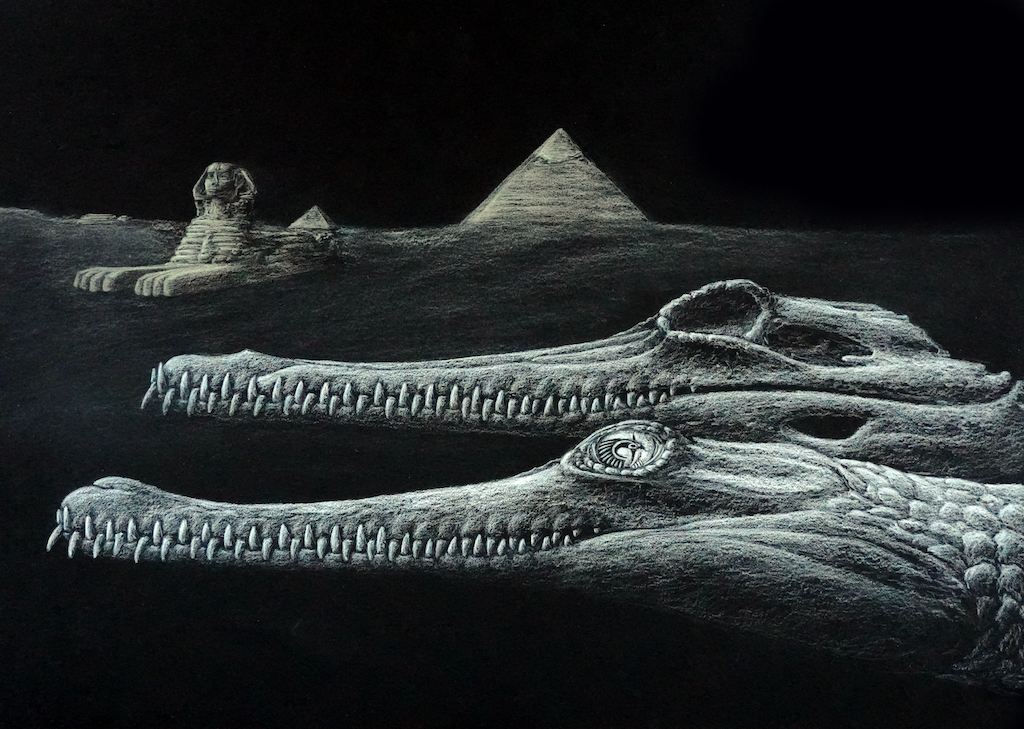
- Researchers have identified a new species of extinct long-snouted crocodile from 45-million-year-old fossils found in the same limestone formation used to build Egypt’s Great Sphinx.
- The fossils were dug up in the 1920s and lumped in with the living false gharial, but CT scans revealed features that set the ancient crocodile apart as its own species.
- Its closest living relatives, the gharial and false gharial, are critically endangered and endangered respectively.
- Today, many species of crocodilians face conservation threats, though some have seen tremendous recovery due to conservation efforts
About 45 million years ago in northern Egypt, a long-snouted crocodile hunted in the warm, shallow sea. Its bones settled into the same limestone formation that ancient Egyptians would later carry and carve into the Great Sphinx. Now, a century after researchers first dug up the fossils, they say the animal is a species new to science.
The extinct reptile, named Herugavialis cairensis, is described in a study published in Royal Society Open Science. Like the Sphinx, the fossil is missing the tip of its nose.
“Given this coincidence with the famously missing nose of the Great Sphinx, we decided to name the new crocodile after the Egyptian god Heru, who was possibly the inspiration for this iconic monument,” Philip Mannion, a paleontologist at University College London who co-led the study, said in a press release.
The fossils, including a nearly complete skull, were recovered in the 1920s from Egypt’s Mokattam Formation. At the time, scientists assigned them to Tomistoma, the genus of the living false gharial (Tomistoma schlegelii), because the two looked alike.
An international team from the U.K., Sweden, Germany and Egypt decided to take another look at the fossils with modern tools. Led by Paul Burke of the Swedish Museum of Natural History in Stockholm, the researchers used CT scans to see inside the skull. They found several features that set the fossil apart from the false gharial.
Herugavialis belongs to a group of long-snouted crocodilians called gavials. Fossils show gavials once lived nearly worldwide, and many species swam in shallow seas.
Only two survive today, both in freshwater in South and Southeast Asia, and both are struggling due to hunting, harvest for folk medicine and changes to the rivers on which they depend. The false gharial of Southeast Asia is listed by the global wildlife conservation authority IUCN as endangered. The gharial (Gavialis gangeticus), which now survives only in India and Nepal, is critically endangered.
Still, crocodilians (the larger group containing alligators, crocodiles and gavials) have seen real conservation success. When the IUCN’s Crocodile Specialist Group (CSG) formed in 1971, every crocodilian species was considered endangered or threatened. Today, more than half are listed as least concern.
“This is mainly thanks to the conservation programs based on creating economic incentives among the local inhabitants, through the sustainable use of the crocodilians there,” Alejandro Larriera, co-chair of the CSG, told Mongabay.
India began breeding gharials in the 1970s and created the National Chambal Sanctuary. In 2025, forest staff counted more than 2,000 in a stretch of the sanctuary, the highest since conservation efforts began there, according to the Times of India.
By the early 1960s, overhunting and habitat loss had made seeing an American alligator (Alligator mississippiensis) in the wild quite rare. After decades of hunting bans and protection under the Endangered Species Act, nearly 5 million American alligators now live in the southeastern U.S. “[I]t’s recovery is considered one of the greatest endangered species success stories in the world,” writes The U.S. Fish and Wildlife Service.
Today, the biggest problem for five of the seven most threatened crocodilian species is habitat loss as human populations grow, Charlie Manolis, co-chair of the CSG, told Mongabay. For the other two species, hunting for bushmeat is one of the main threats.
Meanwhile, back in Egypt, the Nile crocodile (Crocodylus niloticus) is the only crocodile species found there today. Egyptian law bans killing, capturing or trading crocodiles and their eggs. Even so, poaching and smuggling persist, according to Egypt Independent.
Crocodiles are long gone from the Mediterranean. They disappeared about 6 million years ago, when the sea largely dried up, Burke said. Herugavialis, carved into stone and missing its nose, reminds us that the great creature once lived.
Banner image: Reconstruction of the extinct Herugavialis cairensis with the Great Sphinx and pyramids depicted in the background. Artwork by Karim Zanaty.
Citation: Cranial anatomy of the Middle Eocene Egyptian crocodylian Herugavialis cairensis provides new insights into gavialoid diversity in the Mediterranean region. doi:10.1098/rsos.261173

