

Close Menu
NCIJ Network NCIJ Network
    What's Hot

    Is regulation enough to stop AI systems killing us all? | AI (artificial intelligence)

    October 7, 2026

    PETA euthanized 67% of animals it took in during 2024, data shows

    October 7, 2026

    LA and San Diego residents ‘horrified’ by Trump suggesting Iran bomb them | Los Angeles

    October 6, 2026
    Facebook X (Twitter) Instagram
    Trending
    • Is regulation enough to stop AI systems killing us all? | AI (artificial intelligence)
    • PETA euthanized 67% of animals it took in during 2024, data shows
    • LA and San Diego residents ‘horrified’ by Trump suggesting Iran bomb them | Los Angeles
    • Latvia moves to expel Russian journalist who used to work for BBC – POLITICO
    • Ofcom investigates Meta over Instagram Instants feature
    • What exactly is ISOC? And what does it mean for you?
    • Google Launches Nano Banana 2.1: Better Than Its Predecessor at Half the Price
    • An extinct crocodilian was found among rocks that built the Great Sphinx
    • About
      • Our Team
      • Editorial Policy
      • Editorial Independence
      • International Support
    • Trust & Standards
      • AI Usage Policy
      • Conflict of Interest Policy
      • Corrections Policy
      • Ethics Policy
      • Fact-Checking Policy
      • Source Protection
    • Get Involved
      • Guide for Sources
      • Support Independent Journalism
    • Legal
      • Cookie Policy
      • Privacy Policy
      • Terms of Use
    Facebook X (Twitter) Instagram
    NCIJ Network NCIJ Network
    Wednesday, October 7
    • Home
    • World
    • Ai
    • Business
    • Politics
    • Health
    • Crypto
    • Science
    • Technology
    • Cybersecurity
    • Defense & Security
    • Economy
    • Energy
    • Europe
    • More
      • Fact Check
      • Investigations
      • Opinion & Analysis
      • Environment
    NCIJ Network NCIJ Network
    Home»Science

    An extinct crocodilian was found among rocks that built the Great Sphinx

    NCIJ NETWNCIJ NETWORKBy NCIJ NETWNCIJ NETWORKOctober 6, 2026 Science No Comments3 Mins Read
    Share
    Facebook Twitter LinkedIn Pinterest Email

    The Great Sphinx of Giza isn’t the only ancient, stony visage in the area missing its nose.

    A fossil crocodilian discovered in the same 45-million-year-old limestone that ancient Egyptians used to build the Sphinx is also missing the tip of its snout. But the broken specimen is intact enough to be reclassified as a new branch of the gavial family tree, which may help uncover these mysterious animals’ evolutionary history, researchers report October 7 in Royal Society Open Science.

    Sign up for our newsletter

    We summarize the week’s scientific breakthroughs every Thursday.


    Most living crocodilians are in either the crocodile or alligator families. But there are also two species of gavial living in tropical Asia. These are huge, critically endangered, fish-eating crocodilians with long, slender snouts full of needlelike teeth. Fossils of extinct gavials have been found around the world. In 1927, German researchers reported a gavial skull fossil collected from hills near Cairo. The fossil was identified as an extinct species of Tomistoma, a genus found today only as a single species in Southeast Asia.

    But more recent evolutionary studies including this fossil suggested this classification didn’t fit. In 2023, while working on a doctoral degree at University College London, paleontologist Paul Burke went to Germany to study the fossil in detail. Burke and his colleagues made careful measurements of the skull, using 3-D X-ray methods to measure the insides of the brain and nasal cavities. 

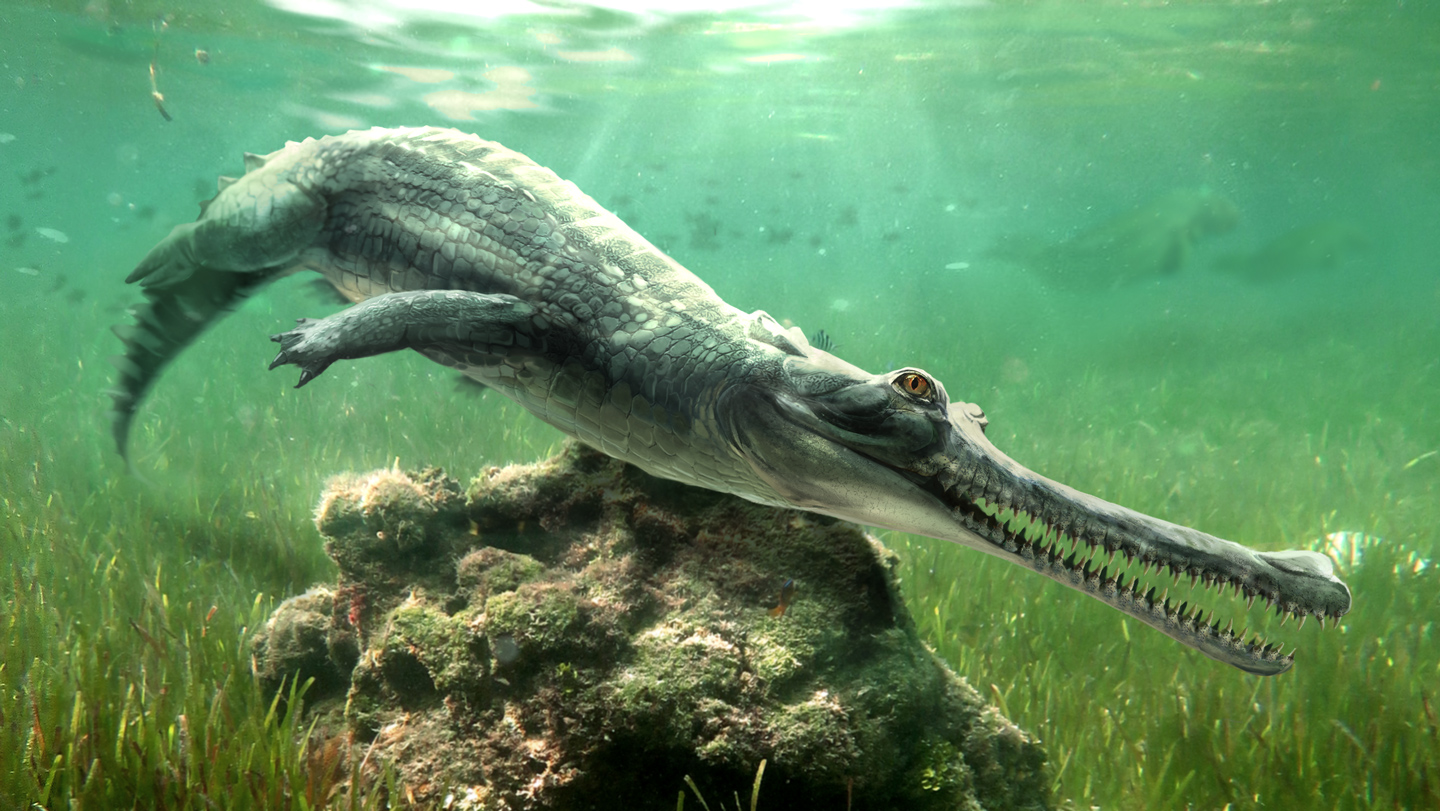
    Herugavialis (shown in foreground) was found fossilized in the same limestone that was sculpted into the Great Sphinx of Giza (background). Karim Zanaty

    “As we’ve advanced in the last 100 years, we’ve got so many new methodologies we could implement to figure out what kind of species this fossil is,” says Burke, currently at the Sweden Museum of Natural History in Stockholm.

    The team compared the measurements to those taken of living and fossil gavials and found that this purported Egyptian Tomistoma was actually an undescribed gavial genus. The researchers named it Herugavialis cairensis, referencing the Egyptian god Heru (or Horus), who has been associated with the Great Sphinx. Coincidentally, the Herugavialis skull is missing the end of its snout — something it shares with the noseless statue.

    “So many species are found from the same [geologic] formation,” Burke says, including fish, sharks and mammals. “But this is the first one with the name associated with the Sphinx.”

    Today, gavials are only found in freshwater environments. But tens of millions of years ago, the reptiles also inhabited nearshore saltwater environments. Herugavialis appears to have been a coastal predator back when the ancient Tethys Ocean covered northern Egypt.

    Khalafallah Salih, a paleontologist at Al Neelain University in Khartoum, Sudan, says the finding supports the idea that the evolution of gavials and their relatives in Africa was much more complex than researchers thought. Herugavialis doesn’t appear closely related to other known gavial-type crocodilians in Africa or the Mediterranean, he says. It appears to have branched off from the lineage early in its evolution. 

    Burke notes that gavials barely breach the public consciousness compared to alligators and crocodiles.

    “They’re still alive today and they’re endangered,” he says. “So, we should know about them and their long history.”

    Sponsor Message


    among Built crocodilian extinct Great rocks Sphinx
    NCIJ NETWNCIJ NETWORK
    • Website

    Keep Reading

    New crocodile species found fossilized in stone used to build Egypt’s Great Sphinx

    Scientists say this simple habit could strengthen your marriage

    Google DeepMind Releases EmbeddingGemma 2, a 740M Open Multimodal Embedding Model Built on Gemma 4

    NASA to Cover Northrop Grumman CRS-24 Spacecraft Departure

    Archaeologists may have finally solved a 100-year-old Florida mystery

    ‘A Mother’s Brain’ explores the neuroscience of motherhood

    Add A Comment
    Leave A Reply Cancel Reply

    Editors Picks

    Is regulation enough to stop AI systems killing us all? | AI (artificial intelligence)

    October 7, 2026

    PETA euthanized 67% of animals it took in during 2024, data shows

    October 7, 2026

    LA and San Diego residents ‘horrified’ by Trump suggesting Iran bomb them | Los Angeles

    October 6, 2026

    Latvia moves to expel Russian journalist who used to work for BBC – POLITICO

    October 6, 2026
    Latest Posts

    4 Best Compression Boots: Therabody, Hyperice, and More (2026)

    August 9, 2026

    Former Iraqi provincial governor arrested as graft crackdown continues | Corruption News

    August 9, 2026

    The culture surrounding ‘ideal’ childbirth has to evolve | Childbirth

    August 9, 2026

    Subscribe to News

    Get the latest sports news from NewsSite about world, sports and politics.

    NCIJ Network is an independent digital news platform delivering trusted investigative journalism, European and global news, in-depth analysis, and fact-based reporting with accuracy, transparency, and integrity.

    Facebook X (Twitter) Instagram Pinterest YouTube

    Is regulation enough to stop AI systems killing us all? | AI (artificial intelligence)

    October 7, 2026

    PETA euthanized 67% of animals it took in during 2024, data shows

    October 7, 2026

    LA and San Diego residents ‘horrified’ by Trump suggesting Iran bomb them | Los Angeles

    October 6, 2026

    Subscribe to Updates

    Get the latest creative news from FooBar about art, design and business.

    Type above and press Enter to search. Press Esc to cancel.