

Close Menu
NCIJ Network NCIJ Network
    What's Hot

    What Project 2025 says about the FAA

    November 17, 2026

    US scolds Ukraine over deep strikes ahead of fresh Russia peace talks  – POLITICO

    November 17, 2026

    Milburn’s absurdly ambitious report offers blueprint for fixing everything and everyone | Youth unemployment

    November 17, 2026
    Facebook X (Twitter) Instagram
    Trending
    • What Project 2025 says about the FAA
    • US scolds Ukraine over deep strikes ahead of fresh Russia peace talks  – POLITICO
    • Milburn’s absurdly ambitious report offers blueprint for fixing everything and everyone | Youth unemployment
    • William and Catherine celebrate Earthshot Prize winners in Mumbai
    • In Zimbabwe, trusted local guardians help communities coexist with lions
    • 5 New House Democrats to Watch on Military and Foreign Policy
    • Was Alan Milburn right to claim 93% of fit note ‘applications’ are ‘signed off automatically’? – Full Fact
    • Who to watch in race to run Spain after 29 November elections
    • About
      • Our Team
      • Editorial Policy
      • Editorial Independence
      • International Support
    • Trust & Standards
      • AI Usage Policy
      • Conflict of Interest Policy
      • Corrections Policy
      • Ethics Policy
      • Fact-Checking Policy
      • Source Protection
    • Get Involved
      • Guide for Sources
      • Support Independent Journalism
    • Legal
      • Cookie Policy
      • Privacy Policy
      • Terms of Use
    Facebook X (Twitter) Instagram
    NCIJ Network NCIJ Network
    Tuesday, November 17
    • Home
    • World
    • Ai
    • Business
    • Politics
    • Health
    • Crypto
    • Science
    • Technology
    • Cybersecurity
    • Defense & Security
    • Economy
    • Energy
    • Europe
    • More
      • Fact Check
      • Investigations
      • Opinion & Analysis
      • Environment
    NCIJ Network NCIJ Network
    Home»Environment

    Turning vulnerable livestock into four-eyed beasts helps protect them in Zimbabwe

    NCIJ NETWNCIJ NETWORKBy NCIJ NETWNCIJ NETWORKSeptember 30, 2026 Environment No Comments5 Mins Read
    Share
    Facebook Twitter LinkedIn Pinterest Email

    • In the first half 2026, the local council of one district in southeastern Zimbabwe recorded 317 cases of human-wildlife conflict, including attacks on livestock by predators.
    • Edson Mabika says he used to lose four or five animals this way every year — until he took an ex-ranger’s advice and painted black and white eyes on the backsides of his livestock.
    • Since then, he told Mongabay, he’s lost just one goat and a lamb.

    NYANGOMBE, Zimbabwe — In the first six months of 2026, the local council in Chiredzi recorded 317 cases of human-wildlife conflict in this district of southeastern Zimbabwe. In villages like Nyangombe, which is flanked by large game reserves such as Save Valley Conservancy and Nyangombe Community Conservancy, residents say wildlife frequently eat their crops and attack livestock or even people.

    “Buffaloes destroy crops and spread diseases, while wild dogs, jackals, leopards and even lions target livestock,” Edson Mabika, a farmer in Nyangombe, told Mongabay.

    Mabika said he lost four sheep and a calf to wild animals in less than 10 days despite having a secure kraal and an experienced herd boy with three dogs. The loss prompted Mabika to think outside the box to protect his livestock. He asked a friend, a former game-reserve ranger, for suggestions on how to scare away wild predators without getting in harm’s way.

    His friend’s advice caught him by surprise: “He just advised me to try drawing eyes on the butts of my animals,” Mabika said.

    One of Edson Mabika’s cows, with decoy eyes painted on its rump. Image by Cecil Dzwowa for Mongabay.

    Mabika thought the former ranger was joking, but says his friend kept insisting. In January 2025, he painted black and white eyes on the backsides of about a third of his livestock. The first victims of the fake “butt eyes” were a pack of local dogs who barked aggressively after being startled by the new “eyes” on the livestock.

    Mabika told Mongabay that before he put decoy eyes on his herd, he lost four or five animals every year. In the last year and a half since he took his friend’s advice, he says he’s lost just one goat and a lamb; in both cases, the animals’ decoy eyes had faded.

    The trick is attracting some copycats among his neighbors and the endorsement of experienced game rangers like Langton Bandama, who is often hired to track down stray animals on conservancies including Save and the Gonarezhou Game Reserve. Bandama told Mongabay that fake eyes are common in nature, and he is confident that they can also prevent or delay predator attacks on livestock.

    “It takes time for a predator to decide to kill before going for the kill,” Bandama said. “I think adding things like horns on the fake eyes will add value to the eyespots, especially against large ambush predators like lions.”

    It’s possible that the idea of drawing eyespots on livestock was brought to Zimbabwe by returning migrants. Tinoda Mafunga worked as a farm laborer in neighboring Botswana before returning to Nyangombe in February. He said he’s familiar with the practice of painting decoy eyes from his time abroad.

    “I am sure the idea was first adopted by villagers along the border with Botswana, where the practice is much more common, until it spread to places like Chiredzi,” he said.

    Nyangombe resident Timothy Chauke is one of several livestock owners in the village who has experimented with false eyes as protection against predators. Image by Cecil Dzwowa for Mongabay.
    Nyangombe resident Timothy Chauke is one of several livestock owners in the village who has experimented with false eyes as protection against predators. Image by Cecil Dzwowa for Mongabay.

    In 2020, wildlife ecologist Cameron Radford set out to test whether eyespots on livestock would discourage ambush predators like lions. In a study involving about 2,000 cattle in Botswana that had recently reported high levels of predation, not a single one of the 683 cows he and his colleagues daubed with artificial eyes was killed by lions or leopards. In contrast, 15 out of 835 unmarked cows in the study area were recorded as killed by one of those two ambush predator species (as were four animals whose rumps were marked with simple crosses).

    Spotted hyenas (Crocuta crocuta) muddied the data, killing one cow from each of the three categories during this period, suggesting their hunting success is unaffected by decoy eyes.

    Many forecasts predict drought conditions for Southern Africa this year, in the shadow of a powerful El Niño event. Bandama said that in his experience, drought pushes herders into game reserves in search of greener pasture, while predators may raid farms and homesteads more frequently.

    It might be time for Mabika and his neighbors to start stocking more tins of paint.

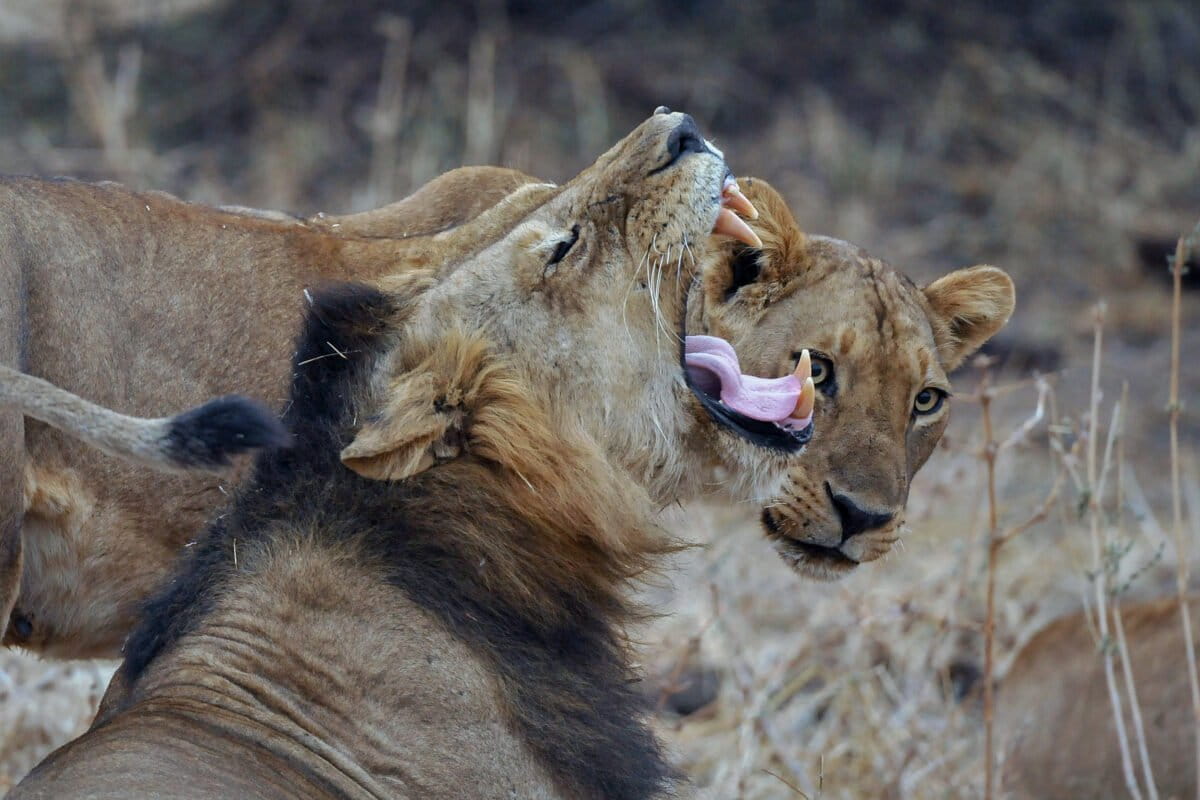
    Banner image: Lions (Panthera leo). Image by Julie Larsen © Wildlife Conservation Society.

    Citation:

    Radford, C., McNutt, J. W., Rogers, T., Maslen, B., … Jordan, N. (2020). Artificial eyespots on cattle reduce predation by large carnivores. Communications Biology, 3(1), 430. doi:10.1038/s42003-020-01156-0

    Conservationist wins top award to protect lions and people in Zimbabwe

    Feedback: Use this form to send a message to the author of this post. If you want to post a public comment, you can do that at the bottom of the page.


    beasts foureyed helps livestock protect turning vulnerable Zimbabwe
    NCIJ NETWNCIJ NETWORK
    • Website

    Keep Reading

    In Zimbabwe, trusted local guardians help communities coexist with lions

    The New Rules of Permitting

    Another Sri Lankan leopard caught in a snare. These big cats need protecting, experts say

    A Landmark Deal Saved Colorado’s Roan Plateau. Now It’s Headed Back to the Auction Block.

    Are Multibillion-Dollar Wildfire Payouts Undermining Efforts to Make Forests Less Flammable?

    Global clean energy transition demands millions of acres, threatening indigenous rights: Report

    Add A Comment
    Leave A Reply Cancel Reply

    Editors Picks

    What Project 2025 says about the FAA

    November 17, 2026

    US scolds Ukraine over deep strikes ahead of fresh Russia peace talks  – POLITICO

    November 17, 2026

    Milburn’s absurdly ambitious report offers blueprint for fixing everything and everyone | Youth unemployment

    November 17, 2026

    William and Catherine celebrate Earthshot Prize winners in Mumbai

    November 17, 2026
    Latest Posts

    SmallSat 2026 – NASA Science

    August 20, 2026

    CFTC Chair Says Agency Will Move Forward on Crypto Regulation if CLARITY Fails

    August 20, 2026

    New CUSTODY Framework Constrains AI Agents Inside the Network

    August 20, 2026

    Subscribe to News

    Get the latest sports news from NewsSite about world, sports and politics.

    NCIJ Network is an independent digital news platform delivering trusted investigative journalism, European and global news, in-depth analysis, and fact-based reporting with accuracy, transparency, and integrity.

    Facebook X (Twitter) Instagram Pinterest YouTube

    What Project 2025 says about the FAA

    November 17, 2026

    US scolds Ukraine over deep strikes ahead of fresh Russia peace talks  – POLITICO

    November 17, 2026

    Milburn’s absurdly ambitious report offers blueprint for fixing everything and everyone | Youth unemployment

    November 17, 2026

    Subscribe to Updates

    Get the latest creative news from FooBar about art, design and business.

    Type above and press Enter to search. Press Esc to cancel.