


Welcome to Foreign Policy’s Southeast Asia Brief.
The highlights this week: Malaysia’s Najib Razak is granted clemency by the king for a second time; the global fuel crisis puts regional airline AirAsia on the brink; and plans by Taiwan to open a new representative’s office in Cebu have created a stir.
Malaysia’s top crook gets leniency
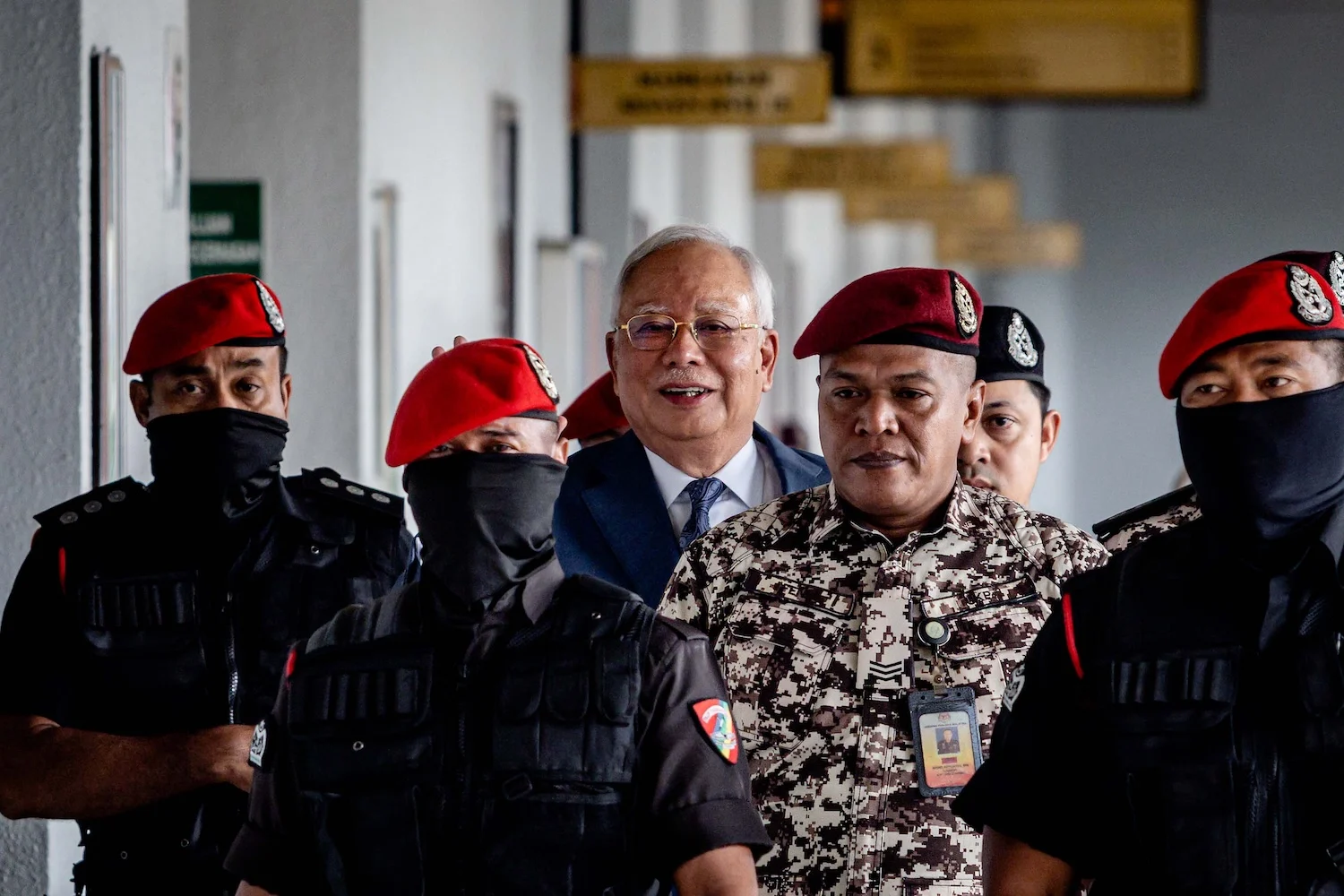
On Friday, Malaysia’s king granted clemency for a second time to the country’s most notorious criminal—former prime minister Najib Razak—allowing him to serve his remaining sentence under house arrest.
Convicted of embezzling millions of dollars from 1Malaysia Development Berhad, a state investment fund, Najib has slimed his way into royal pardons with a tenacity that would be admirable if it were used for another endeavor.
His pardon will further take the shine off the current government, which came to power promising reform after the graft of the Najib years.
The move has also enraged reformers in Malaysia who had pinned hope on the current prime minister, Anwar Ibrahim, to clean things up. Anthony Loke, leader of the Democratic Action Party—the largest party in Malaysia’s government—resigned from his post as transport minister in protest.
It also seems at odds with the king’s own declaration in February, following another corruption scandal, that “no one is above the law.”
So, why the clemency? Anwar has disavowed any responsibility, arguing that the power lies with the pardons board and ultimately the king. But critics still blame him.
One factor at play is surely Najib’s ability to retain the vocal loyalty of hardcore supporters within his party who insist that “Bossku,” or their “boss,” is the victim of some elaborate witch hunt or is somehow the victim, and not the perpetrator, of fraud.
His party, the United Malay National Organisation, is a key component of the current coalition government. In recent months, it has seen a revival of its political fortunes that would have been unthinkable a few years ago.
The clemency seems extraordinary given the sheer scale of the corruption that Najib oversaw and the weight of evidence against him.
Police seized goods valued at up to $273 million from his various properties, including bags of cash in multiple currencies, jewelry, and designer handbags (his wife was an avid collector). Another $681 million turned up in Najib’s personal bank account, which he claimed was a gift from the Saudi royal family.
In 2020, Najib was sentenced to 12 years in prison, with an additional five years unless he paid a fine of around $51.5 million for misappropriating $10 million from a 1MDB subsidiary.
In 2025, he was sentenced again. This time, it was 15 years in jail plus $3.3 billion in fines over improperly channeling some $700 million from 1MDB. And in March 2026, he was found liable in a civil case for $1.3 billion in losses accumulated by a 1MDB subsidiary.
However, these sentences have gradually been eroded. In early 2024, the pardons board halved Najib’s first 12-year sentence and reduced the fine to $12.3 million. A “royal addendum” added that he could serve his sentence under house arrest, but that was subject to endless litigation. Now, a second pardon has granted this extra boon.
Najib’s supporters are now rallying to raise the money for the outstanding fine from his first conviction. His wife, Rosmah Mansor, has said that this includes donations from foreign friends. Between that and the supposed Saudi gift, Najib seems to have some astonishingly generous friends.
He’s not completely in the clear, however. Najib could head back to prison if he loses his appeal against the 2025 conviction. But there’s now a clear precedent for softening the blows of his convictions.
Perhaps we should not be surprised. In Southeast Asia, major corruption cases are often subject to political considerations, and full accountability is rare.
Indonesia’s 1998 revolution toppled President Suharto, who oversaw corruption on an epic scale. While some assets were returned, his his family remains extremely wealthy.
In Thailand, the status of former Prime Minister Thaksin Shinawatra’s corruption conviction has shifted over the years with the political winds. And in the Philippines, corruption investigations are becoming tools in the impeachment trial of Vice President Sara Duterte.
Airline on the brink. Southeast Asia’s biggest regional carrier is teetering due to rising fuel prices caused by the Iran war.
For many travelers in the region, Malaysia’s AirAsia is their default choice. It competes ruthlessly on prices and has routes to a lot of second and third-tier destinations that big international carriers don’t bother with. In its home country, it controls around 60 percent of the domestic market.
The model has worked well. In 2025, the airline announced plans to launch long-distance routes to Europe.
Now, though, it’s been reduced to selling its newly delivered planes as investors speculate that the company could face bankruptcy. AirAsia co-founder Tony Fernandes has denied that he’s looking for a government bailout but said that he is looking to raise $1 billion on international markets to restructure and refinance existing debt. Whether lenders will take on such a risky prospect is an open question.
Fernandes said that the cause of the current difficulty was the spike in prices following U.S. strikes on Iran and the subsequent disruption to Middle East oil deliveries.
Senate scandal. Senators are facing charges for rigging the 2024 election. The opposition is pushing for a wider-ranging investigation, alleging that the current case omits key members of Thailand’s leading government party.
The election system for the Thai Senate is strange. Ten candidates each are selected by votes from 20 occupational groups, including civil servants, soldiers, medical workers, and women’s groups. Senators are not supposed to belong to political parties.
It is alleged that in 2024, during the first election under this system, there was widespread rigging. An investigation in February 2025 implicated 229 people, including 38 senators and 21 members of the Bhumjaithai Party, which leads the current government.
Last week, the Election Commission shrank that list to 77 people who it referred to the Supreme Court on charges related to improper involvement of party representatives in the election and corruption. The accused includes 26 senators but no members of parliament or party officials.
The opposition has gone on the offensive. The People’s Party accused the Election Commission of intentionally ignoring the coordinated nature of the cheating scandal and the involvement of Bhumjaithai officials.
Meanwhile, Prime Minister Anutin Charnvirakul has sued a leader of a prominent nongovernmental organization who alleged that he was involved in the rigging.
New Taiwan office. Plans by Taiwan to open a new representative’s office in Cebu in addition to its one in Manila has created a stir.
Two weeks ago, this newsletter speculated that the Philippines had taken a stance on Taiwan that was somewhat more accommodating of China.
The announced opening of a new quasi-consulate in the Philippines suggests that ties are in fact being strengthened. And, on Monday, Intelligence Online reported that the Philippines, Taiwanese, and Japanese coast guards have begun to quietly share information with each other.
China’s reaction has been predictably moody. A Chinese Foreign Ministry spokesperson said they “urge the Philippine side to abide by the one-China principle with concrete actions, and refrain from taking any steps that could harm China-Philippines relations.”
The Philippines’ reaction has been robust. Defense Secretary Gilberto Teodoro Jr., who has consistently been the strongest voice in the government pushing back against China, declared, “We define the One China policy. We define it. Not them.”
Meanwhile, on Friday, a Chinese Coast Guard vessel rammed a Philippine Coast Guard vessel in the South China Sea. As with previous similar incidents, China blamed the Philippines.
Residents from coastal communities burn an effigy depicting a crocodile as a politician as they protest against government corruption in flood control projects in Calumpit, the Philippines, on Sept. 20.Ezra Acayan/Getty Images
FP’s Most Read This Week
Why has Indonesia been hit so hard by forest fires this year? Arlina Arshad and Wahyudi Soeriaatmadja flag how key programs have lapsed because of the government in The Straits Times.
Myanmar’s junta may be gearing up for a push in the south, according to Marwaan Macan-Markar in Nikkei Asia.
A trade deal with the United States is near, To Lam told Bloomberg’s Haslinda Amin in an interview.
46.2 percent. That’s Singapore’s year-on-year growth in exports for August, which is the strongest growth in 38 years. The surge is being driven by the artificial intelligence boom, with exports of electronics up 131.8 percent.
In Focus: Duterte faces trial
On Wednesday, former Philippine President Rodrigo Duterte appeared for the first time in person at the International Criminal Court.
Duterte faces trial for crimes against humanity committed between 2011 and 2019 as part of the “war on drugs,” which prosecutors said resulted in thousands of state-sponsored killings. He was arrested in March 2025 in the Philippines as the political alliance between President Ferdinand Marcos Jr. and the Duterte family disintegrated.
Proceedings for the full trial will start on Nov. 30. The current hearing covered various pretrial issues, most notably the 81-year-old’s health—specifically, his mental fitness to stand trial. Defense lawyers have claimed a judge-ordered medical assessment reveals Duterte thinks he is living in 2007 or 2008 and cannot recall who the current U.S. president is.
In the Philippines, his daughter—Vice President Sara Duterte—declared she was “happy” that “the judges were able to see the condition of [Duterte].”
Also examined at the hearing were issues of evidence disclosure. The prosecution has compiled a huge volume, which reportedly includes 324,000 pages of evidence, more than 1,000 video and audio files, and an estimated 193 hours of direct examination of witnesses.
The defense has complained that it doesn’t have enough time to examine all the evidence properly. It further claimed the prosecution had “dumped” reams of disorganized material during disclosure.
This links back to the health issue. Presiding Judge Joanna Korner declared that due to Duterte’s age and health, “it’s important this trial goes ahead as quickly as possible.”
Some will suspect that Duterte is faking cognitive decline to avoid justice. But if he is truly senile now, then it raises the challenging question of whether justice can be served when prosecuting someone who is no longer able to comprehend the charges against them.
