


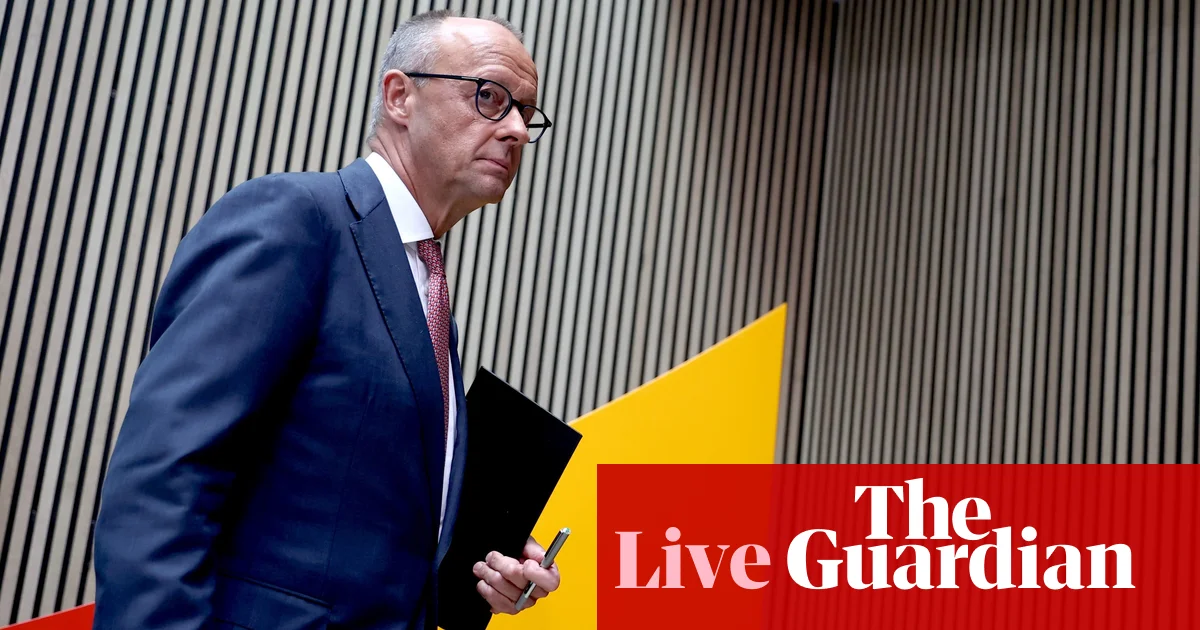
Germany’s Merz ‘grateful’ centre-left SPD wants to remain in coalition
German chancellor Friedrich Merz has said that he is grateful the centre-left Social Democrats wanted to remain in a coalition with his conservatives after a dramatic setback for his CDU party in state elections.
“I am grateful that we have heard from the Social Democrats this morning that they intend to remain part of the coalition in Berlin,” Merz said at a press conference.
“That applies to us too, and it applies to me as well. Together, we are determined to rise to the historic challenges facing our country,” he said.
“We are determined to live up to the historic responsibilities our country is facing,” he added, referring to the coalition between his centre-right CDU and the centre-left SPD.
“It is about nothing less, and nothing more, than the democratic future of our country.”
Key events
UK, Canada, Norway, Australia, New Zealand slam ‘sham’ Russian vote
A joint statement just out from these allied Western democracies condemning the Duma parliamentary vote taking place in occupied Ukrainian territories.
Elections were held in ocupied Crimea and Donetsk, as well as in the Ukrainian cities of Kherson, Luhansk and Zaporizhzhia.
The countries brand the move “part of a wider system of occupation”.
France earlier also issued a statement blasting the fake election, listing factors including:
-
Heightened repression against civil society and the opposition
-
Exclusion of several political parties
-
Growing restrictions on freedom of expression
-
Banning of independent media
This had “undermined the Russian people’s ability to freely form and express their choice,” France’s foreign ministry said.
Merz said the election losses marked a “profound turning point” for the mainstream conservative party.
It’s the first time the CDU has crashed out of a local parliament since the end of WW2 – a “uniquely dramatic result… that will have repercussions for us for a long time to come”, said Merz.
September’s three elections losses are a wake-up call to a CDU who haemorrhaged their support base to the far-right AfD in Meckenburg-Western Pomerania and Saxony-Anhalt two weeks earlier.
AfD now nationally have the biggest share of support of voters, with their vote greatest in the former East Germany states, but the other established parties will be vying to keep them out of government.
Merz said his government needed to push ahead with reforms to tax, welfare and pensions, to give people “answers” but SPD leader Lars Klingbeil, junior partner to Merz’s CDU-led federal coalition, said the signal from voters in all three elections showed “we don’t agree with what you’re doing in Berlin”.
‘No debate’ on party leader change says Merz
The German leader in his remarks post party meeting pushed back against some calls for him to step down. Critics have pointed out his approval rate is at 13%.
But “the reasons for these election results go far beyond my own person,” Merz said.
“We are witnessing a profound transformation of the political party system in Germany as well as in many other countries around the world.”
When asked by a reporter if he felt he had enough support within the party, he said: “There has been neither a personnel question nor a personnel debate yesterday or today.”
Russia has intensified surveillance, intimidation and reprisals against critics overseas since its full-scale invasion of Ukraine in 2022, a UN expert said today.
The Special Rapporteur on human rights in Russia told the Human Rights Council in Geneva that Russia had become one of the most prolific perpetrators of “transnational repression“, through attempted assassinations, assaults and poisonings, Reuters reported.
“It is the continuation, beyond Russia’s borders, of the same structural, state-sponsored system of repression I have documented at home,” Mariana Katzarova said in a statement, citing her new report based on 400 documented cases.
“Leaving Russia does not mean leaving Russian repression behind,” she added. Some 650,000-900,000 people have left Russia since 2022, her report said.
Merz, responding to strong gains by the Left Party in Berlin over the weekend, said that his government would pursue legislation to prevent expropriations.
Lead candidate Elif Eralp campaigned on the soaring cost of housing in the German capital and immediately promised to follow through with a pledge to nationalise private housing associations that account for a large share of the city’s housing stock.
“Mass expropriations are not the solution,” Merz said at a press conference.
“Ultimately, they lead to job losses, they reduce the construction of new housing, they will drive up rents and exacerbate the very problem that the Left Party set out to solve.“
Germany’s Merz ‘grateful’ centre-left SPD wants to remain in coalition
German chancellor Friedrich Merz has said that he is grateful the centre-left Social Democrats wanted to remain in a coalition with his conservatives after a dramatic setback for his CDU party in state elections.
“I am grateful that we have heard from the Social Democrats this morning that they intend to remain part of the coalition in Berlin,” Merz said at a press conference.
“That applies to us too, and it applies to me as well. Together, we are determined to rise to the historic challenges facing our country,” he said.
“We are determined to live up to the historic responsibilities our country is facing,” he added, referring to the coalition between his centre-right CDU and the centre-left SPD.
“It is about nothing less, and nothing more, than the democratic future of our country.”
Kremlin welcomes AfD win in north-eastern Germany
Germany’s AfD party has been consistently pro-Russia and pro-Kremlin, with the party always voting against sanctions on Russia and further aid to Ukraine. Several lawmakers have also made visits to Moscow.
Unsurprisingly then, the Kremlin has weighed into the election results with spokesman Dmitry Peskov this morning claiming AfD’s win was down to Berlin no longer buying cheap Russian gas.
Before the Ukraine war and sanctions, Germany had sourced more than one-third of its crude oil and half of its gas from Russia.
AfD has called for the Nord Stream pipelines to be repaired to restore cheap Russian oil and gas imports. Reuters reported on the weekend that AfD party leadership were preparing talks with the Kremlin to restart such supplies – even though AfD are not in office anywhere in Germany yet.
Tens of thousands of German car workers protest industry decline
Staying in Germany, tens of thousands of automotive workers at Volkswagen, BMW, Mercedes-Benz and other car brands are protesting on factory floors across the country today for government and management help to save their jobs.
Volkswagen has announced plans to cut 100,000 jobs in the next three years and BMW and Mercedes are also slashing their workforce.
The problem is a near-existential one: the rise of Chinese EV carmakers with their cheaper, and in some cases more advanced models, has thrown the German car industry into crisis. The Germans, who have been far slower to transition to electric vehicles, simply aren’t selling as many cars anymore and need to retool to keep up.
The fears are reflective of wider concerns over Europe’s industrial base being eroded by Chinese competition. Union leaders – pointing to state support for Chinese car makers- are calling for government support, like energy subsidies and financial help, or putting up trade protections.
Some more detail on the two electoral races we saw in Germany on Sunday.
In Mecklenburg- Western Pomerania, some analysts say the real battle for votes was between AfD and the center-left Social Democrats who ran a campaign presenting themselves as the bulwark against the far-right.
While AfD emerged with the biggest base, SPD was close behind with 35.5% of the vote. Their campaign may have pulled voters from other mainstream parties, such as the CDU, analysts say.
SPD’s state governor Manuela Schwesig will now be looking to form a left-leaning coalition with other parties to keep AfD out of government.
In Berlin, the CDU lost its 2023 majority to the hard-left, and Die Linke looks to be in the pole position to form city government now.
But what’s also notable here is AfD’s strong gains. The party’s increased its vote to 16% in the capital which has tended to lean left. Alice Wiedel this morning said the far-right party had “replaced” the CDU as the “people’s party” in Germany and that it had “reached the mainstream”.
Speaking of EU sanctions, Kaja Kallas this morning in her condemnation of the Russian election fixing, also called for penalties against those who had helped stage the vote in occupied Ukraine.
She said she had “proposed measures against those facilitating these sham elections in occupied Ukrainian territories”.
European Parliament members have also deplored the vote held in “the world’s least-free territories” which they said were staged under martial law, “amid coercion, forced passportisation, door-to-door balloting in the presence of armed personnel and credible reports of grave human rights violations.”
More widely, the Duma vote had been held in the “most repressive environment” with “criminalisation and elimination of political opposition”, read a joint statement from senior Russia and Ukraine EP committee heads.
They noted the exclusion of any political competition – particularly the Yabloko party and jailing of its leaders in the lead-up to the vote.
EU sanctions deal locked amid France’s surprise push on Putin ally
Jennifer Rankin
EU senior diplomats will resume talks later today on maintaining sanctions against nearly 3,000 Russian individuals and companies, with the issue deadlocked over the status of tycoon Alisher Usmanov.
The EU last week agreed a one-week extension to stop the sanctions expiring, after France joined Slovakia in pushing for Usmanov to be removed from the list.
The Uzbekistan-born multibillionaire, who made his fortune in metals, mining and telecoms, was sanctioned by the EU in March 2022. He was described in the EU sanctions listing as “a pro-Kremlin oligarch with particularly close ties to Russian president Vladimir Putin”.
France stunned EU partners by joining Slovakia earlier this month in petitioning for his removal from the list, which covers nearly 3,000 Russian individuals and entities that are accused of offering support to Vladimir Putin’s brutal war on Ukraine.
The French government wants his release in order to facilitate the release of French nationals in Azerbaijan. France’s envoy has told his EU counterparts the government is seeking the delisting on national security grounds, while details of the prisoner release deal were first reported by the FT.
Azerbaijan, along with the Organisation of Turkic States, has previously lobbied western decision-makers to release Usmanov, describing him as “a renowned philanthropist” who has built bridges between the West, Central Asia and wider Turkic world. Slovakia’s populist government began lobbying for Usmanov and fellow billionaire Mikhail Fridman to be removed from the EU sanctions list in the summer.
EU ambassadors meeting first thing on Monday failed to break the deadlock and agreed to resume talks later (1400 CET).
The sanctions are due to expire on Tuesday and the delay has caused frustration among the majority of EU member states, who highlight the backdrop of intensifying hybrid attacks on Europe blamed on Russia.
The UK transport secretary, Heidi Alexander, has just said that the technical issue has been fixed. But airlines have expressed their “disappointment” with the UK’s NATS air traffic control systems.
A British Airway spokesperson said:
Yet another technical fault with Nats means some of our customers are likely to experience disruption to their travel plans today. This is disappointing, and while it is an issue that is entirely out of our control, we’re doing everything we can to limit the impact on customers and are keeping them updated.
An easyJet spokesperson said:
A Nats air traffic control system failure in its Prestwick centre is causing delays to flights with some unable to operate. This, once again, calls into question the resilience of Nats’s systems and demonstrates the need for firm actions to prevent these repeated failures.
Flights disrupted at UK airports
Another air traffic control failure has disrupted flights at several British airports, about two weeks after a software glitch caused widespread flight chaos across the region.
Currently, Manchester, Glasgow and Belfast airports are experiencing delays. The NATS air traffic control provider says this is due to an issue at one of its Scottish centres.
London’s Gatwick and City Airports have warned of disruption, while British Airways has alerted customers and easyJet airline has cancelled some flights.
“This, once again, calls into question the resilience of NATS’ systems and demonstrates the need for firm actions to prevent these repeated failures,” easyJet said.
CDU routs force Merz into survival mode
Deborah Cole
Polls had been predicting the humiliating result for Merz’s conservatives, which came after a historic rout two weeks ago in the former communist state of Saxony-Anhalt, where the CDU scored just 17% to the AfD’s nearly 44%.
But the cumulative effect of the series of losses, coupled with Merz’s dire approval rating and a far- right with clear momentum, can hardly be exaggerated. Despite his vow to stay the course, many saw the German leader on borrowed time.
“Friedrich Merz is fighting for his political survival,” said Berenberg bank chief economist Holger Schmieding.
“Although Merz has vowed to stay on as chancellor to spearhead the much needed pro-growth reforms, it will not be easy for him to contain the unrest within his party.”
Speculation was already rife after the Saxony-Anhalt race about a Kanzlertausch or chancellor swap. But as long as none of the potential successors appears ready to wield the dagger, and Merz remains unwilling to step aside, a volatile deadlock will reign.
Merz, 70, had gathered the CDU leadership at the party headquarters in Berlin to watch the exit polls together late Sunday.
Local media reported that some of those assembled loudly objected to remarks that he planned to deliver his programme, saying that it amounted to ignoring what voters were obviously shouting from the rooftops with their choices.
Merz cancelled a planned trip to New York this week to speak before the UN general assembly, already anticipating he would need to be in Berlin to grapple with the state elections’ aftermath.
Now more than ever, he will have his work cut out for him after just 16 months in office.
Putin’s party records supermajority in controlled parliament vote
Also rolling in this morning are the numbers from Russia’s orchestrated lower-house election, where Vladimir Putin’s party has retained a huge majority against token opposition.
Electoral officers say the ruling United Russia party is on track to gain 355 of the 450 seats in the State Duma – even larger than the previous 2016 record.
It’s the first election since the Kremlin launched the full-scale invasion of Ukraine four-and-a-half years ago and parties critical of Putin were excluded from the vote.
The EU’s Kaja Kallas has slammed the sham this morning, calling it “another major setback for Russian democracy.”
“Their outcome was never in doubt,” she writes.
“The Kremlin silenced dissent, barred the only registered party that opposed its war in Ukraine, and shut out international election monitors. The veneer of democracy is all that remains in Russia.”
The CDU also lost its majority in Berlin yesterday to the hard-left Die Linke which gained 25.7% of the vote.
We’re expecting a press conference from Merz at 1.30pm local time following this morning’s meetings with party seniors and CDU state governors.
The eight of them backed Merz in a letter released last week. However, that was before the drubbing in Mecklenburg- Western Pomerania.
Some critics have already started calling for Merz – 16 months in office- to step down. But is Merz’ personal popularity the issue here?
“I don’t see that swapping out a leadership figure would really bring a change,” Education Minister Karin Prien, who is also a deputy CDU leader, has told Phoenix television. She said she doesn’t see “another personnel offer” coming.
“So we must now discuss with one another — together with the chancellor as a government, and on the other hand as a party — how we win more acceptance and more credibility among the population.”
Opening summary: Merz vows to stay despite heavy losses in state elections
Good morning and welcome to our Europe live blog, where we’ll start in Germany after a bruising night for Friedrich Merz’s party.
The German chancellor is staring down pressure over his leadership and authority after the CDU suffered heavy losses in two regional elections. For the first time in 77 years, it’s failed to enter a state parliament, in the former East German state of Mecklenburg- Western Pomerania.
This was the home state of former CDU chancellor Angela Merkel; the party there last night pulled just 4.9% of the vote, losing more than half of its support.
Many of its voters have flocked to Alternative für Deutschland (AfD). The far-right, anti-migrant party gained 38% of the vote, doubling its share to now become the largest party in the state. This result comes just a fortnight after AfD romped to a majority in Saxony-Anhalt.
Merz called it a “disaster” last night in a public address, but vowed to stay the course and press on with his government’s reforms.
