



HM Treasury has laid the final draft of the Financial Services and Markets Act 2000 (Cryptoassets) (Miscellaneous Amendments) Regulations 2026, which would narrow parts of the UK’s forthcoming crypto regulatory perimeter for UK qualifying stablecoin payments.
The draft instrument, laid before Parliament on Sept. 15, would remove qualifying transfers from the rules for dealing as principal, dealing as agent and arranging deals. It has not been made and is not in force.
The relief is narrower than a blanket exemption for sterling stablecoins. A UK qualifying stablecoin must be issued through the regulated article 9M activity by a firm holding the relevant permission. An overseas-issued token, or a coin that merely tracks sterling, would not qualify on that basis alone.
Sending a UK qualifying stablecoin to another person could fall outside the dealer perimeter. So could exchanging it for money or another UK qualifying stablecoin.
The boundary changes when the transaction resembles financing or crypto trading. If the recipient has a right or obligation to return the stablecoin later, the transfer does not receive the basic exclusion, leaving ordinary lending or borrowing potentially regulated when the underlying activity tests are met. Swapping the stablecoin for another kind of qualifying cryptoasset, such as Bitcoin, also remains outside the payment carve-out.
The final text adds a separate wholesale-style exception for some title-transfer collateral and repo arrangements involving qualifying stablecoins. It can apply when the original holder is neither a consumer nor a person in a category specified by the Financial Conduct Authority.
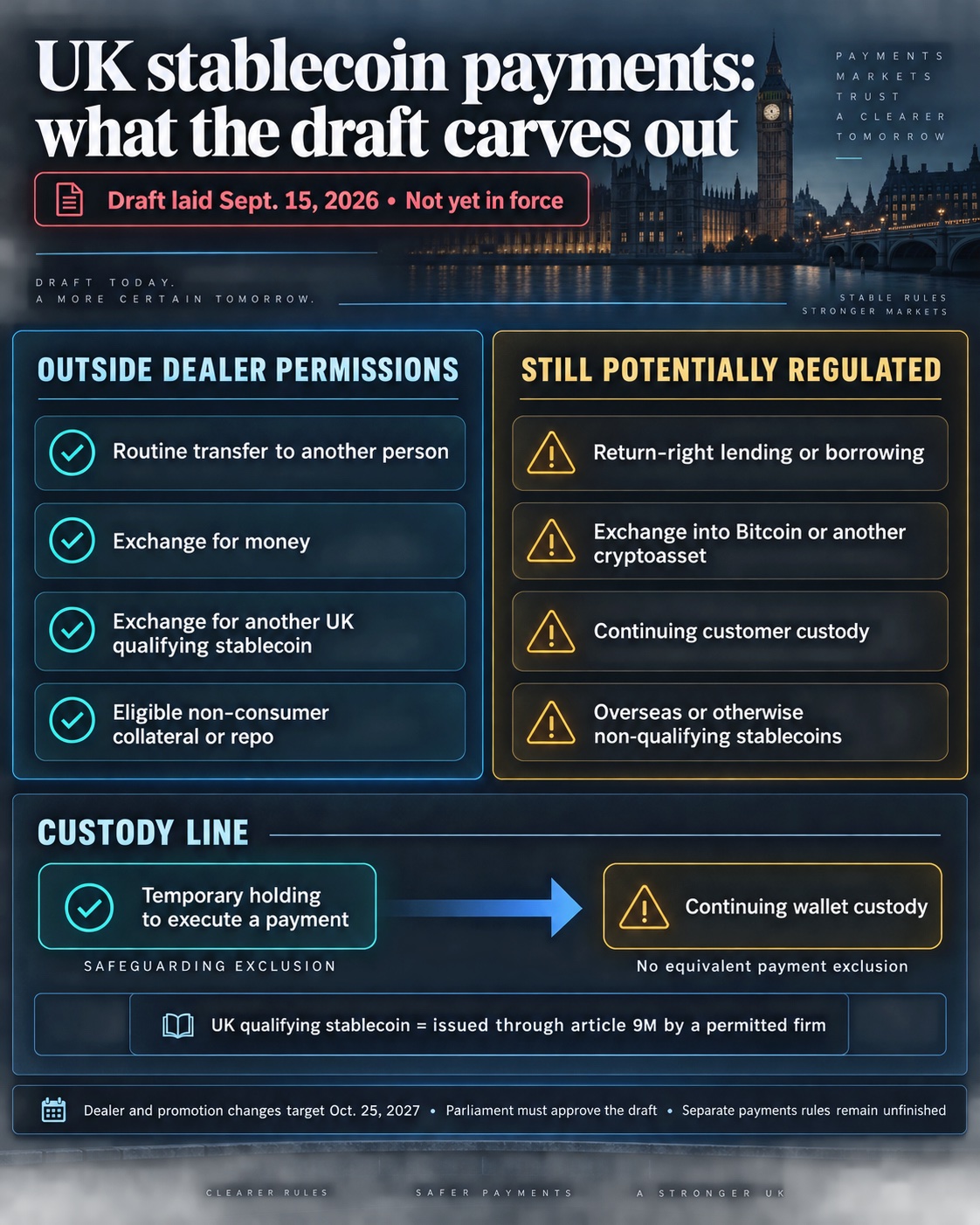
Temporary UK qualifying stablecoin holding gets custody relief
A new safeguarding provision would exclude temporary holding of a UK qualifying stablecoin when that holding is connected with executing a payment. Longer-term custody, such as maintaining a customer wallet, receives no equivalent payment exception and can remain within the safeguarding activity.
That differs from HM Treasury’s April proposal, which said payment firms would still need safeguarding permission and proposed limiting the temporary-settlement exclusion to holding ancillary to other crypto activities. The final draft instead distinguishes brief payment execution from continuing custody.
The financial-promotion rules, which govern marketing, broadly align with the transfer, exchange, collateral and repo exclusions. Their coverage is not identical, and arrangements requiring the stablecoin to be returned do not receive the basic promotion exemption.
The dealing, arranging and financial-promotion amendments are drafted to begin on Oct. 25, 2027, when the FCA says the new regime for crypto firms starts. Amendments made through regulation 4 would begin after the instrument is made. Parliament must approve the draft first, and HM Treasury’s separate payments reform still has to define the longer-term rules for stablecoins used in payments.
