


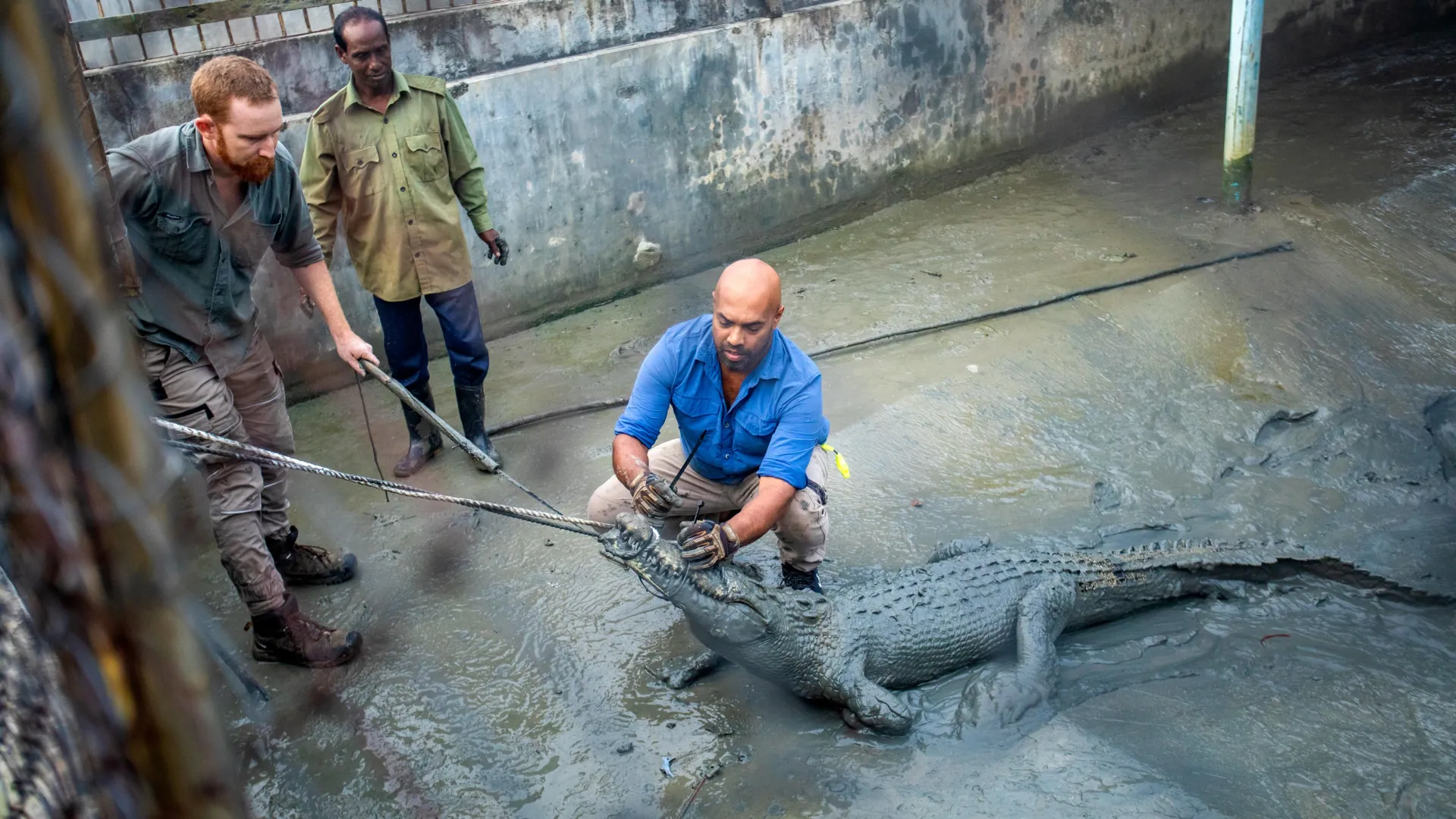
A new study suggests that saltwater crocodiles born or raised in captivity may not try to return to their breeding centers once they are released into the wild. The finding could help conservationists improve efforts to restore declining crocodile populations.
Finding the way back home is an important behavior across the animal kingdom. For many species, it can play a major role in survival and reproduction. Some animals make short daily trips back to nests or burrows after searching for food, while others navigate across vast distances over weeks or months.
Crocodiles Have a Powerful Homing Instinct
“Crocodilians, the largest predators in most tropical, subtropical freshwater and brackish environments, are a unique case when it comes to homing behavior,” said behavioral ecologist and Adjunct Associate Professor Ru Somaweera, from Murdoch University.
“Crocodiles are remarkably good at finding their way home, often returning to their original capture sites and limiting the success of relocation programs. What we still don’t fully understand, though, is how this behavior plays out in individuals that have been bred or kept in captivity for long periods before being released back into the wild.”
Researchers carried out the study in the Sundarbans mangrove forest in Bangladesh, one of the country’s last major refuges for saltwater crocodiles. Heavy commercial hunting for crocodile skins severely reduced the species in Bangladesh until the 1970s. Although saltwater crocodiles have been legally protected there since 1973, their numbers have shown no measurable recovery.
Most of the country’s remaining known crocodiles are now found in the Sundarbans. Even there, the population is small, with the most recent survey estimating just 140 mature individuals.
Could Older Captive Crocodiles Help?
“If crocodiles who are bred and raised in captivity subsequently return to their enclosures or breeding facilities after being released, attempts to reintroduce them into the wild as part of conservation efforts will ultimately fail,” Associate Professor Somaweera said.
“The traditional approach has been to use hatchlings in reintroduction programs, but their survival rates are extremely low and they take a long time to reach reproductive maturity. Understanding whether larger, captive-bred crocodiles can be used instead represents an important knowledge gap.”
To investigate, the researchers fitted five mature saltwater crocodiles with satellite tracking devices. The group included three captive-reared females that had spent 8-22 years in captivity, one local wild crocodile that was captured and then released at the same site, and another wild crocodile that was moved (translocated) a long distance from where it had been caught.
The scientists then tracked the animals for several months after release.
Captive Crocodiles Did Not Try To Go Back
According to Associate Professor Somaweera, the most encouraging result involved the three captive-reared crocodiles. None showed signs of attempting to return to the breeding facility where they had lived.
“Instead, they settled into small, well-defined areas and moved in much the same way as the local wild crocodile we tracked, which tells us they are possibly able to adapt to their new environment seamlessly,” he said.
The outcome was very different for the translocated wild crocodile, named Jongra.
“Unfortunately, the results weren’t as good for the wild crocodile Jongra, who was translocated about 132km from his home before being released.
“Although Jongra didn’t make it back to his original capture site during the study, his movements were very clearly going in that direction. He traveled far more each day than any other crocodile we tracked, covered an exceptionally large area, and even recorded single-day movements of more than 30 kilometers: all typical signs of homing behavior.”
A Potential Tool for Crocodile Conservation
The contrast between the captive-reared and translocated wild crocodiles could have practical value for conservation programs.
“These findings suggest that releasing subadult and adult captive-reared crocodiles can be a viable strategy to strengthen wild populations,” Associate Professor Somaweera said.
“For translocated crocodiles, it’s important there is careful release planning to manage their tendencies to return home.”
The study, What is home? Post-release movements of captive-reared and translocated mature saltwater crocodiles in Bangladesh, was published in the journal Wildlife Research. It was funded by the Deutsche Gesellschaft für Internationale Zusammenarbeit and led by IUCN Bangladesh and the Bangladesh Forest Department.
