


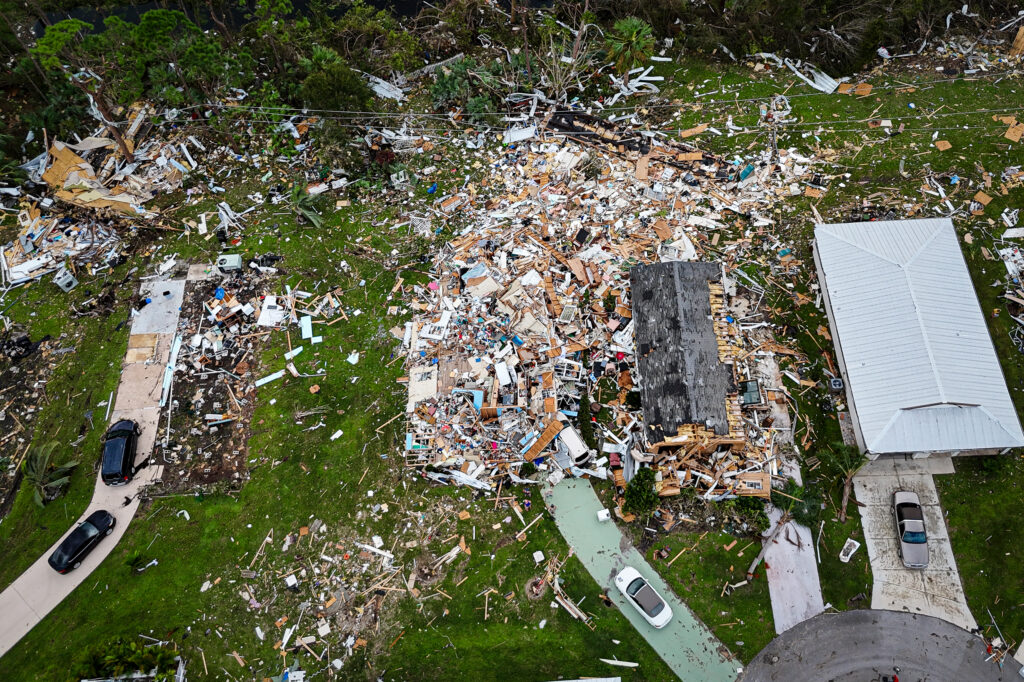
On the night of Feb. 22, 1998, tornadoes tore through Central Florida while most of the region slept. By dawn, 42 people were dead; to date, it is the deadliest tornado outbreak in the state’s history. Nearly all those who died lived in the same kind of housing: mobile homes and RV parks around Kissimmee, where families had no basement to shelter in and, in the dark, little chance to outrun a storm they couldn’t see coming.
That storm unfolded during one of the strongest El Niño climate patterns ever recorded. This winter, another one is forming.
Forecasters now put the odds of a strong El Niño—possibly a “super” El Niño rivaling that of 1997-98—above 90 percent, peaking between January and March. On average, that pattern tilts the odds toward a more active cool season for severe weather in Florida, even as it tends to quiet the nation’s spring tornado season farther north, said Kelsey Malloy, a climatologist at the University of Delaware who studies how large-scale climate patterns shape tornado activity.
The Florida signal is real but weaker and less certain than the national one, she cautioned, and no single season is guaranteed. But the stronger the El Niño, she said, the more confidence forecasters can place in it.
A warming climate widens the odds further, said Jeff Schlegelmilch, who directs Columbia University’s National Center for Disaster Preparedness. As the distribution shifts, he noted, once-rare events arrive more often and storms can turn up where they haven’t before.
What makes that forecast matter is who sits in its path. Nationally, people in mobile and manufactured homes are 15 to 20 times more likely to die in a tornado than people in permanent homes, and they account for more than half of all tornado deaths that happen at home, despite making up less than 6 percent of the nation’s housing. The homes are elevated and anchored to the ground rather than set on foundations, so when wind gets underneath them, they can be lifted and torn apart.
Nationally, people who live in mobile-home parks skew disproportionately elderly and low-income, with poverty rates of 31 percent, more than double those of renters, estimated at about 15 percent.
Manufactured home parks are “the perfect representation of environmental justice in the disaster context,” said Andrew Rumbach of the Urban Institute. Parks were historically pushed onto the cheapest, least desirable land, Rumbach said, and today’s zoning rules often bar them from expanding or moving; residents, as he put it, are “locked in place.” Many residents are what his colleague Esther Sullivan calls “halfway homeowners”: they own the home but rent the land beneath it, leaving them little power to make their communities safer and little ability to leave.
After Hurricane Andrew destroyed nearly all the mobile homes in its path in 1992—99 percent in Homestead, the hardest-hit town—federal regulators rewrote the rules, and by 1994 required manufactured homes in Florida to be built to withstand stronger winds.
State analyses after later hurricanes found the newer homes survived at far higher rates. A violent tornado packs far higher wind speeds into a small, fast-moving path—the standards top out around 110 mph, while a tornado spawned from Hurricane Milton in 2024 that hit Fort Pierce carried winds near 160—so a direct hit can destroy even a new home. That, experts say, is why the only real protection is to leave for a sturdier shelter.
Florida has more manufactured homes than any state; roughly 830,000, according to Census data. No one knows precisely how many predate the stronger 1994 standards, because the Census doesn’t track build years that finely. But the estimates are large: The manufactured-housing industry has put the number of older, pre-code homes around 600,000.
The systems meant to support these communities are strained. A federal program built to fund community storm shelters, known as the Building Resilient Infrastructure and Communities program, or BRIC, was terminated by the Trump administration in 2025; a federal court ruled the termination unlawful and in March 2026 ordered it restored, attributing the delay partly to FEMA’s own layoffs, according to Schlegelmilch.
Other federal money can pay for storm shelters—the Department of Housing and Urban Development’s Community Development Block Grants can fund them—but that money is administered by state and local officials with broad discretion over competing priorities, and it flows to governments, not to the private manufactured-home parks where these residents live.
An Inside Climate News review of FEMA’s mitigation-grant records found that over roughly two decades, none of the community safe rooms funded in Florida went to a manufactured-home community.
The gap is structural, said Schlegelmilch: BRIC money is awarded competitively, and the communities that need it most rarely have the staff or data to win a federal grant.
He likened it to being told you can have the money if you “put on [a] football helmet and play against an NFL team and beat them.” Safe rooms—hardened structures built to survive tornado-force winds—are also expensive, Rumbach noted, and most parks are privately owned and too crowded to fit one.
And because a federal disaster declaration covers at least 75 percent of recovery costs, states have little reason to spend on prevention up front.“You pay for it now or you pay for it later,” Schlegelmilch said.
Florida’s own response—a new law that took effect in July 2026, opening state housing funds for mobile home repairs—is only beginning to reach homeowners. And the warnings meant to wake people at night reach people unevenly. They also don’t always arrive in a language residents can read. During Hurricane Milton in 2024—the storm that spawned a tornado that killed six at a Fort Pierce manufactured-home community—the National Weather Service sent its alerts in both English and Spanish, but the counties that issued the remaining warnings did so largely in English only, a federal review found. An estimated 577,000 households in the affected counties have limited English proficiency. And translation alone isn’t enough: The review noted that some Guatemalan immigrants, unfamiliar with hurricanes and in some cases unable to read, couldn’t fully understand the warnings.
In Osceola, Orange, Seminole and Volusia counties—where most of the 1998 deaths occurred—little has changed underfoot. “There’s really no shelters in these parks,” said Jody Brown, who represents manufactured-home owners across the region for the Federation of Manufactured Homeowners of Florida, describing one Seminole County community of more than 1,100 homes with nowhere to take cover. Many residents are elderly, she said, don’t get warnings quickly and simply stay put.
This winter, the pattern that killed 42 people in 1998 is taking shape again, over a landscape of homes, and a population, largely as exposed as they were almost three decades ago.
About This Story
Perhaps you noticed: This story, like all the news we publish, is free to read. That’s because Inside Climate News is a 501c3 nonprofit organization. We do not charge a subscription fee, lock our news behind a paywall, or clutter our website with ads. We make our news on climate and the environment freely available to you and anyone who wants it.
That’s not all. We also share our news for free with scores of other media organizations around the country. Many of them can’t afford to do environmental journalism of their own. We’ve built bureaus from coast to coast to report local stories, collaborate with local newsrooms and co-publish articles so that this vital work is shared as widely as possible.
Two of us launched ICN in 2007. Six years later we earned a Pulitzer Prize for National Reporting, and now we run the oldest and largest dedicated climate newsroom in the nation. We tell the story in all its complexity. We hold polluters accountable. We expose environmental injustice. We debunk misinformation. We scrutinize solutions and inspire action.
Donations from readers like you fund every aspect of what we do. If you don’t already, will you support our ongoing work, our reporting on the biggest crisis facing our planet, and help us reach even more readers in more places?
Please take a moment to make a tax-deductible donation. Every one of them makes a difference.
Thank you,

Fellow
Kate Waxman is a Florida-based Outrider fellow at Inside Climate News, where she covers climate injustice across the state. She earned her M.S. in journalism from Columbia Journalism School and her B.A. in environmental science from Barnard, with reporting focused on coral reefs, climate science, and the communities closest to the water.
