


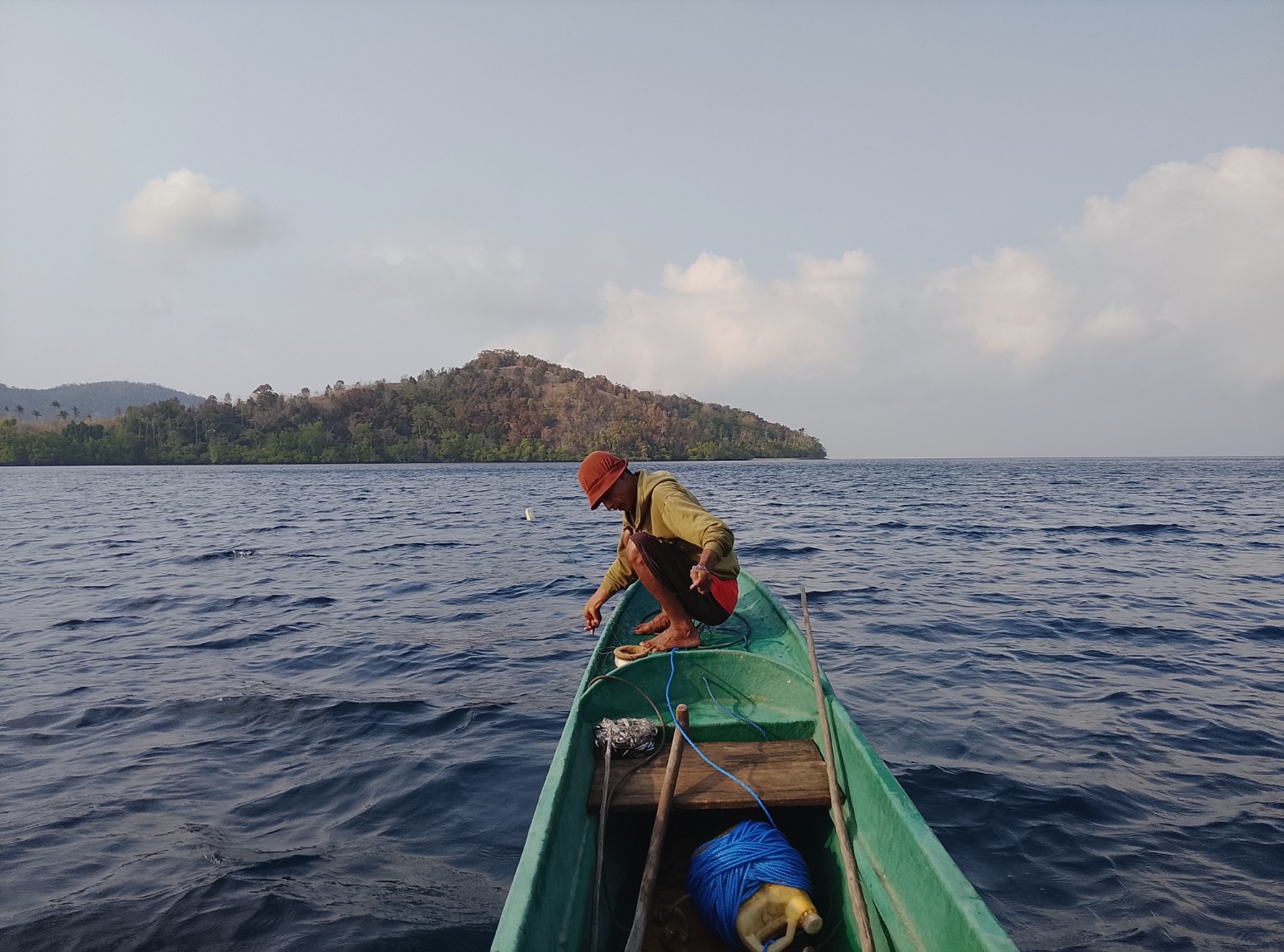
- Fishers in Indonesia’s Maluku Islands say increasingly rough seas are keeping them ashore and reducing their catches as the current El Niño intensifies, threatening livelihoods in communities dependent on fishing.
- Early monitoring shows declining catches at some sites around the Maluku islands of Ambon and Seram.
- Meanwhile, a recently published global study found that extreme ocean heat and low marine productivity are associated with a greater risk of exceptionally poor catches, particularly in tropical regions.
- With Indonesia bracing for prolonged dry conditions under the El Niño, researchers are investigating whether changing ocean temperatures and coastal habitats are adding to the challenges facing local fishing communities.
Fishers in the east Indonesian Maluku Islands say rough seas are keeping them ashore and shrinking their catches as El Niño builds, according to early local monitoring and interviews.
Yustinus Pesireron, a 64-year-old fisherman from Kaibobo village on Seram island in Maluku, told Mongabay on Oct. 2 he had not been to sea for almost a month — the longest break of his three decades on the water. He said fishing is the main source of income in the village of about 1,800 people. Pesireron said the earnings he makes from selling his catch finance daily household needs and school expenses for three of his six children.
Local monitoring by partners of the UK-headquartered conservation group Blue Ventures shows the amount of fish caught on an average fishing trip in coastal waters around Ambon and Seram islands fell to an average of 3.6 kilograms (7.9 pounds) in April-July 2026 at one monitoring site, down from 8.3 kg (18.3 lb) in 2025 and 10.6 kg (23.4 lb) in 2024. The group said the data do not show that fish populations are shrinking. Rather, fishers report that higher waves and rougher seas are limiting how long they can fish and how far they can travel.
“Sometimes, even when the weather isn’t good, we still go out to sea and catch some fish,” Pesireron told Mongabay in a phone interview. “But, as we say here in Maluku, such a catch is only enough to cover the cost of fuel, and perhaps food. That’s about it.”
Asura Rumanama, program coordinator at Nusa Bahari Lestari (SAHARI), a local development NGO that was one of Blue Ventures’ monitoring partners, said the changing conditions had become increasingly noticeable since March, and that fishers were also contending with unusually intense heat while working offshore.
“We don’t yet know whether the extreme heat is affecting the sea and marine ecosystems, but it is certainly affecting our fishers,” Rumanama said in a statement outlining Blue Ventures’ findings that the group shared with Mongabay.
The symptoms described by Pesireron and other fishers in Maluku — unusual ocean conditions coinciding with poor fishing — follow a global pattern that scientists warned about in a study published Sept. 1 in the journal Nature Communications. The global study found that extreme ocean heat and low marine productivity are linked to a greater likelihood of very low catches, though it did not look at the Maluku archipelago specifically.
Researchers at Canada’s University of British Columbia (UBC) and the University of Bern in Switzerland analyzed three decades of catch records from 254 regions worldwide (not including the Seram and Ambon fisheries).
They found that extreme ocean heat and unusually low ocean productivity, meaning less growth of the microscopic algae that feed the marine food web, were associated with higher odds of very low catches, particularly when the two occurred together or in sequence. Heat on its own raised the odds, while low productivity on its own did so mainly when it was the lowest in a region’s record. Two consecutive years of extreme heat raised the odds of an extreme low catch by about 40%, according to the study, and heat followed by very low productivity raised the odds by up to about 80%. The strongest effects were in tropical regions, small-island nations and communities dependent on seafood.
“Our findings show why fisheries managers need to consider more than temperature alone,” William Cheung, the paper’s lead author and a professor at UBC’s Institute for the Oceans and Fisheries, said in a statement. “Understanding how different extremes interact will be essential for anticipating risks to fisheries and the communities that depend on them.”

The researchers examined fisheries catch records from 1993 to 2019 along with ocean temperature and marine productivity data during the same period. Using statistical models, they estimated how unusually high temperatures and low productivity, separately and together, were associated with the likelihood of exceptionally low catches, both in the same year and with a one-year delay. They tested the findings against alternative datasets and methods.
Using three climate models, the study then projected these relationships to 2060 under two emissions scenarios: one assuming strong cuts to greenhouse gas emissions and one assuming none. Assuming past relationships between extreme conditions and catches hold, the share of stocks in vulnerable regions experiencing extremely low catches would rise, on average across the models, from about 11% in the early 1990s to almost 16% by mid 21st century under both scenarios. The paper found the two paths looked similar because the ocean responds slowly and much near-term warming is already locked in under either scenario.
The study said heat and low productivity could limit fish food, slow fish growth and reduce reproduction, leading to fewer fish overall. It added that warmer or less productive waters could also push fish into other areas, leaving fewer for local fishers even when the species is not declining.
The World Meteorological Organization warned on Oct. 8 that the current El Niño event could become one of the strongest since at least 1950 and would likely peak at the end of 2026. Indonesia’s Meteorology, Climatology and Geophysics Agency, or BMKG, says the country is experiencing a very strong El Niño, with conditions expected to persist into early 2027. The agency has issued drought warnings for parts of Maluku, according to an Oct. 13 statement.

Whether the cause is fewer fish or fewer days at sea, many fishing families are already finding it difficult to make ends meet, according to the Blue Ventures report. Dry weather has also triggered bushfires on land and cut harvests from the farming that many in Seram and Ambon rely on for extra income. Fishing communities have received little attention as governments prepare for El Niño, said Michelle Tigchelaar, who leads climate and environmental sustainability work at the Malaysia-based research group WorldFish, in a statement.
Fisheries and aquaculture, which support global food security, “tend to be left out of a lot of the food system responses,” Tigchelaar said. The statement cites WorldFish research showing fisheries received 1% of tracked climate adaptation finance for food systems in 2019 and 2020.
Blue Ventures’ next step is to look beyond the weather, Wahyu Dita Septiani, the group’s data science manager, told Mongabay in an interview. The group will now assess the condition of habitats near the villages, including mangroves, coral reefs and seagrass beds, to see if they have changed over time, which could possibly lead to reduced fish stocks, she said. It will also assess whether catches are being affected by changes in sea temperatures as well as by weather, she said.
The group will also run household surveys to assess people’s economic conditions and how they may be changing. “We want to understand whether declining catches are affecting the economic well-being of local communities,” Septiani said.
Pesireron, the fisher, said he’d turned to harvesting and selling sago — a staple food in Maluku — for some income as he waits for the weather to ease. He said he could only hope he would head back out to sea soon, “The weather seems to be getting a little better.”
Basten Gokkon is a senior staff writer for Indonesia at Mongabay.
See related story:
Finance and support are key to fishers adopting eco-friendly gear, study shows
Citations:
Cheung, W. W., Frölicher, T. L., Morgante, I., & Palacios-Abrantes, J. (2026). Large fisheries declines linked to compound and extreme climate events. Nature Communications, 17(1). doi:10.1038/s41467-026-77077-z
FEEDBACK: Use this form to send a message to the author of this post. If you want to post a public comment, you can do that at the bottom of the page.

