


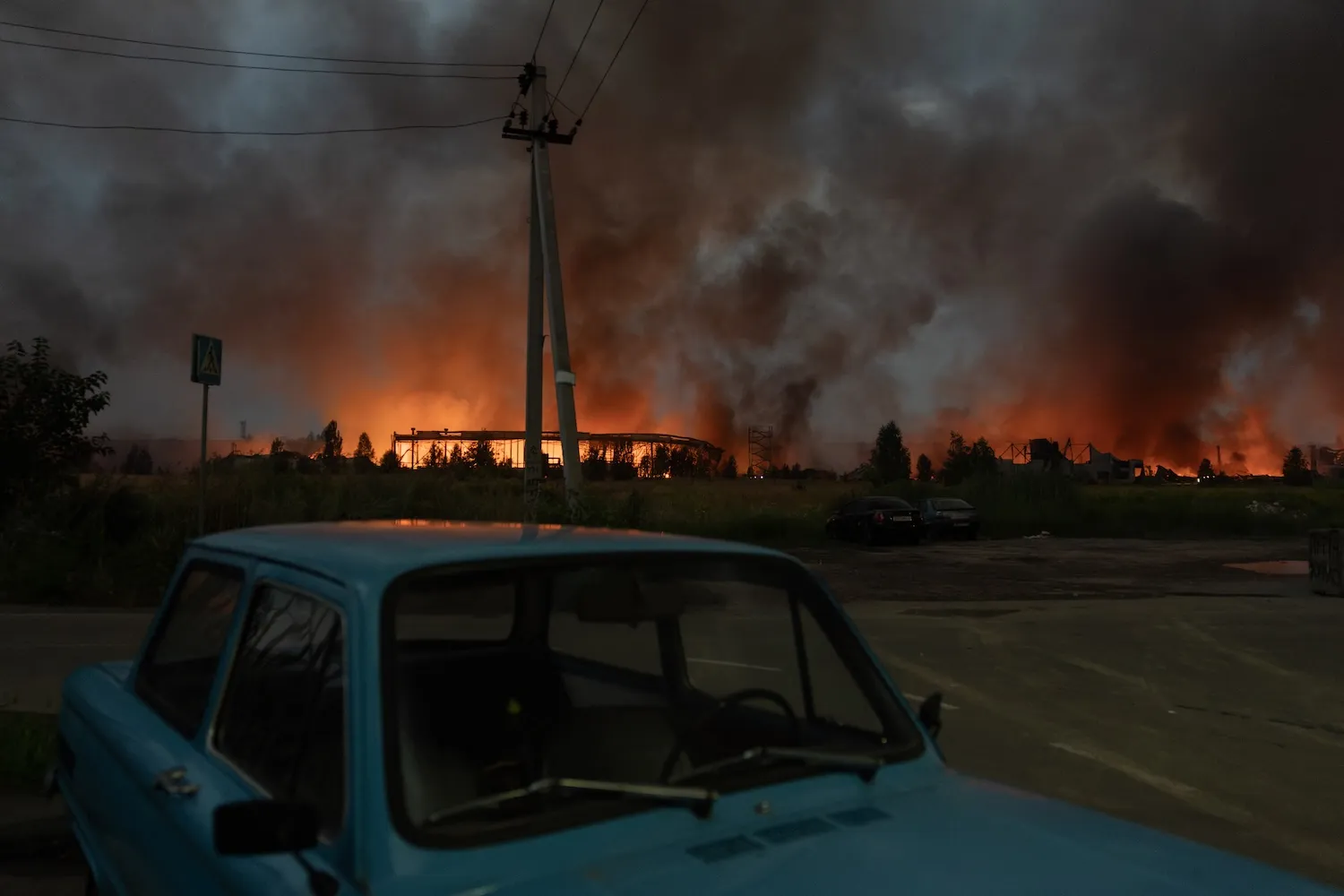
In July, the deadliest month for Ukrainian civilians since April 2022, Ukraine intercepted only 29 of Russia’s 195 incoming ballistic missiles, according to the Ukrainian Defense Ministry.
As Russia intensifies its ballistic missile attacks, Ukraine is running dangerously low on the interceptors needed to defend against them. Neither of its major sources of support appears willing and able to fill the gap: European allies have already drawn heavily on their own air defense stocks, and the United States continues to deplete its own missile-defense interceptor inventories in its war against Iran. On Aug. 5, Ukrainian President Volodymyr Zelensky said that supplies of air defense missiles from allies this year have fallen to roughly one-third of their 2025 levels.
Ukraine has explored domestic options to replenish supplies, including seeking permission from Washington to manufacture Patriot interceptors and developing its own Freyja ballistic missile interceptor. But Washington has so far rejected the former, and bringing the latter into service would require substantial capital; engineering work; testing; and, crucially, time.
With Ukraine’s domestic capacity still years away from meeting its needs and U.S. and European supplies constrained, South Korea is one of the few countries capable of filling the gap. Zelensky has appealed to Seoul, saying: “We would very much like to receive support from South Korea in the form of what we lack—air defense systems.” But Seoul has so far declined.
That is a mistake. Since Russia’s full-scale invasion of Ukraine in 2022, South Korea has emerged as a major arms supplier to Europe. Providing air defense systems to Ukraine would give Seoul an opportunity to prove that it is not merely an arms exporter to Europe but also a genuine security partner.
South Korea is particularly well suited to help, because it has developed sophisticated, multilayered missile-defense capabilities to counter North Korea’s nuclear and missile threats, and it has enough surplus to export to other countries. Its homegrown Cheongung-II system has already been battle-tested in the United Arab Emirates with a 96 percent success rate. Its systems are also competitively priced: A Cheongung-II interceptor costs about $1.1 million, roughly one-third the price of a Patriot interceptor. South Korea also produces about 95 percent of the system domestically, reducing its exposure to foreign supply-chain disruptions and export restrictions.
Perhaps most importantly, South Korea is also known for its ability to scale production rapidly and deliver systems on time. Although there are concerns that South Korea may lack the capacity to provide these systems to Ukraine quickly due to high demand, its defense industry has noted that existing production facilities are operating below capacity and that factories under construction in Poland and Romania could potentially be utilized to expand production.
Yet in response to Zelensky’s request, a South Korean Foreign Ministry official stated, “Our defense supplies … have been provided while complying with relevant domestic laws and policies.” Indeed, South Korea has maintained its long-standing policy of not directly supplying lethal weapons to countries at war, thus far providing Ukraine with humanitarian assistance and nonlethal military equipment and supplying ammunition indirectly through the United States.
This, however, is not a categorical legal prohibition, let alone a constitutional ban, as Zelensky has suggested. Some point to Article 5, which stipulates that “The Republic of Korea shall endeavor to maintain international peace and shall renounce all aggressive wars,” as a legal basis for opposing arms transfers to Ukraine. Yet one could argue that assisting a country that has been invaded in violation of international law—and thereby helping to uphold international peace and security—is more consistent with the spirit and purpose of the article.
More relevant is South Korea’s Defense Acquisition Program Act, which allows the government to restrict exports of defense material when necessary to maintain international peace and security, protect national security, or avoid diplomatic friction. The government retains discretion over whether to authorize such exports. The Foreign Trade Act restricts arms exports to “peaceful uses,” but it does not clearly define what constitutes a “peaceful use.”
Whether to provide Ukraine with air defense systems is thus, fundamentally, a political choice. If Seoul has the political will, it could approve such transfers on the compelling grounds that they are defensive weapons intended to protect a country subjected to illegal aggression.
Seoul’s hesitation is understandable. South Korean President Lee Jae-myung has sought to maintain workable relations with Russia, which remains economically and strategically important to South Korea, rather than distance itself on values-based grounds, as his predecessor Yoon Suk-yeol did.
Before the war, annual bilateral trade amounted to roughly $27 billion. Russia has also traditionally been an important actor on Korean Peninsula issues because of its leverage over North Korea, although the extent of that influence has ebbed and flowed over time.
The relationship became particularly thorny when South Korea imposed economic sanctions against Russia after its invasion of Ukraine; more recently, Moscow has protested South Korea’s humanitarian aid to Ukraine and defense industry cooperation with NATO. Direct arms transfers to Ukraine would likely cross what Russia considers to be a red line—as a South Korean diplomat reportedly noted—and could make it significantly more difficult for Seoul to repair relations with Moscow after the war ends.
Moreover, South Korean policymakers worry that directly arming Ukraine could encourage Moscow to deepen military cooperation with North Korea, including transfers of sensitive technologies relating to nuclear-powered submarines, military satellites, or other systems. These technologies would enhance North Korea’s precision-strike capabilities, improve the survivability of its nuclear forces, and strengthen its deterrent against the United States, thereby undermining the credibility of the U.S. security guarantee. Former Russian President Dmitry Medvedev has also suggested that Russia could provide North Korea with the latest nuclear weapons technology if South Korea were to lend Ukraine military support.
However, it is questionable whether South Korea’s efforts to manage its relationship with Russia would ultimately bear fruit. As Russia-North Korea ties have deepened into a treaty-based alliance, it is increasingly unlikely that Seoul will be able to restore its previous relationship with Moscow—or, even if it does, that Moscow would support South Korea’s broader geopolitical objectives. Moreover, Russia is reportedly already providing North Korea with some sensitive technologies, although the nature and extent of these transfers remain difficult to verify.
On top of that, whatever value Seoul sees in managing its relationship with Russia should be weighed against what it may lose by doing so—namely, the opportunity to consolidate its security partnership with Europe.
Cooperation between South Korea and Europe has expanded considerably in recent years, with Seoul participating in NATO summits and signing a security and defense partnership with the European Union. This relationship has become more important than ever, as both face growing security threats from neighboring powers amid waning confidence in U.S. security commitments.
South Korea’s defense industry has already become an important part of Europe’s effort to expand military capacity: From 2021 to 2025, South Korea was the second-largest supplier of major arms to European NATO countries, after the United States. That partnership has been driven most visibly by rapid deliveries of howitzers, tanks, multiple-launch rocket systems, and aircraft to Poland, alongside deals with Romania, Norway, Finland, and Estonia.
Yet the political environment in Europe is changing, and the “Buy European” sentiment is gaining momentum as governments seek to revitalize the continent’s defense-industrial base. The European Union’s Security Action for Europe (SAFE) program has allocated approximately $175 billion to support defense procurement and industrial expansion within Europe but requires at least 65 percent of the component value of funded projects to originate within the European Union. South Korea’s exclusion from SAFE could make its systems less attractive for EU-funded procurement.
South Korean policymakers and defense industry leaders increasingly recognize that Europe cannot be treated simply as a destination for Korean weapons. Sustainable cooperation must become more reciprocal cooperation and a broader security partnership.
Lee has articulated this ambition, saying that South Korea must “go beyond exporting advanced products” and become “a trusted partner in security cooperation.” In other words, deepening defense cooperation with Europe—whether in the defense-industrial sphere or more broadly—would require Seoul to establish itself symbolically as a trusted security partner, rather than just a business partner.
Ukraine presents the clearest opportunity to demonstrate precisely that. Ukraine is the front line of European security, and strengthening its ability to resist Russian aggression directly contributes to Europe’s deterrence and defense at a time when the continent faces its most serious security challenges since the end of the Cold War.
South Korea cannot aspire to become one of Europe’s trusted security partners while simultaneously insulating its relations with Moscow from the consequences of that choice. Providing Ukraine with air defense systems would show that South Korea is prepared to contribute to European security when the stakes are highest—not simply profit from European demand.
