


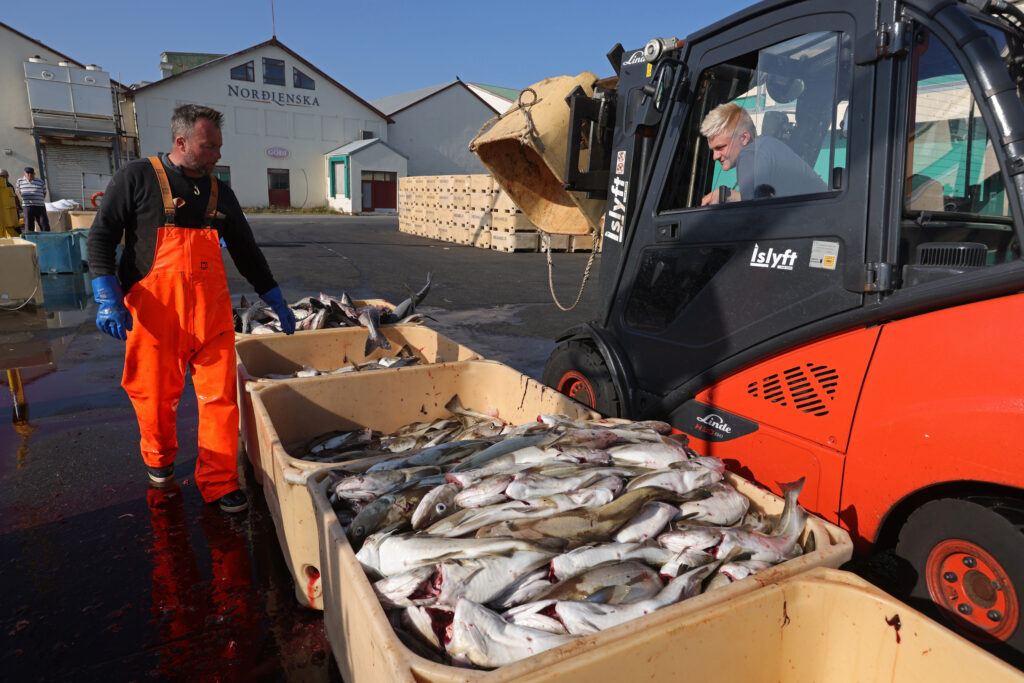
Over the weekend, Iceland voted against resuming talks to join the European Union. At the heart of the referendum question: fish.
More than a decade since talks previously collapsed, Euroskeptics won 52.8 percent of the vote, according to the National Electoral Commission.
Just over 12,700 votes separated the two camps.
While the referendum—which was moved forward a year because of Trump’s repeated threats to Greenland—was originally framed around Arctic geopolitics and security, it instead became a proxy vote on fish; namely, who gets to decide the future of stocks already facing pressures from warming waters and excessive fishing.
“Our people fought for these 200 miles around Iceland,” a trawler captain told AFP ahead of the vote last week, referencing the victory over British boats in the Cod Wars of the 1970s. “We are a little bit afraid that if we join the European Union, we would have to give up some of what we fought so hard to gain.”
Fishing is a vital part of Iceland’s economy and culture, accounting for almost 40 percent of all exports, and employing almost four percent of the nation’s workforce. Those factors made the prospect of granting E.U. access to Icelandic waters an especially divisive question.
And, unlike in the 1970s, it’s no longer just cod. In the early 2000s, warming waters saw mackerel stocks expand northward into Icelandic territory, while diminishing elsewhere due to overfishing.
Today, Iceland’s fish stocks are far healthier than their European neighbors. Stocks of Icelandic cod and haddock, for example, are deemed sustainable or even abundant, while the equivalent E.U.-managed stocks face regional collapse.
A recent Gallup poll showed that 90 percent of Icelandic companies linked to fishing opposed joining the E.U. or its Common Fisheries Policy framework, perhaps a result of the disparities in how marine resources are managed.
“The E.U.’s behavior when it comes to fishing is abysmal,” said Jonny Hughes, senior policy manager at Blue Marine Foundation, a British ocean conservation charity. “I imagine they’re looking at [Iceland’s waters] as an absolute pot of gold.”
While both Iceland and the E.U. pledge to never set fishing quotas above scientific advice, Brussels routinely ignores the recommendations of its own scientists.
Indeed, in 2020—the year the E.U. previously set as its absolute deadline to end overfishing—nearly half of all quotas were set above scientific advice, according to The Pew Charitable Trusts.
“The European fishing industry is very good at shooting itself in the face,” said Hughes, noting years of consistent overfishing and a policy of ignoring how oceans are changing. “When it comes to fisheries, neither the E.U. or the U.K. is incorporating climate into its decision-making.”
The outsized role fisheries played in Reykjavik’s referendum highlights how politicized access to marine resources is becoming in the North Atlantic, exposing weaknesses in the current management approach.
“Too often agreements on shared stocks are still built around historical distributions, short-term quota negotiations, and single-species management approaches,” said Jean-Christophe Vandevelde, international fisheries manager at The Pew Charitable Trusts, in an email. “Climate change is altering productivity, distribution, and ecological relationships across entire marine ecosystems.”
Vandevelde argues that climate-driven shifts to stock distribution, such as mackerel moving into Icelandic waters, “should not become a justification for continued political disagreement or overfishing.”
Rather, governments should move beyond managing individual species in isolation and adopt an ecosystem-based approach that accounts for food-web dynamics, predator-prey relationships and the growing effects of climate change.
While a “No” vote over the weekend locked in Iceland’s exclusive fishing authority across the island’s 200-mile zone, borders drawn on a map can’t stop fish on the move. As the North Atlantic warms and European overfishing continues largely unchecked, the resulting legal gaps means this weekend’s referendum is far from the last dispute over marine resources.
About This Story
Perhaps you noticed: This story, like all the news we publish, is free to read. That’s because Inside Climate News is a 501c3 nonprofit organization. We do not charge a subscription fee, lock our news behind a paywall, or clutter our website with ads. We make our news on climate and the environment freely available to you and anyone who wants it.
That’s not all. We also share our news for free with scores of other media organizations around the country. Many of them can’t afford to do environmental journalism of their own. We’ve built bureaus from coast to coast to report local stories, collaborate with local newsrooms and co-publish articles so that this vital work is shared as widely as possible.
Two of us launched ICN in 2007. Six years later we earned a Pulitzer Prize for National Reporting, and now we run the oldest and largest dedicated climate newsroom in the nation. We tell the story in all its complexity. We hold polluters accountable. We expose environmental injustice. We debunk misinformation. We scrutinize solutions and inspire action.
Donations from readers like you fund every aspect of what we do. If you don’t already, will you support our ongoing work, our reporting on the biggest crisis facing our planet, and help us reach even more readers in more places?
Please take a moment to make a tax-deductible donation. Every one of them makes a difference.
Thank you,

Fisheries Reporter
Johnny Sturgeon is a London-based reporter covering fisheries and aquaculture. Joining us from the Outlaw Ocean Project, he has experience producing in-depth maritime investigations for nonprofit newsrooms. A former boatbuilder, he holds a B.A. in History & Politics from the University of Oxford, and an M.S. from Columbia Journalism School.
