


- For decades, conservationists have argued that protecting nature cannot rely indefinitely on donor funding. To endure, conservation efforts must generate enough economic value to sustain themselves.
- That search for sustainable financing has prompted governments, investors and conservation organizations to experiment with models that seek to align commercial returns with environmental protection.
- On Tanzania’s Pemba Island, a company called Asili is betting that sea cucumber ranching can do both. The venture is building the infrastructure needed to cultivate and process sea cucumbers for sale while supporting the restoration and protection of marine ecosystems.
- Yet, significant questions remain. Can enough sea cucumbers be produced to make the business commercially viable? Can profits be shared equitably with local communities? And can a model built around conservation and commerce truly deliver on both promises?
PEMBA, Tanzania — Like many coastal communities across East Africa, the residents of Shamiani have grown accustomed to watching the sea yield less and less. Warming waters, degraded marine habitats and decades of fishing pressure have all taken a toll on the resources that once sustained local livelihoods, according to community members.
On Tanzania’s Pemba Island, a part of the semi-autonomous region of Zanzibar, Shamiani is no exception. Here, however, residents are trying something different. Ropes now mark out protected sections of shallow seagrass meadows, the result of months of community meetings and negotiations over how the area should be managed.
For generations, the island’s coastal waters have supported fishing families. But in recent years, many residents say nearshore resources have steadily declined. Sea cucumbers, once abundant enough to be harvested and processed locally, have become increasingly scarce. Fishers and gleaners now work harder for smaller returns, trying to make a living from coastal waters that many say are less productive than they once were.
That decline is what led Asili, a Tanzania-based aquaculture company working with communities in Pemba since 2022 to ranch sea cucumbers inside locally protected marine areas. The model aims to restore depleted coastal ecosystems, generate income from a high-value export product, and return a share of expected profits to the communities that give up access to part of their fishing grounds, according to co-founder Tim Kluckow.
“This didn’t happen quickly. This has been a process of many, many, many hours of discussions with the community – discussing what it means when the area will be closed, what the incomes that will be generated in the beginning, what the revenues, how they will be shared,” Kluckow told Mongabay during a recent visit to the island.
At the center of the model is the idea that if communities help protect coastal habitat, and if sea cucumber ranching succeeds, conservation becomes something that can put money into people’s pockets.

A luxury species and a local shortage
Sea cucumbers globally are among the ocean’s most valuable marine products. In East and Southeast Asia, especially China, they are prized as luxury food and believed to have medicinal properties. The U.N. Food and Agriculture Organization has warned that heavy global demand has contributed to the overexploitation of many wild populations, fueling interest in mariculture (a specialized branch of aquaculture involving the farming and harvesting of marine plants and animals — such as fish, shellfish and seaweed — in saltwater environments, including coastal waters, the open ocean and saltwater ponds) as a possible alternative.
The species has long held an elite status in Asian markets, Asili co-founder Alexandra Garcin told Mongabay. “It became a real treat,” she added, tracing its history in Chinese cuisine and medicine. “It’s part of the four sacred products of Chinese cuisine with shark fin, abalone, sea cucumber and bird’s nest.”
The business of sea cucumbers depends on that demand. Garcin said the price for freshly harvested sea cucumber can reach $70 to $80 per kilogram at the beach, while direct export to wholesalers could push prices higher. Over time, she said, the company wants to target not only food markets in Asia but also the growing market for nutraceuticals, where sea cucumber is processed into powders and pills.

Mongabay spoke with Jennifer Howard of the international NGO Conservation International, who is familiar with Asili’s business model. Howard says the high value of sea cucumbers in export markets offers communities an opportunity to generate significant income, but cautions against becoming overly dependent on a single commodity. “If it becomes the dominant livelihood, communities are exposed to variations in pricing and various market dynamics,” she said.
Previous Mongabay reporting from Tanzania’s Mafia Island found that between 2012 and 2019, Tanzania accounted for just under 500,000 kilograms (1.1 million pounds) of more than 3 million kilograms (6.6 million pounds) of dried sea cucumber exported from East Africa to Hong Kong alone.
At the ecological level, the species matters for another reason. Sea cucumbers are often described by marine scientists as important ecosystem engineers: They recycle nutrients, help oxygenate sediments and support the health of surrounding habitats. Without them (sea cucumbers), the seabed can become the equivalent of soil without earthworms, Garcin told Mongabay.
That ecological logic is part of why the project links farming to no-take or low-take areas. “For our model to be a success, we need to protect vast areas,” Garcin said.

A community business, or a risky promise?
In Shamiani, the project is being built around a cooperative model rather than individual ownership. According to Asili, about 300 people in a village of roughly 900 adults have signed up to participate. Much of the work so far — clearing paths, setting up patrol and monitoring systems, and preparing protected zones — has been done by local residents, many of them women and youths.
Speaking through an interpreter, Sharif Tano Sharif, a young man from Shamiani, said the project has generated considerable optimism among participating residents. “Based on what we are seeing, we think it’s going to bring a lot of benefits and profit,” he told Mongabay.
That sentiment was echoed by several other young people interviewed in the village. Like Sharif, Ali Juma Ali, Ngana Hamza Juma and Khamis Juma Ali are participating in the initiative, helping to build monitoring infrastructure, joining community patrols and supporting efforts to protect the designated sea cucumber ranching areas.
Speaking to Mongabay in a group interview through an interpreter, they described the potential they see in the initiative and their hopes that it could provide new livelihood opportunities for people in Shamiani.
Kluckow said the company is trying to avoid what he sees as a pattern that has played out elsewhere in coastal aquaculture projects, which is privatizing a shared marine resource and leaving most of the community out. “We are building a ground-up equity-based model, where we are continually useful to the communities that we partner with,” he said.
Under the arrangement described by the company, future harvest profits would be split so that 50% returns to the community side and 50% remains with the company side to sustain operations and growth. Of the community share, Kluckow said half would go directly to those doing the work, while the other half would be set aside for a broader community fund to support needs such as schooling, water or livelihood development.
That structure is meant to answer a hard question: How do you close off part of a communal fishing area without reproducing inequality?

“When communities co-own decisions, equity, and profit flows, they have a direct stake in keeping ecosystems healthy and the business viable, which typically increases long-term conservation compliance and reduces conflict and project abandonment over time,” Howard said.
Kluckow said the model was shaped partly by lessons the Asili founders learnt from their work in Madagascar, where earlier forms of sea cucumber aquaculture benefited some farmers but did little for the wider village. “What we saw is that after two years of making an income, the water situation wasn’t better; the healthcare situation wasn’t better; the school wasn’t better,” he said.
Still, the model carries real risks. The first is commercial: The farm is not yet generating revenue, and sea cucumbers take roughly a year to a year and a half to reach marketable size. The hatchery, which produces juveniles for stocking, is central to the whole enterprise. Without it, Garcin said, “none of this is possible.”
The second is social and political. The company’s agreement with the community is still evolving, and Kluckow acknowledged that the model depends heavily on local consent continuing over time.
“We’re taking a big bet, absolutely,” he said, arguing that stronger legal control by the company would defeat the point. “We don’t want to get into any agreement or any formal document that would mean that we are taking power out of the hands of the community.”
There is also the question of who controls community benefits once money starts to flow. Kluckow said payments tied directly to labor are easier to track, but broader community funds are more vulnerable to elite capture. The company says it is trying to create a wider decision-making framework so funds are not simply handed over as unrestricted cash.

Women, work and a longer horizon
One of the most visible parts of the model is who is doing the work. In Shamiani, women are expected to take the lead in daytime monitoring, control and surveillance shifts at a new watchtower under construction near the shore. Men are expected to cover night shifts.
During the day, women will also help monitor seagrass and ecosystem conditions, and later assist with harvest and processing.
For Kluckow, that matters because the local economy has narrowed sharply. In some places, he said, one of the few remaining income opportunities for women is collecting cowries, a type of marine sea snail, for very small returns. “We’re fishing down the food chain, fishing down the value chain,” he said.
The early phase of the project is being financed by outside support. Kluckow said most of the money so far has gone into community infrastructure and wages, while Garcin said current support has come through conservation-linked partners, with additional financing being pursued for expansion. Kluckow said neighboring communities have already expressed interest, and the company hopes eventually to work with at least 30 communities; each with 30 to 60 hectares (74 to 148 acres) of production zone.
If the first sea cucumber model works, Garcin said, Asili may later explore other species, including seahorses, oysters and possibly seaweed. She stressed sea cucumbers come first, because they offer the clearest commercial path.
However, that future remains uncertain. Whether the model succeeds will depend on several factors: Producing enough sea cucumbers, maintaining community support and finding reliable markets for the final product.
“People here are not supposed to be beneficiaries of a project,” Garcin said. “For this to be sustainable, they need to be considered as actors and enablers and business partners.”
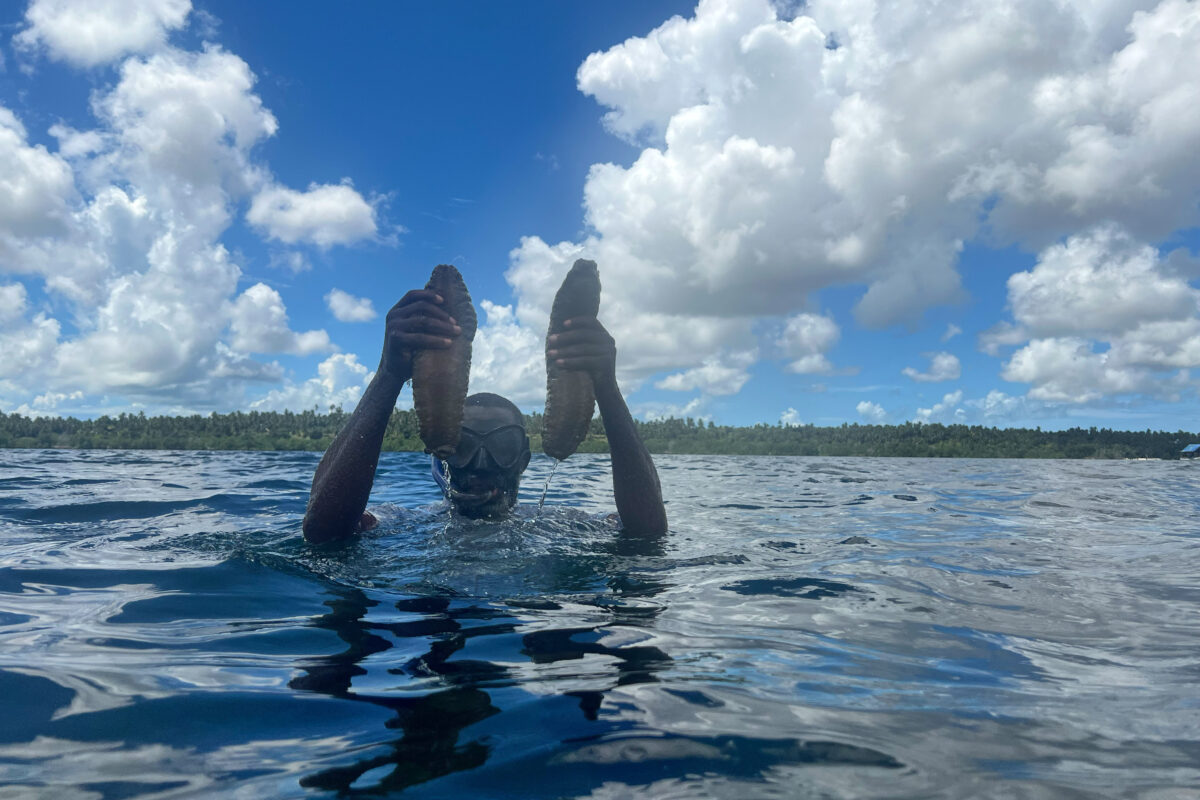
Banner image: Sea cucumbers are harvested beyond Pemba Island in Tanzania. Here, a sea cucumber rancher displays part of his harvest from a ranch on Mafia Island. Image by Ashoka Mukpo/Mongabay.
Tanzania’s Mafia Island eyes sea cucumber farming to prevent extinction
Down on the ranch with Mafia Island’s free-range sea cucumbers
Feedback: Use this form to send a message to the author of this post. If you want to post a public comment, you can do that at the bottom of the page.
Cite this article
David Akana (2026). A sea cucumber venture in Zanzibar seeks to balance business and conservation. Mongabay Conservation news. DOI: https://doi.org/10.66709/news-327729

