


Unlock the Editor’s Digest for free
Roula Khalaf, Editor of the FT, selects her favourite stories in this weekly newsletter.
Airbus is exploring a sale of its US space business as the Franco-German planemaker focuses on building a pan-European satellite champion through a three-way merger.
The company is gauging interest from prospective buyers for the US business, according to people familiar with the matter. Airbus US space systems include a factory in Florida and the Arrow family of small satellites that can be mass produced for both commercial and government communications and imaging, including national security needs.
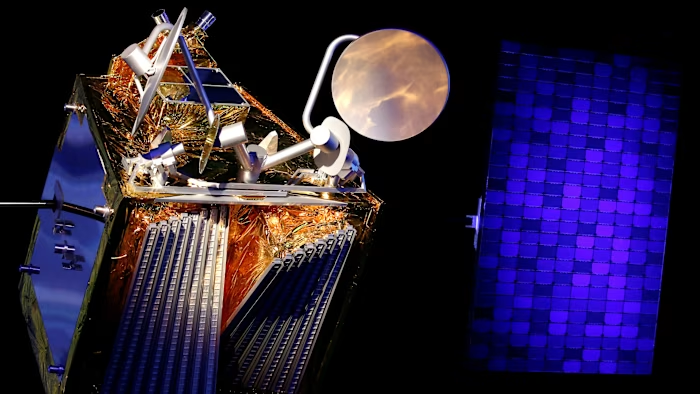
Airbus in 2024 took full control of its Airbus OneWeb Satellites (AOS) joint venture after acquiring the 50 per cent stake it did not already own. Established in 2016, the venture had built more than 600 satellites for OneWeb’s first-generation constellation, a low-orbit network that can provide space-based internet coverage, according to its website.
Airbus has been shifting satellite production back to Europe from the US for some time, including building 440 low Earth orbit satellites in its Toulouse facility, which it called a “further step for European sovereignty”. The orders have come from France’s Eutelsat, which acquired OneWeb of the UK out of bankruptcy in 2022.
While the company does not publish revenue figures for the US space business, two people familiar with the unit estimated that it had several hundred million dollars in sales. The space business employed more than 200 people at its Merritt Island facility on Florida’s Space Coast near the Kennedy Space Center and close to Jeff Bezos’s rocket business Blue Origin. That compares with about 11,000 employees worldwide supporting space activities at Airbus.
The potential sale of the US assets underscores Airbus’s efforts to turn around its struggling global space business, where it booked €989mn in charges in 2024. The company in October struck a deal with Leonardo of Italy and France’s Thales to combine activities spanning satellite manufacturing to space systems and services to better compete with Elon Musk’s SpaceX and Chinese rivals.
Codenamed Bromo, the three European parties aim to submit the plan to antitrust authorities in Brussels later this year with a view to making the new company operational in 2027. The firm has been reviewing its US space footprint for some time and the divestment plans are not related to Bromo’s talks with the European Commission around potential remedies to secure competition approval, some of the people said.
While the planned three-way combination has drawn criticism from other European players, including Germany’s OHB and Spain’s Indra Space, the three companies are betting on growing calls in Brussels for European champions.
The proposed tie-up comes as Europe’s space industry faces growing pressure from US and Chinese competitors. Brussels is putting greater focus on increased European sovereignty in the space sector, as the bloc’s members seek to end their dependence on the US by building satellite constellations for reconnaissance, intelligence and communications.
European satellite makers have struggled to adapt to the revolution in satellite demand, starkly demonstrated by Ukraine’s reliance on SpaceX’s Starlink in its war against Russia.
Airbus declined to comment on “market rumours or speculation”.
