


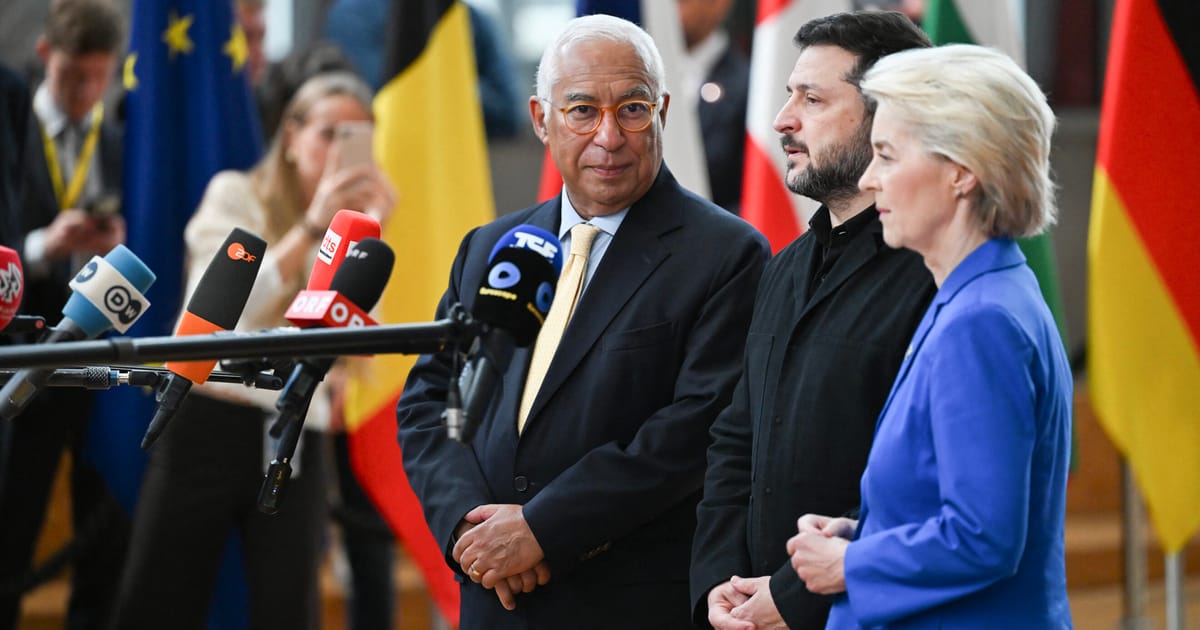
“I think [a decision] is possible by the end of the year,” Macron told journalists at the summit’s conclusion, adding that failure to strike a deal this year would not “be a good method from a democratic standpoint.”
Instead, leaders spent much of the two-day summit trying to gain a tactical upper hand over rivals on EU climate rules and migration policy.
Trench warfare
A push led Polish Prime Minister Donald Tusk to water down an emissions trading scheme known as ETS2 hijacked discussions for hours on Thursday. But despite wider support for Tusk’s position than at previous summits, it was easily defeated by countries that support the current scheme.
On migration, Denmark, Italy and Poland led a determined effort to harden the EU’s position, proposing tweaks to the summit’s conclusions that would have explicitly linked irregular migration to crime rates and branded the phenomenon a threat to the cohesion of European societies.
The proposal, which ultimately won support from a group of around 10 countries including Hungary, according to two EU diplomats, also indirectly took aim at Spain, where Prime Minister Pedro Sánchez’s decision to regularize some 1 million irregular migrants has sparked clashes with Italy’s Giorgia Meloni and Denmark’s Mette Frederiksen.
Ursula von der Leyen confirmed that the Commission would put forward an emergency response framework before the end of the year to allow EU countries to respond to a sudden mass movement, such as the one that caused chaos in the Spanish exclave of Ceuta over the summer.
