


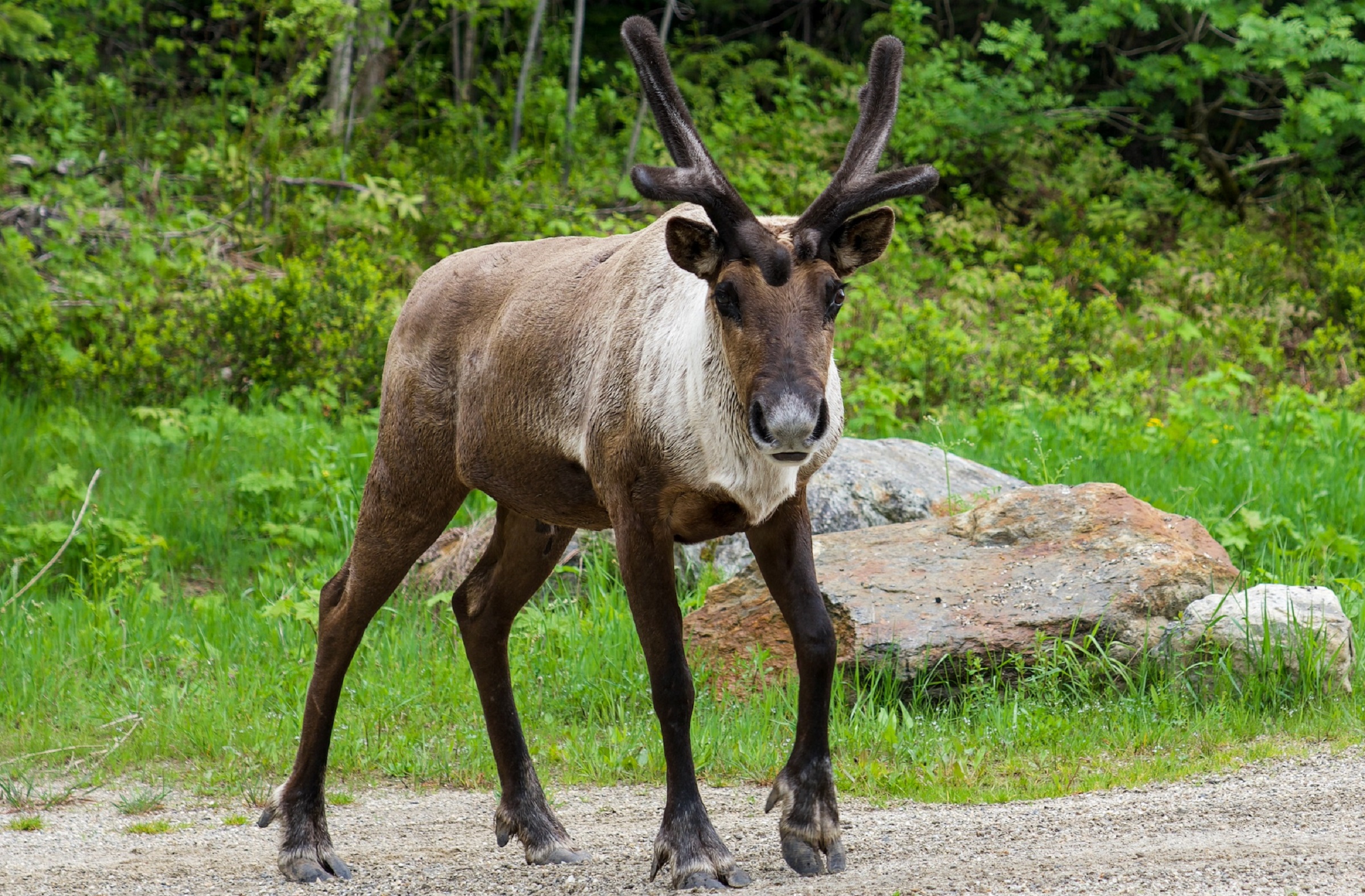
- Southern mountain caribou are a type of caribou found in mature forests of western Canada, where they subsist on lichen as a winter food.
- Habitat loss — primarily driven by logging — has transformed their mature forest habitat, upsetting the predator-prey balance and leading to caribou declines.
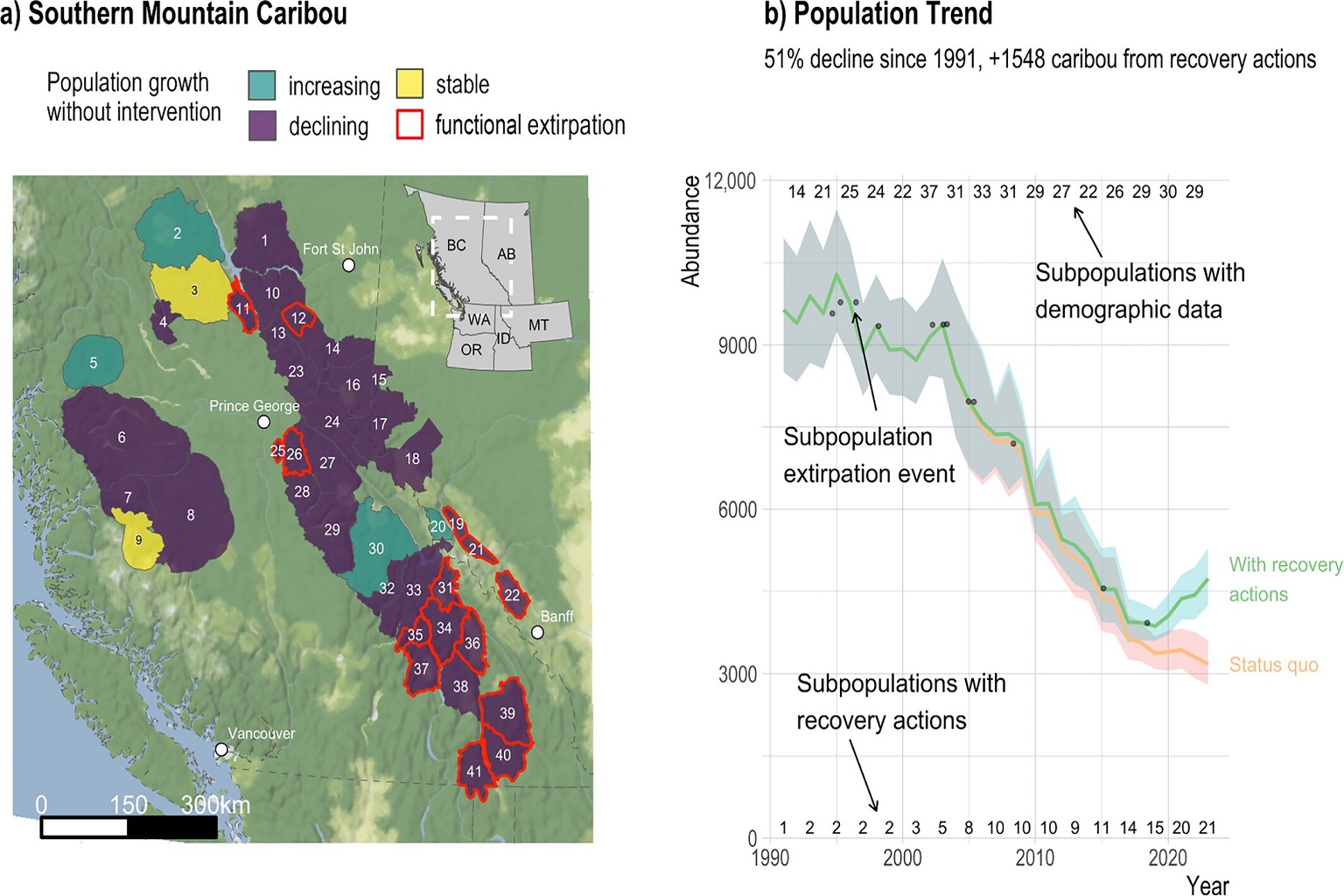
- In the past 20 years, 15 of 40 southern mountain caribou herds in British Columbia and Alberta have winked out, including a transboundary herd that once ranged into the U.S. states of Idaho and Washington.
- In June, the Syilx Okanagan Nation asked the Canadian government to issue an emergency order to protect caribou, with a spokesperson calling provincial efforts insufficient to stop logging of caribou habitat within Syilx Okanagan traditional territory; the Xatśūll First Nation joined the petition in July.
“Under our Syilx Okanagan law, everything is sacred to us. We believe that Mother Earth is alive, all of kʷuləncutn, the creator’s creation, that it’s all alive,” Chief Dan Wilson of the Okanagan Indian Band, a Syilx Okanagan Nation, told Mongabay in a phone call.
“That’s why the caribou are so important to us … they reflect on the job we’re doing for preserving kʷuləncutn as a creation for the next generation.”
Southern mountain caribou are a type of woodland caribou (Rangifer tarandus caribou) found in mountainous regions of Western Canada, and until recently, parts of the U.S. They live in mature forests, and depend on lichen as a winter food.
Three caribou herds — all imperiled — remain within Syilx-Okanagan territory in southern British Columbia. The Columbia North herd is the strongest with 185 individuals. The Central Selkirk herd has just 27 individuals, and the Frisby-Boulder herd, with eight individuals, is considered too small to remain viable.
A fourth herd, the Columbia South, was extirpated from Syilx-Okanagan territory in 2023.
The situation is mirrored across the southern mountain caribou’s range, where logging has chipped away at their mature forest habitat.
In the past 20 years, 15 out of 40 herds once found in British Columbia and Alberta have disappeared or are too small to stand a chance, with numbers falling from nearly 10,000 in 1991 to just over 4,700 in 2023. In British Columbia alone, 11 of the province’s 32 herds have either vanished completely or become so small that researchers consider them functionally extirpated. The last transboundary herd that ranged into the U.S., vanished in 2019.
Syilx Okanagan, Xatśūll call for emergency order
In June, the Syilx Okanagan Nation under Section 80 of Canada’s Species at Risk Act (SARA), petitioned the federal government for an emergency order to protect critical caribou habitat. In July, the Xatśūll First Nation joined the Syilx Okanagan in petitioning for a protection order.
An emergency order under Section 80 would allow the federal government to intervene in areas of provincial jurisdiction when a species faces imminent extinction. That includes placing restrictions on forestry, road-building and other industrial activities. The provision is seldom used, with only two emergency orders issued since SARA came into force in 2003.
The current filing claims that the government of B.C. has not fulfilled commitments to reverse caribou declines made in an agreement with the federal government under Section 11 of SARA. The 2011 agreement was in response to a previous Section 80 petition.
Wilson describes the province’s response to caribou declines as “piecemeal” and “ad-hoc,” with logging still eating away at caribou habitat. The Nation wants to see a “unified approach from all levels of government,” for caribou recovery, Wilson said.
“We’re trying to fulfill our responsibility … [by] protecting the last remaining herds of the deep snow caribou,” Wilson said.
Chief Rhonda Phillips of the Xatśūll Nation shared a similar sentiment in a media release: “Xatśūll will not stand idly by while selcwéycen [caribou] and their habitat continue to face serious threats.”
Logging at the heart of the declines
Southern mountain caribou are the most southerly caribou in the world. Most herds favor mid- to high-elevation mature forests, with some making seasonal migrations between summer and winter ranges, and up and down mountain slopes. Herds within the wet interior forests — including in Syilx-Okanagan territory — are known as “deep snow caribou” for their habit of balancing atop deep snowpacks to reach tree lichen, which adorn the branches of mature trees. In drier regions, the caribou crater through snow to feed on ground lichen.
Historically, few other ungulates survived in the mature forests favored by caribou, and consequently, predator numbers were low. But over the past 50 years, logging has transformed this landscape from old to young forests, with ample shrubs and grasses drawing moose and deer. Wolves and cougars soon follow, traveling quickly along logging roads and seismic lines, deep into caribou habitat. The influx of predators has proved too much for caribou, which end up as bycatch.
“It’s a slow, continuous [decline], over a very long period of time. That’s, in my opinion, more concerning than some crash that we might recover from,” said Douglas Heard, an adjunct professor at the University of Northern British Columbia and independent caribou biologist.

‘Hard to sugarcoat the reality’
To bring self-sustaining caribou herds back onto the landscape, two things need to happen, according to caribou expert Rob Serrouya, co-director of the nonprofit Wildlife Science Centre: Long-term habitat protection, and, in the interim, management of the predator-prey system to avert imminent extinction. Neither is a quick fix or easy solution.
“It’s hard to sugarcoat the reality,” Serrouya said.
In 2014, the federal government published a southern mountain caribou recovery strategy, which included partial mapping of critical habitat.
Over the next five years, 909 square kilometers (351 square miles) of that critical habitat was logged, according to a 2020 study.
In 2020, the B.C. government released the much-heralded Old Growth Strategic Review recommending a “paradigm shift” in forestry, with consideration of ecological value alongside timber value. The province’s Old Growth Technical Advisory Panel (TAP) was subsequently charged with identifying priority areas of old growth forests for logging deferrals, including mature forests within caribou range.
But a combination of policy failures has led to “unfulfilled promises,” said Karen Price, an independent ecologist and member of the Old Growth TAP.
A 2025 report, on which Price was co-author, found logging was four times more likely inside at-risk old growth forests recommended for deferral, than in other old growth forests.
“Continued harvest of big treed old growth is a little disturbing when the government committed to a paradigm shift to put ecosystem health and communities first,” Price said.
These at-risk forests include caribou habitat. A June 2026 study found the pace of logging within southern mountain caribou critical habitat has remained unchanged over the past decade, with an additional 954 km2 (368 m2) logged since 2020.
While there has been some progress on habitat protection — for example, the substantial expansion of the Klinse-Za/Twin Sisters Park in 2024 — logging is still happening within core caribou habitat, Serrouya said.
A spokesperson for the Ministry of Forests said that a suite of professionals, including biologists, advise on forestry and road permits. “That advice supports beneficial management practices and mitigation strategies to manage impacts on caribou and many other forest values,” they said in an emailed response to questions submitted by Mongabay.
“What we’re hearing a lot about now is if we just log a bit differently, or, you know, do smart partial cuts or commercial thinning, it will help things, but there’s no evidence of that,” Serrouya said. “It really is just about the gross amount of alteration that’s going on out there and whether or not the rate of habitat gain is exceeding the rate of habitat loss. And in most herds, it’s not.”
![Old growth western red cedar in BC’s inland temperate rainforests, within the Columbia North caribou herd’s range. “These are trees that can be up to three to four meters [9.8 to 13.1 feet] in diameter and they can be up to 1,600 [to] 1800 years old ... This is the inland temperate rainforest, where researchers and lichenologists are still finding new-to-science species,” says Eddie Petryshen from Wildsight.](https://imgs.mongabay.com/wp-content/uploads/sites/20/2026/08/28230742/2-old-growth-cedar.jpg)
Killing wolves to save caribou
To avert the imminent disappearance of caribou herds, the B.C. government has, since 2014, opted for predator control.
Wolves are shot from a helicopter, with the aim to kill entire packs and eliminate up to 90% of wolves in caribou range. Cougars are targeted with hounds. In the winter of 2024-2025, predator control was applied in the range of 13 herds; 351 wolves and six cougars were killed, and 15 wolves captured and relocated, at a cost of over $1.5 million CAD (approximately $1.04 million USD).
In some herds, predator control has been paired with maternal penning, where pregnant females are corralled in predator-proof enclosures to give birth and raise young for a number of months. The longest running of these is for the Klinse-za herd, where the combination of recovery actions has seen caribou numbers rise from 38 to 187 over 12 years.
Researchers and managers have also tried supplemental feeding, and increasing moose harvest, alongside predator control.
The combination of recovery actions is buying caribou time, and reversing the downward population trajectory, according to a 2024 study, on which Serrouya and Heard were co-authors. Predator control was the most effective action, and the only one that worked in isolation, the study found.
The predator control plan is now up for extension, and is not without opposition.
Serrouya said the science is clear. “It’s now mostly an ethical question,” Serrouya said. “How long does society and managers want to intensively manage the predator-prey system versus protecting habitat? That’s the trade off.”
For self-sustaining caribou herds, predator control must be paired with long-term habitat protection and a reduction in logging, researchers stress. The first signs of habitat recovery would be older forests less favorable to moose and deer, and by extension, wolves. That could take 35 to 60 years, depending on forest type, Serrouya said. Eventually, mature trees and abundant lichen would provide food for caribou.
Caribou recovery is “entirely doable,” at least at high elevation ranges, Heard said, even in the most southern portions of their range. But, while acknowledging there has been some progress on caribou recovery, he said real earnest action hasn’t yet begun.
“We’re not changing the logging practices that will let the forest go to a more natural age distribution,” he said.

Uneven protection in Syilx Okanagan territory, expert says
Wilson explains that SARA affords caribou protection on federal land, including Reserves under the Indian Act — but provincial action hasn’t kept pace.
“[Caribou] inhabit all of our traditional territory, … the uneven approach to protection of their habitat, it just adds to their further decline,” Wilson said.
A spokesperson for the B.C. Ministry of Water, Land and Resource Stewardship described caribou recovery as a “long term complex effort,” with the province “taking a comprehensive, coordinated approach to caribou recovery rather than a piecemeal one,” in an emailed response to Mongabay questions.
“All three herds referred to in the Syilx filing currently benefit from caribou-specific habitat protections and additional habitat designations protecting significant portions of core habitat. Continued efforts are underway to increase protection levels where needed,” the email notes.
Yet, logging is an ever-present threat, said Eddie Petryshen, conservation specialist with Wildsight, a B.C.-based nonprofit, with an increasingly desperate industry pushing into remote valleys and felling the rare inland temperate rainforest on which deep snow caribou depend.
“It’s pretty heartbreaking,” Petryshen said. “You’re seeing these ecosystems that have been there for a very long time, go in a month or two, … leaving on the back of [logging] trucks.”
A 2025 analysis by Wildsight and partner organizations has documented ongoing logging within southern mountain caribou habitat, including that of the Columbia North herd, one of the three remaining in Syilx Okanagan territory. It found that 76% of their habitat is at risk of logging.
Every cutblock means “locking in” years or even decades of predator control, Petryshen said.
“And I don’t think that’s a palatable solution or trade-off for people,” he said.

Banner image: A southern mountain caribou (Rangifer tarandus caribou) from the Columbia North herd. The herd is one of three remaining within the Syilx Okanagan Nation territory, and, with an estimated population of 185, the one considered most viable. Image by Eddie Petryshen.
Citations:
Lamb, C. T., Williams, S., Boutin, S., Bridger, M., Cichowski, D., Cornhill, K., … Serrouya, R. (2024). Effectiveness of population‐based recovery actions for threatened southern mountain caribou. Ecological Applications, 34(4). doi:10.1002/eap.2965
Palm, E. C., Fluker, S., Nesbitt, H. K., Jacob, A. L., … Hebblewhite, M. (2020). The long road to protecting critical habitat for species at risk: The case of southern mountain Woodland caribou. Conservation Science and Practice, 2(7). doi:10.1111/csp2.219
Palm, E. C., Fluker, S., Nesbitt, H. K., Jacob, A. L., Burkhart, T., … Hebblewhite, M. (2026). Incomplete protection of critical habitat still plagues southern mountain caribou in British Columbia, Canada. Conservation Science and Practice, 8(7). doi:10.1111/csp2.70344
FEEDBACK:Use this form to send a message to the editor of this post. If you want to post a public comment, you can do that at the bottom of the page.
Cite this article
Ruth Kamnitzer (2026). First Nations in Canada call for emergency order to protect southern mountain caribou. Mongabay Conservation news. DOI: https://doi.org/10.66709/news-327848

