


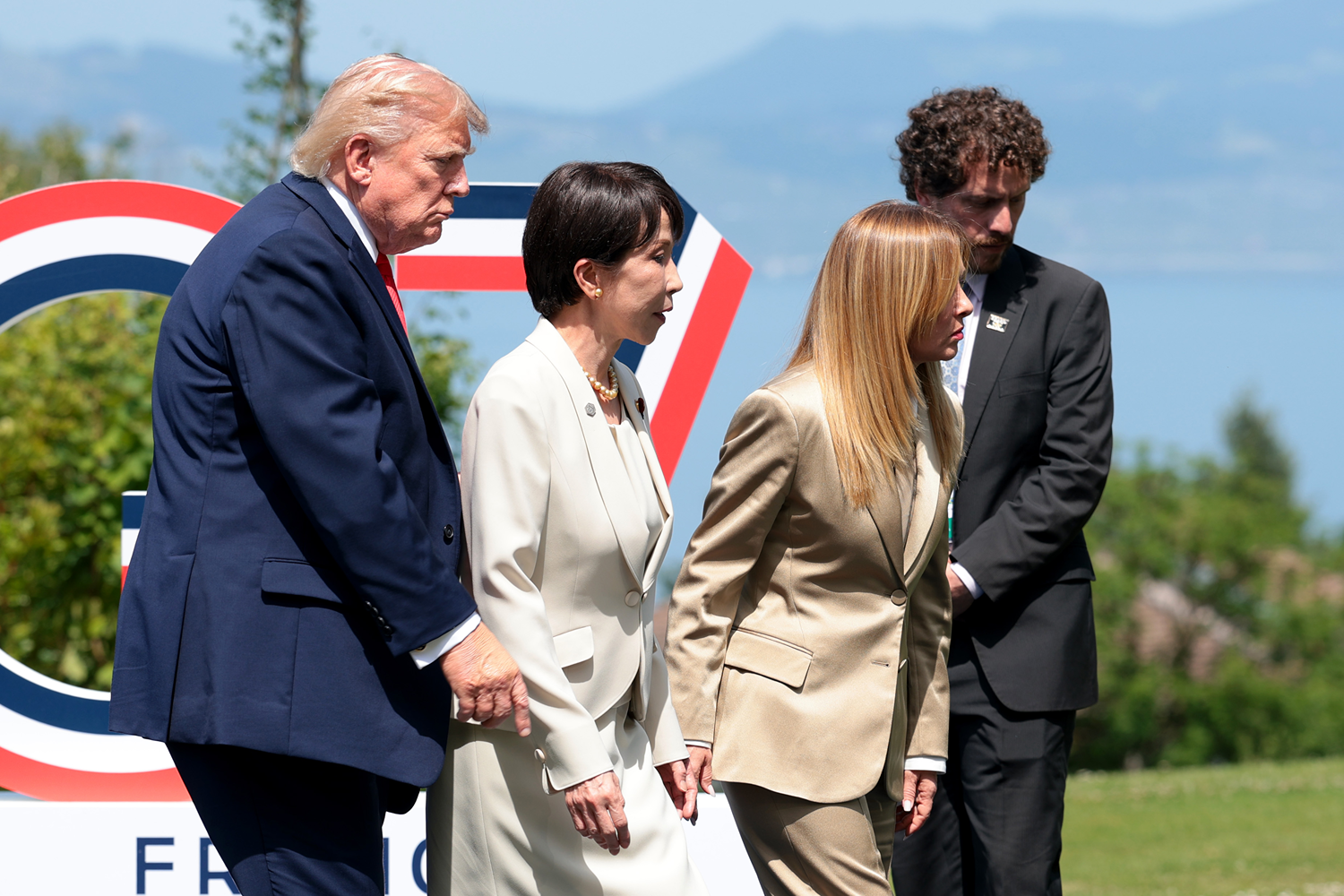
There is probably no better ally to the United States than Japan. However, the relationship between the two countries today seems particularly one-sided as the ever-changing policies of the Trump administration hit Japan, both intentionally and otherwise. The uncomfortable reality for Tokyo is that there is very little that can be done about it.
Nurturing the relationship with the United States has been a paramount issue for every Japanese prime minister since the end of World War II. The level of success was often a factor in how leaders fared domestically. Yasuhiro Nakasone buddied up to Ronald Reagan at a time when Japanese exports were flooding into the United States. Junichiro Koizumi was close to George W. Bush. Shinzo Abe was famous in Japan for his ability to soft-soap Donald Trump during his first term. But no Japanese leader has faced more hurdles than the current incumbent, Prime Minister Sanae Takaichi, herself an Abe protégé.
There is probably no better ally to the United States than Japan. However, the relationship between the two countries today seems particularly one-sided as the ever-changing policies of the Trump administration hit Japan, both intentionally and otherwise. The uncomfortable reality for Tokyo is that there is very little that can be done about it.
Nurturing the relationship with the United States has been a paramount issue for every Japanese prime minister since the end of World War II. The level of success was often a factor in how leaders fared domestically. Yasuhiro Nakasone buddied up to Ronald Reagan at a time when Japanese exports were flooding into the United States. Junichiro Koizumi was close to George W. Bush. Shinzo Abe was famous in Japan for his ability to soft-soap Donald Trump during his first term. But no Japanese leader has faced more hurdles than the current incumbent, Prime Minister Sanae Takaichi, herself an Abe protégé.
Takaichi seems to have done well personally with Trump. Their first meeting last October was heavy on public relations, and their second meeting in March was seen by Japan as a success. But this masks more fundamental issues about what Japan wants and requires from its patron. The risks are multifaceted.
The Trump administration has painted Japan as an economic villain, mostly because of its large trade surplus. Trump’s ideas sometimes seem stuck in the 1980s, when Japan was painted as a potential threat to the United States. Last year was dominated by various tariff threats from the administration, aimed mainly at auto exports.
To protect the important U.S. market for Japanese carmakers, Tokyo had to agree to an extraordinary $550 billion investment program, in which Trump calls the shots and the United States—or possibly the White House itself, since the finances are unclear—keeps most of the profits. While the deal is viewed as incredibly one-sided, Japan has said that it will stick to it—even though the threatened tariffs were overturned by the U.S. Supreme Court.
Some analysts do see positives to the deal, saying the pact is an opportunity for Japan to buy into the U.S. economy at the expense of other foreign rivals, especially China. The first round of investments totaled $36 billion, and another $73 billion is pending for the second round. With the early deals representing low-hanging fruit, it is unlikely that it would even be possible to meet the $550 billion figure by November 2028—a deadline that is no doubt in Tokyo’s mind.
Willingness to go along with Trumpian demands also doesn’t seem to have given Japan any credit in Washington. Earlier in August, the United States cited Japan as one of the countries involved in China’s “great transshipment scam” to sneak goods into the country. The report from Peter Navarro’s Office of Trade and Manufacturing Policy didn’t offer any evidence for its findings and instead rested on trading patterns (trade from China is down while other countries are up). The report also offered no explanation for how Japan is linked to this, since Japanese exports to the United States have been roughly stable since the start of the second Trump administration.
Takaichi has also absorbed the blowback from Trump’s Iran adventure. While global oil prices have risen more modestly than many had expected, the impact on Japan has been quite large, given that Japan historically imports 94 percent of its oil from the Middle East. While consumers have been shielded through costly government subsidies, wholesale-level inflation is currently at 7.2 percent, costs that will eventually filter into retail prices. Takaichi’s solution has been to announce plans to provide even more subsidies by slashing the national consumption tax on food from 8 percent to 1 percent, putting a dent in an already shaky fiscal outlook.
U.S. officials have talked about support for Japan, such as the coordinated intervention in the foreign exchange market on July 30 to 31 to help bolster the value of a declining Japanese yen. “We’re always there for Japan. Japan’s been very good to us, with the exception, of course, of Pearl Harbor,” Trump told reporters earlier in August. The reality is that the move, orchestrated by U.S. Treasury Secretary Scott Bessent, was more about stopping Japan from using some of its massive investments in U.S. Treasury securities, where it is the largest foreign holder. With the market already wobbly, the last thing that Bessent needs is for Japan to start selling.
It’s not just economic policy, of course. Tokyo has had to dance around the Trump administration’s drive to shut down the International Criminal Court, an institution long supported by Japan both politically and financially. The latest Trump administration actions have specifically sanctioned court’s president, Tomoko Akane, who is a Japanese national—a rather embarrassing situation since she now faces travel restrictions and cannot have an account at any bank that does business with a U.S. counterpart.
Picking up the Trump cudgel, U.S. Secretary of State Marco Rubio spoke in apocalyptic terms: “Today, it threatens every aspect of our political and legal system,” he said in July. “If they believe they can deprive us of our sovereignty, we will teach them the full meaning of American resolve.” The Japanese government seemed at a loss over how to deal with this. Takaichi called it “unfortunate” and declined to directly criticize the Trump administration.
Another worry is over how Trump views North Korea, long identified by Japan as one of its greatest security threats and, according to Japan’s 2026 Defense White Paper, poses “an even more grave and imminent threat to Japan’s national security than ever before.” Over the years, Japanese governments have pushed for sanctions against Pyongyang, actions that threaten to go up in smoke if Trump, who recently praised North Korean leader Kim Jong Un and attacked Seoul, reaches some kind of deal that would likely protect the United States while leaving Japan and South Korea on their own.
But the biggest worry is over China, especially in relation to Taiwan. Although Trump remains vague on how he views Taiwan, grumbling about how Taiwan Semiconductor Manufacturing Company has supplanted U.S. chipmakers, Japan sees a potential Chinese invasion of an island just 100 miles from its own territory—one with long-standing ties to Japan—as an existential threat to its security. Trump has swung wildly in his rhetoric around China, but he has also repeatedly praised Chinese President Xi Jinping, seemingly in the hope of some grand deal.
The concern is that China would not stop there but make good in its claim that the entire South China Sea is its territorial waters. The fact that there is little legitimate backing to this claim is not important in a world of doing whatever you can get away with. Chinese media has been promoting the idea that Okinawa, home to more than 50,000 U.S. military and civilian personnel, is not really a part of Japan because it was an independent kingdom until 1879.
Takaichi has ratcheted up the hard-line policies against China that took shape under Abe from 2012-2020, drawing considerable fire from Xi. She has further strengthened defense and diplomatic ties with other “like-minded” nations such as the Philippines and Australia, and she has tried to mend relations with South Korea. “I’ve been impressed with how quickly they have come along in the past few years. They have a lot more domestic license in Japan to do these types of things,” said Corey Wallace, an associate professor at Kanagawa University who specializes in Asian security issues. “But these relationships are not a replacement for U.S.-Japan ties and probably never will.”
But the need for diversification is now increasingly clear. The last U.S. aircraft carrier in Asia, the USS George Washington, left its home port near Tokyo for the Middle East earlier in August as a stopgap replacement for the USS Abraham Lincoln, after the latter’s extended deployment led to concerns over the crew’s well-being. The removal means that Asia now has no aircraft carriers instead of the usual two.
Given this new environment, analysts have said that Japan must do more on its own. “Previous planning was based on the overwhelming U.S. military advantage, but the expansion of China has meant that U.S. forward deployment and force projection face greater risk while Japan cannot achieve superiority on its own,” Ken Jimbo, co-founder of the Research Institute for Advanced Innovation and GeoStrategy, a think tank that works to promote greater Japanese defense readiness, said at the Foreign Correspondents’ Club of Japan.
Japan is also bracing for more trouble ahead as a beleaguered Trump, weighed down by failure in Iran and plummeting poll numbers, looks for some victories ahead of the United States’ upcoming midterm elections. With a Takaichi-Trump meeting likely to occur in September, Trump is expected to push on two fronts: Japan’s overall defense budget, which is still below 2 percent of annual GDP and far from the 3.5 percent that Washington wants, and the amount that Japan pays to have U.S. forces in the country, which is now around $1.25 billion per year. During the first Trump administration, the U.S. president was pushing for the payments to quadruple. The current deal runs out in March 2027, and Tokyo is not looking forward to new negotiations.
While Takaichi has shown a willingness to increase defense outlays, she is also coming up against the realities of fiscal health. Her tax cuts to offset higher inflation are already putting pressure on Japan’s bond market, with yields at their highest levels in 30 years.
Takaichi’s only course of action will be to lean, as her predecessors did, on the personal relationship. “We have to impress upon the United States how much we can be an important and significant ally,” Jimbo said. Amid all the demands of “America First,” “this is a very difficult time to manage the alliance,” he said.
