


- In the past decade, palm oil-producing countries, such as Indonesia, have introduced policies and company-level commitments to curb deforestation.
- In both concessions linked to companies with zero-deforestation commitments (ZDCs) and those not linked to ZDCs, data suggests annualized deforestation has dropped dramatically from the 2000s.
- Despite this drop, a new study suggests ZDCs have not, in fact, led to additional reductions in deforestation.
- A decline in palm oil prices and historic deforestation in concessions may have contributed to this contrasting picture, say researchers.
JAKARTA — A new study of palm oil concessions linked to Indonesian supply chains finds no evidence that corporate zero-deforestation commitments have led to additional reductions in deforestation.
Tropical countries such as Indonesia continue to lose their forests at an alarming pace. In 2025, the world lost 4.3 million hectares of tropical primary forest, equivalent to more than 11 football fields of forest a minute .
To curb this trend, palm oil-producing countries have introduced national policies in the past decade, while companies have increasingly adopted zero-deforestation commitments (ZDCs).
When viewed through a before-and-after lens, Indonesian palm oil ZDCs appear highly successful at reducing deforestation.
To determine how effective these commitments actually are, an international team of researchers compared deforestation trends in Indonesia’s palm oil sector — the world’s largest producer and exporter of the commodity — between concessions linked to supply chains with ZDCs and those without them.
Using public databases to identify companies that have adopted ZDCs, the study, published in the Proceedings of the National Academy of Sciences (PNAS), found that companies had largely complied with their commitments.
However, it found no evidence that those commitments produced an additional reduction in deforestation in Indonesian palm-oil concessions beyond broader changes affecting the sector.
In both ZDC-linked and non-ZDC concessions, the study says, .
During the full implementation period for ZDCs from 2018 to 2020, annualized deforestation fell to around 0.5% in both groups. In the researchers’ preferred, the decline was 6.5 percentage points in ZDC-linked concessions and 6.63 percentage points in non-ZDC concessions, resulting in an estimated additional reduction of just 0.12 percentage points. With a standard error of 0.67 percentage points, the difference was statistically indistinguishable from zero.
This suggests that the commitments had little additional effect on deforestation, the researchers say.
“This implies that these companies aren’t unique,” says Robert Heilmayr, . “Deforestation has dropped dramatically across both companies with and without ZDCs.”
While the commitments may help protect forests from future pressures, Heilmayr adds, “they do not explain the recent decline in deforestation in Indonesia.”

‘Old frontiers’ and a history of deforestation
One possible explanation is that most of the forest had already been cleared in the concessions studied by the researchers.
Most concessions in the sample were already “old frontiers”, meaning they had previously experienced significant deforestation. By 2012, the average ZDC-linked concession had lost about half of the forest it had in 2000, leaving forest covering just 11% of its total area, according to the study.
In other words, there was relatively little forest left for ZDCs to protect within many of these already-allocated concessions.
Non-ZDC concessions have followed almost exactly the same trajectory, losing 54% of their forest since 2000 and retaining about 10% in 2012.
Taken together, the researchers say, these similar patterns could help explain both the high compliance with ZDCs and the lack of additional benefit: There was relatively little forest left to clear in many ZDC concessions, while non-ZDC concessions had similarly little forest remaining.
Lower palm oil prices
Another possible explanation is the decline in palm oil prices, the researchers note.
During the 2018–2020 period, crude palm oil (CPO) prices were significantly lower than during 2001–2012. This reduced the likelihood that new palm-oil investments would generate positive returns and, therefore, lessened companies’ incentives to clear remaining forested land within concessions.
A 2022 study published in PLOS One found that a 1% decline in palm-oil prices was associated with a 1.08% decline in new industrial plantations and a 0.68% decline in forest loss.

The impact of moratoria
The researchers also argued that government policies might have simultaneously constrained palm oil expansion into forests.
In 2011, Indonesia instituted a moratorium on the allocation of new forestry, agriculture and mining concessions, including palm oil concessions, in primary forests and peatlands.
This was followed by a nationwide ban on clearing carbon-rich deep peatlands in 2016 and a 2018–2021 moratorium on new palm oil plantation permits.
These policies potentially reduced companies’ ability to establish and exploit new concessions, especially in areas with high forest cover, affecting both ZDC and non-ZDC concessions, the researchers noted.
However, there are some caveats to this argument, they added.
The researchers acknowledged that the moratoria had been criticized for loopholes, a lack of transparency, inadequate monitoring and weak enforcement. They also cited research questioning whether the forest moratorium significantly reduced forest and peatland loss relative to control areas.

Positive spillovers
To measure the effect of ZDCs, the researchers compared two groups of oil-palm concessions. The “treated” group consisted of concessions linked to companies with zero-deforestation commitments, while the “control” group consisted of concessions not linked to such companies. The researchers used the latter as a comparison to estimate what might have happened to deforestation without ZDCs.
But companies in the control group may also have been influenced by the commitments. For example, growers not formally connected to a ZDC company might still avoid clearing forest if they believe doing so would cause them to lose access to major buyers.
NGO monitoring and collective initiatives such as the Consumer Goods Forum could also influence companies that are not directly linked to ZDCs.
This is what researchers mean by a “positive spillover”: an effect of ZDCs that reaches beyond the companies directly covered by the commitments. If companies in the control group also reduce deforestation because of these broader pressures, their performance becomes more similar to that of the ZDC-linked group. That would make it harder for the researchers to detect an additional effect from the commitments and could make ZDCs appear less effective than they actually are.
There is another limitation that could also have caused the study to underestimate the effect of ZDCs: The researchers could observe supply-chain relationships only during 2018–2020. That means some concessions classified as controls during that period may previously have been linked to companies with ZDCs during the earlier period when the commitments were being introduced. Because sourcing relationships can frequently change, the researchers say this could have resulted in some previously treated concessions being counted as controls.

ZDCs may matter more in the future
While the researchers found that ZDCs did not contribute to an additional reduction in deforestation during the period studied, they pointed out that this does not mean such commitments are necessarily ineffective.
The researchers tested the commitments during a period when deforestation pressure was already relatively low, with much of the forest in the concessions already cleared and economic and regulatory incentives for further clearing weakened.
Therefore, ZDCs might become more important during a future surge in deforestation triggered by factors such as higher international CPO prices, changes in conservation policies or policies that create new domestic demand, including biofuel mandates.
“We hypothesize that the additionality of ZDCs might become more significant during deforestation peaks than during the relatively calm period observed here,” the researchers write.
“It is in times of crisis, when pressure on forests increases, that ZDC commitments could play a truly additional protective role,” says Matthieu Stigler at the University of Geneva (UNIGE), who led the study.
That possibility is particularly relevant as Indonesia expands its use of palm oil for biodiesel.
Indonesia’s mandatory B50 biodiesel program, which requires a 50% biodiesel blend, began on July 1 with a formal government launch on July 9.
Government estimates have previously put the additional land required for B50 at around 2.3 million hectares (5.7 million acres), based on an estimated need for 19.73 million kiloliters (5.2 billion gallons) of palm-based FAME, a type of renewable biodiesel.
Environmental groups have offered higher estimates. Campaign group Satya Bumi estimates that meeting palm-oil demand under an aggressive expansion scenario could require 5.36 million hectares (13.2 million acres) of additional plantations by 2039, with potential deforestation reaching 1.5 million hectares (3.7 million acres).
If biodiesel demand creates new incentives to clear forests, the researchers’ hypothesis could face a real-world test: Whether companies with zero-deforestation commitments actually prevent deforestation when the economic pressure to clear returns.
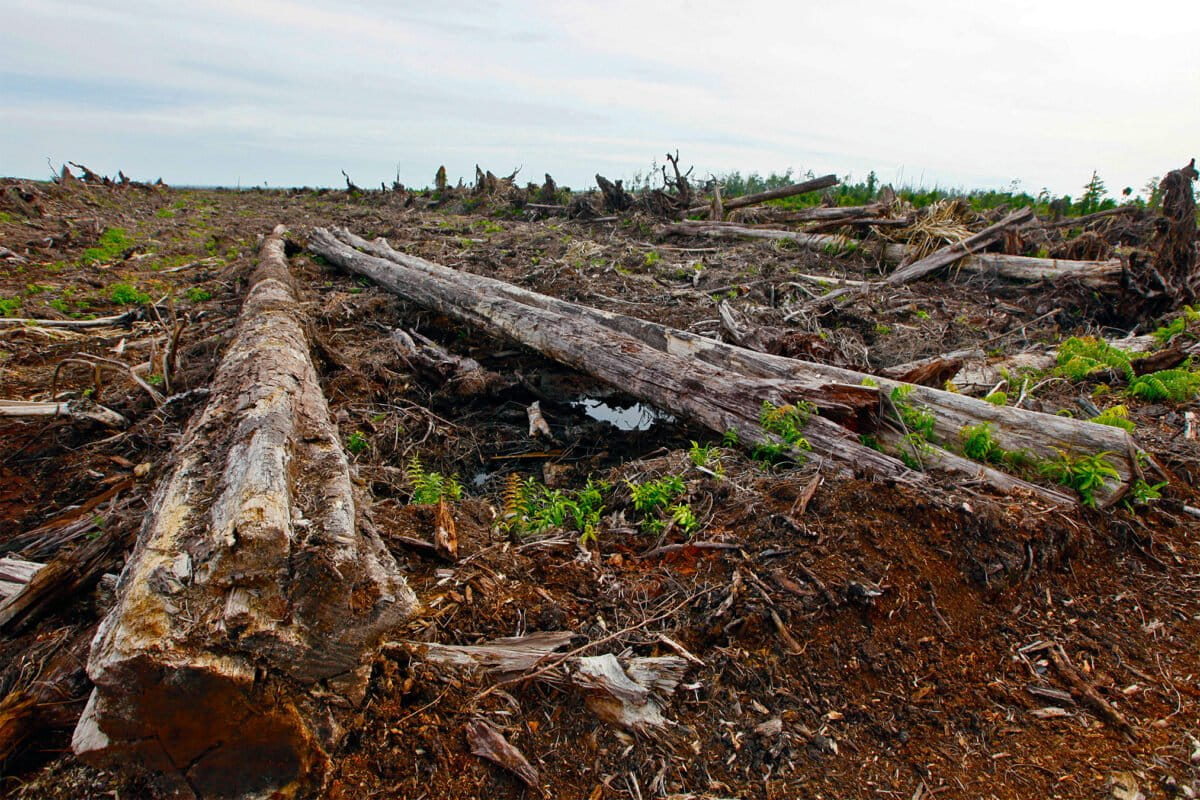
Banner image: Cleared land at an industrial oil palm plantation at Tripa peat swamp in Aceh province. Image by Dita Alangkara/CIFOR via Flickr (CC BY-NC-ND 2.0).
Major orangutan study finds Sumatran population fell nearly 20% despite slower forest loss
Loopholes undermine palm oil industry’s antideforestation pledges
Indonesia says 4 million hectares of plantation, mining lands reclaimed in crackdown
Citations:
Stigler, M., Grabs, J., Heilmayr, R., Carlson, K. M., Chandra, A., Benedict, J. J., & Garrett, R. D. (2026). Zero-deforestation commitments in Indonesia’s palm oil sector achieve high compliance but no additionality. Proceedings of the National Academy of Sciences, 123(29). doi:10.1073/pnas.2511503123
Gaveau, D. L., Locatelli, B., Salim, M. A., Husnayaen, Manurung, T., Descals, A., … Sheil, D. (2022). Slowing deforestation in Indonesia follows declining oil palm expansion and lower oil prices. PLOS ONE, 17(3), e0266178. doi:10.1371/journal.pone.0266178

