


- Currently, Bangladesh has 35 certified green buildings and sustainable offices in various non-manufacturing sectors, and the concept is gaining more ground.
- The country is encouraging LEED (Leadership in Energy and Environmental Design)-certification for industries, and holds 53 of the world’s top 100 highest-scoring green factories.
- Key drivers behind green construction include lowering carbon emissions and ensuring sustainable development, besides the wellbeing of industry employees and connected workers.
- Mongabay spoke with a few major corporate companies, builders and experts about the adoption of green building initiatives in Bangladesh to understand where industries in the country stand in support of this approach.
The concept of green building in Bangladesh started solely for its vast apparel industry. Now, the country’s corporates and realtors, too, are constructing green certified buildings, also known as eco-friendly buildings.
The vision behind green building is to reduce environmental impacts and to also ensure a healthy workplace for employees.
It has become a part of corporate branding and responsibility towards sustainability to demonstrate and function as carers of the environment, preserving for the next generation a healthy living.
In Bangladesh
According to the United States Green Building Council (USGBC), there are 35 certified buildings and corporate offices in Bangladesh representing various sectors like financial institutions, corporate offices and hospitals.
Besides these, the country also has many green factories, mostly in the ready-made garments (RMG) sector.
According to Bangladesh Garment Manufacturers and Exporters Association (BGMEA), Bangladesh houses 290 LEED (Leadership in Energy and Environmental Design)-certified RMG factories — including 125 platinum-rated, 145 gold-rated and 16 silver-rated.
The country also holds 53 of the world’s top 100 highest-scoring LEED-certified factories.
“Green-certified buildings in Bangladesh are typically associated with manufacturing and garments. Breaking this convention, Unilever Bangladesh [UBL] built its corporate building to demonstrate sustainability in corporate office environments as well, earning LEED-gold certification from USGBC in 2023,” said Syeda Durdana Kabir, human resources director of UBL.
She said UBL’s initiative was driven by a clear vision: to integrate sustainability into daily operations rather than treat it as a one-time achievement. The corporate office was designed to minimize resource consumption while promoting responsible behavior among employees.
Drivers behind the green adoption
With temperatures rising, employees find it difficult to work amid heatwaves.
Bangladesh is among the countries most exposed to rising temperatures. According to a 2025 World Bank report, Bangladesh’s maximum temperature has increased by about 1.1° Celsius (about 2° Fahrenheit) since 1980, while the country’s “feels-like” temperature has risen by 4.5°C (8°F), significantly increasing heat stress on people and communities.
The report found that in 2024 alone, heat-related physical and mental health impacts contributed to an estimated loss of 250 million workdays, costing the economy as much as $1.78 billion, equivalent to about 0.4% of the country’s GDP then.
Given these situations due to new temperatures, corporations are gradually moving towards building infrastructure to maintain workers’ productivity and ensure healthy workplaces.
Rahi Aftab, assistant general manager and head of marketing at the real estate developer Shanta Holdings Limited, said about their clients that brands and their policies are increasingly focusing on sustainability and that big corporations don’t want to ignore the demands of time — they’d rather focus going hand-in-hand towards future directions.
“Our vision behind constructing green buildings was driven by two key factors — the brand’s commitment and attitude towards sustainability. From the very beginning, our goal has been to set standards in construction by caring for the environment,” he said.
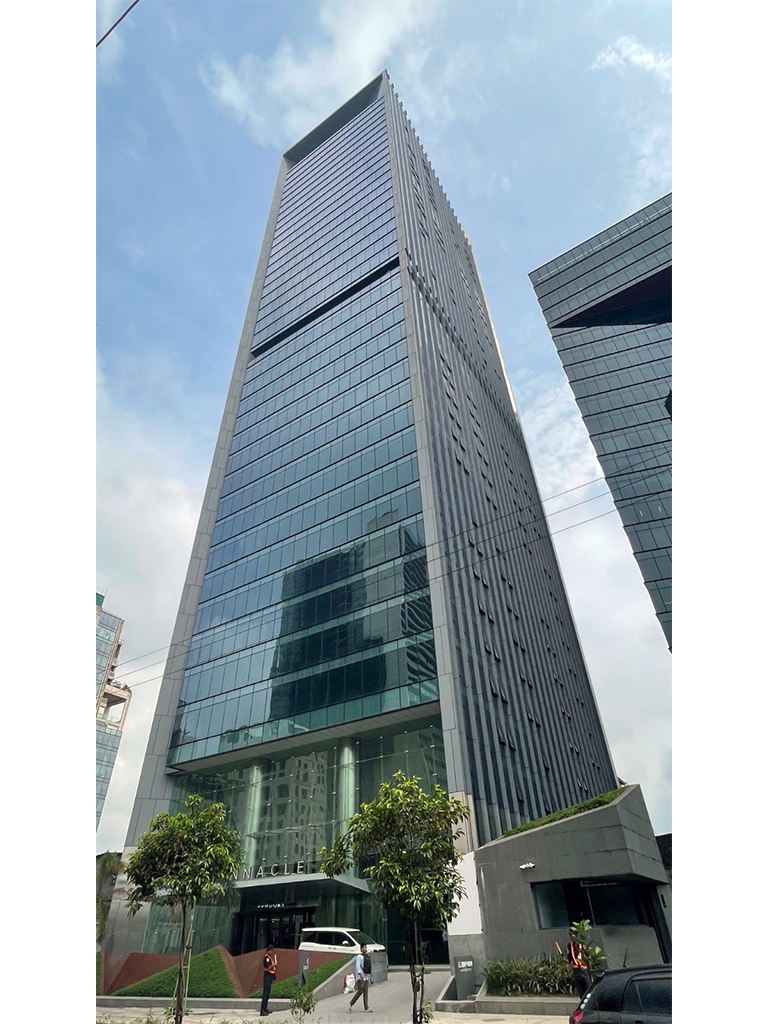
He said Shanta Holdings built Shanta Pinnacle, the country’s first 40-story LEED-platinum certified commercial skyscraper.
“So, keeping the sustainable urbanization and aligning development with the environment in mind, Shanta Holdings has moved towards eco-friendly building construction,” Rahi said.
He said factories should not only focus on urbanization or industrialization but also on preserving the environment for the next generation. “It’s crucial.”
Sources Mongabay spoke to said that during construction, trees are inevitably cut down, plus construction works cause pollution and consumption of energy, emitting carbon. An eco-friendly building compensates for a healthy environment to at least some extent as it consumes less energy and incorporates water recycling and installation of energy efficient technologies.
A few corporations said that green buildings are a social responsibility.
“Our motive is not just a green certification. You can term it as a social responsibility and our attitude towards the environment,” said S.N.R. Tawfiq, director of InnStar Limited, another high-end real estate and construction company that has developed several certified ecofriendly buildings.
“If we can’t do tiny tasks through our business that will bring benefits to the environment and lead paths towards carbon footprint reduction, it’s a failure. It is our duty to limit carbon emission and reduce natural resources,” Tawfiq said.
Tanjil Chowdhury, director of the oil and petroleum company MJL Bangladesh PLC, also known as Mobil Bangladesh, said, “When we conceptualized Mobil House, our vision extended far beyond constructing a corporate headquarters. We wanted to create a workplace that reflects our commitment to sustainability, operational excellence, employee well-being, and responsible corporate citizenship.”
Mobil House achieved a LEED platinum certification in October 2019.
“One of the most important outcomes has been the creation of a healthier and more productive workplace. We believe that corporate offices should also play a leadership role in reducing environmental impact,” Tanjil said.
Cost and return of investment
Compared to traditional buildings, construction of certified green buildings costs 10-20% more. This is due to the extra expenses required to install newer technologies to environmental impacts.
“It costs about 20% more than traditional construction. Maintaining a balance between sustainability and commercial viability is crucial,” Tawfiq said.
Costs include local and foreign consultancy fees, documentation, compliance issues and extra capital for sourcing new technologies required to construct a LEED building.
Mongabay’s real estate sources said there is a mismatch between costs and payments in the case of commercial buildings. Buyers do not pay more but they prefer green establishments as they consume less energy and pay off in the long term.
“It’s not the price — what we get is preference. When clients select a space to rent or buy, they prefer an environmentally friendly building than a traditional one,” Tawfiq said.
How green building reduces emissions
Green building involves high efficiency heating, ventilation and air conditioning (HVAC) systems, high-performance double-glazed facades, occupancy and daylight sensors, intelligent lighting controls, and water-efficient fixtures are used. They are also equipped to harvest rainwater and recycle water, as well as have rooftop solar panels installed. Smart elevators and lift management systems are also in place, which are run on the basis of needs and consume less electricity.
This way, green building reduces energy usage, water consumption and carbon emission through a combination of efficient technology and sustainable management practices.
“Use of efficient technologies contribute to roughly 30% energy savings compared with conventional office buildings, while water recycling and sustainable management practices result in approximately 50% lower water consumption,” Tanjil said.
Bangladesh’s electricity generation is still largely dependent on fossil fuels, and every unit of electricity saved directly reduces carbon emissions.
“Natural daylight is maximized to eliminate daytime lighting needs. Sensor-based lighting and water systems reduce unnecessary usage,” Rahi from Shanta Holdings Limited said. “Efficient temperature control at 24°C [75°F] and strict operational discipline, such as switching off air-conditioning after office hours, further reinforce energy efficiency.”
“We harvest rainwater, grey water recycling, reuse of water after treatment, and have a sewage treatment plant, which end up being both environmentally friendly and less expensive,” he added.

What’s next
To make the trend more sustainable and more encouraging in Bangladesh, there is a need to formulate policies to develop the country’s own mechanisms to align with local climate and ingredients, experts Mongabay spoke to said.
“The concept of green buildings is a positive and timely initiative, and it will help to attain the sustainable development goals,” said Sajal Chowdhury, head of the architecture department at Chittagong University of Engineering and Technology.
“The most prominent green certification mechanism is LEED,” he said. “But we don’t have our own mechanism for certification. Bangladesh is highly dependent on USGBC, which is designed based on the US climate, construction materials and environment.”
“So, there is a question whether this standard is suitable for Bangladesh or not considering our climate. Bangladesh should develop a green building rating system based on its own climate,” he said.
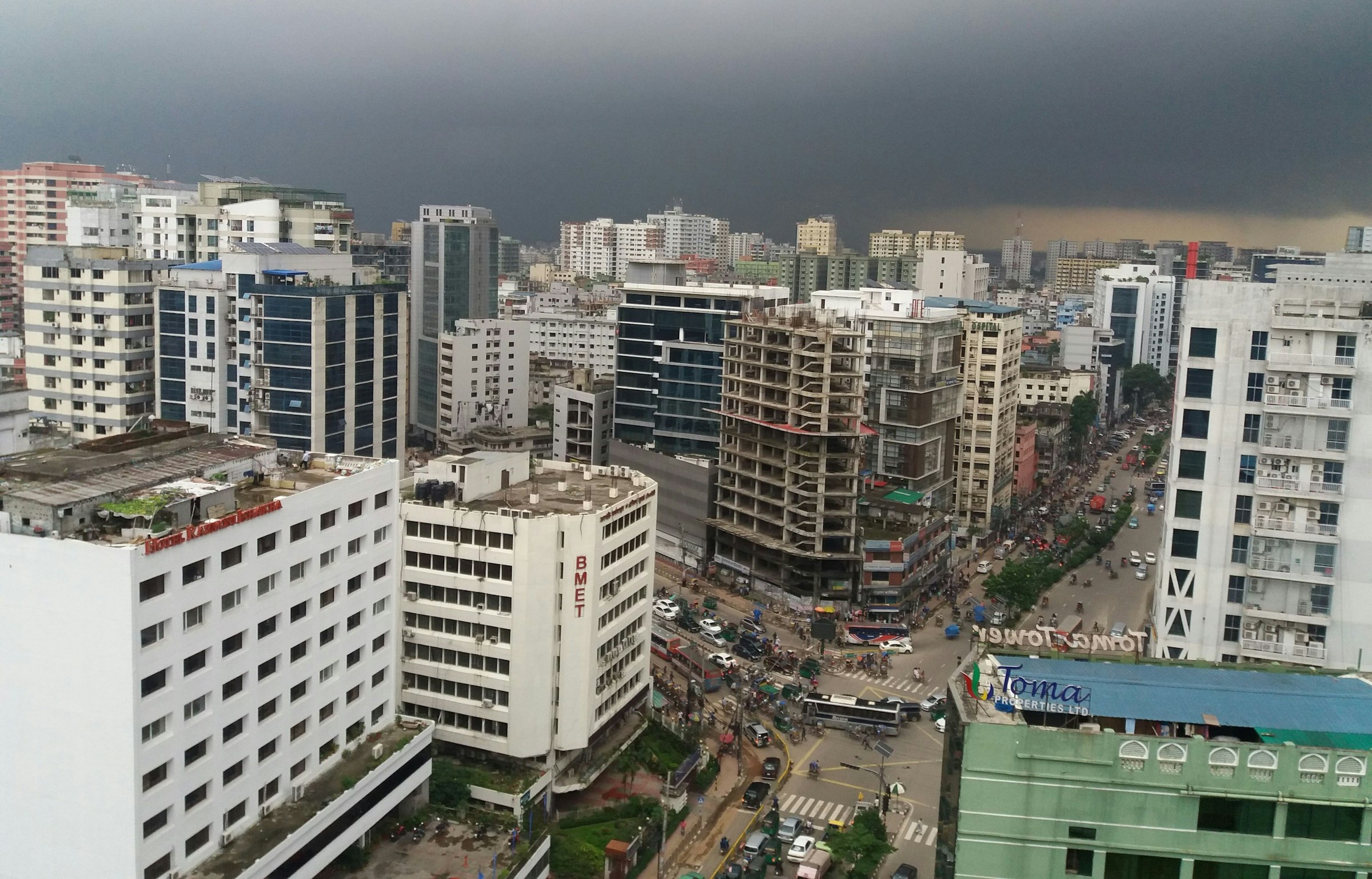
Banner image: A part of Dhaka. Image by Mahmudul Hasan Roni via Unsplash.
Extreme heat is eroding health, productivity and incomes of Dhaka’s informal workers
Despite energy crisis, Bangladesh’s factories are slow to adopt solar power: Study
Feedback: Use this form to send a message to the author of this post. If you want to post a public comment, you can do that at the bottom of the page.
Cite this article
Ibrahim Hossain Ovi (2026). Bangladesh’s green building drive grows beyond factories amid climate pressures. Mongabay Conservation news. DOI: https://doi.org/10.66709/news-327058

