


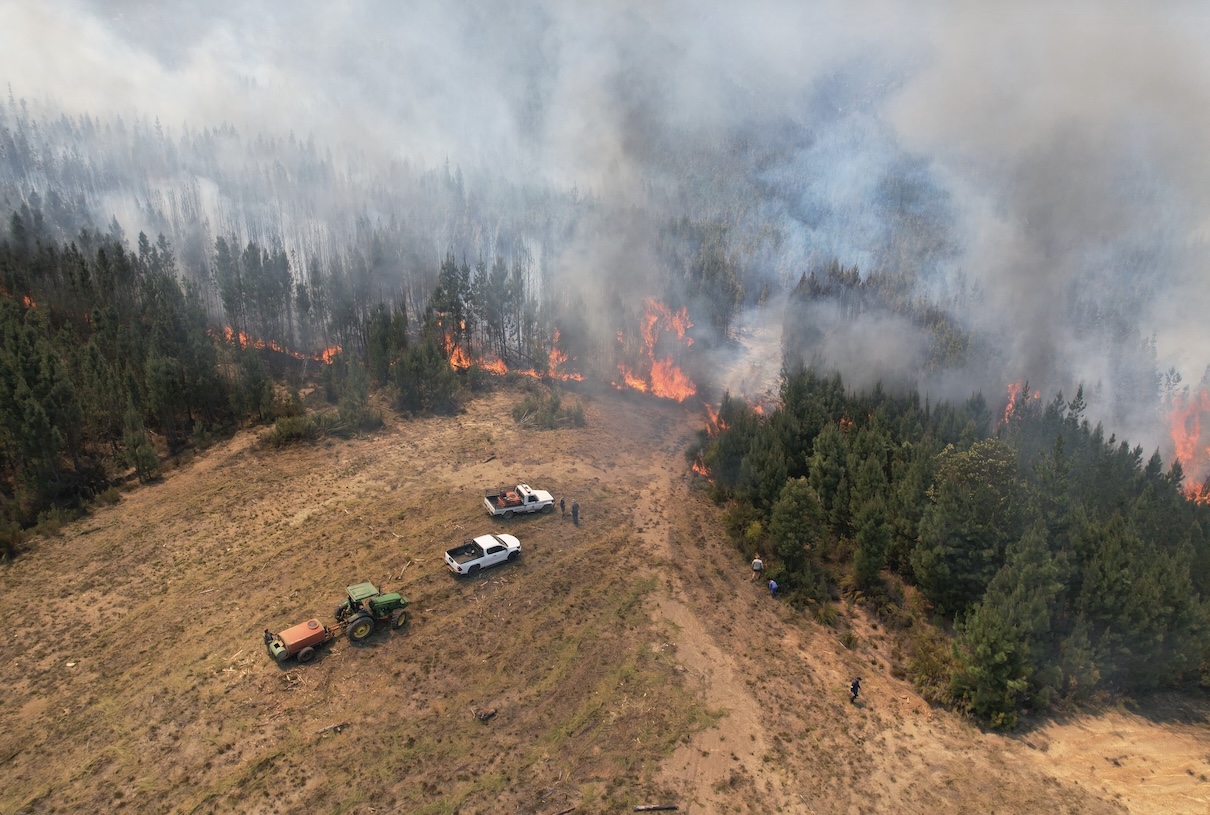
- Managing fire as a part of restoring ecosystems is vital to protecting both communities and economies from disaster: While fire is a natural part of many ecosystems, when forests are poorly managed they become fuel reservoirs just waiting for a spark.
- Spain’s Muga Valley and South Africa’s Langkloof share such a management history but are now pivoting to ecosystem restoration to protect communities, economies and biodiversity.
- “It is the health of the landscape that will determine whether fire acts as a force of connection or destruction. The choice, in effect, is whether we leave that risk unmanaged, or begin to build insurance into the land itself,” a new op-ed argues.
- This article is a commentary. The views expressed are those of the authors, not necessarily of Mongabay.
Huddled shoulder to shoulder, a flicker of glowing orange illuminates the faces gathered around. The world quiets. The dark presses in from every side, and the cold with it. At the center of it all, a fire is roaring.
Fire warmed us, fed us, and kept the dark at bay long after the sun went down, allowing us to gather together when solitude was the alternative.
But the same flames that draw people together can just as easily tear through a landscape, destroying livelihoods and communities.
Whether they do depends on the condition of the land itself. In some cases, fires are a natural part of the ecosystem. But when forests are poorly managed they become fuel waiting for a spark. Invasive vegetation, in particular, can burn hotter and more explosively than the indigenous ecosystems it displaces, turning a landscape adapted to survive fire into one that is destroyed by it. Restore the landscape, and you don’t eliminate fire, but you can change how fire behaves. In that sense, healthy landscapes act as vital risk infrastructure, reducing the likelihood that a spark becomes a catastrophe.
The landscapes of Spain’s Muga Valley and South Africa’s Langkloof share a history of poor management that has left them degraded and exposed to wildfire. Today, both areas are discovering that managing fire as a part of restoring ecosystems is vital to protecting both communities and economies from disaster.
The Muga Valley
In Catalonia’s Muga Valley, a three-hour drive up the coast from Barcelona, centuries of wood extraction followed by decades of abandonment have left forests denser and drier than ever.
Jaume Fabrega, who leads forest work and valley relationships, explains that forests left unmanaged can cause flames to jump from the ground to the canopy and race through the treetops, transforming a manageable ground fire into an unstoppable crown fire.
Esteve Guerra, vice president of the Catalan tourism association, warns that “everything can disappear with a sixth-generation fire” — the kind of extreme blaze that an overgrown, poorly managed forest is primed to produce.
But an overcrowded forest doesn’t just burn hotter. It also consumes more than its share of water when it’s not burning, intercepting rainfall before it can reach the aquifers below. The Boadella reservoir, which supplies Catalonia’s northern coast, depends on that water making it through the watershed intact.
After droughts hit in 2022, reservoir levels fell to just 18%. By 2050, projections suggest it could hold 26% less water, with roughly two-thirds of that decline linked to decades of forest mismanagement. Climate change is exacerbating droughts, but the state of the forest plays a huge role too.
That overlap between fire risk and water security has transformed the community’s response. Rather than treating wildfire as an isolated problem, residents have started restoring the watershed itself, removing excess biomass to reduce fire intensity while allowing up to 30% more water to infiltrate the landscape.
The technical solutions, however, are only part of the puzzle. Restoring the landscape also means creating a sense of shared purpose across people with different responsibilities and priorities, so the environmental organization Pioneers of Our Time has been working to bring together landowners, municipalities, and regional leaders around a shared vision for restoring it.
“My dream for 2040 is to see the stars, as I have always seen them from here, to be able to drink water from the river, and to see the forest cared for by all the neighbors of the valley,” a Muga Valley resident said when asked about his vision for the future of the landscape.
That sense of a shared future is becoming as important as any technical fix, turning restoration from a project with an end date into philosophy for living with the landscape.

The Langkloof
Nearly 9,000 kilometers (over 5,500 miles) away, in South Africa’s Eastern Cape, fire itself is not the intruder.
This region is fynbos country, one of the world’s most biodiverse ecosystems. Fynbos is Afrikaans for “fine bush” and is a shrubland vegetation type found almost nowhere else on Earth. It is characterized by tough, needle-like leaves and remarkable plant diversity packed into a small area.
Unlike many other vegetation types, which can be devastated by fire, the fynbos has evolved to depend on it. Some species release their seeds only after a burn, while others can only germinate after being exposed to smoke. In this region, the danger is not fire itself but what happens when natural fire cycles are interrupted.
Decades of fire suppression, driven by changing legislation and fears of liability, combined with the spread of invasive pine trees, have allowed combustible biomass to accumulate across the landscape, turning the valley into a tinderbox. This also negatively impacts the water balance as these invasive trees are much more thirsty than fynbos vegetation. Now, when fires do come, they burn much hotter and more out of control, taking on completely different characteristics to the type of natural fires that used to actually regenerate fynbos species.
In December 2025, during severe drought, a lightning strike ignited a fire across roughly 20,000 hectares (nearly 50,000 acres), revealing what happens when a fire-adapted ecosystem is prevented from functioning as it evolved to.
The response has extended well beyond firefighting. Farmers, foresters, conservation agencies, and local institutions that once worked independently are now exploring coordinated landscape management, including a regional Fire Fund and shared planning for prescribed burning, invasive species removal, and watershed restoration.
That work is being led by Living Lands, a South African nonprofit working across the Baviaanskloof and Langkloof landscapes to regenerate ecosystems by strengthening the relationships between people, land, and water. Rather than treating wildfire, biodiversity, agriculture, or water as separate challenges, Living Lands helps farmers, conservation agencies, researchers, and government partners develop shared responses at the landscape scale, including directing resources toward preventative restoration rather than reactive disaster response.
Like the Muga Valley, the Langkloof is working to reduce wildfire risk by restoring the landscape that shapes it.
Landscape restoration as risk management
One of the main arguments to encourage investments toward nature and nature-based solutions is that it can generate commercial returns for investors and should be considered as an asset class. That argument has struggled to attract capital at scale — mainly because it rarely holds true — so global investment continues to flow overwhelmingly toward extractive industries rather than regenerative ones, outpacing it by more than 30 to one.
But while nature restoration does not always provide higher financial returns, it can certainly reduce risks for communities, public, private and financial sector.
Every economic actor in a landscape, whether it’s a farmer, a processing company, or transport infrastructure relies on ecosystem services to generate revenue. This is also the case for the financial sector that underpins those activities. Indeed, the ability of these actors to continue paying their mortgage, insurance premiums, or loans ultimately depends on the functionality and resilience of the landscape they work in.
When wildfires ravage forests and plantations, when soils lose their capacity to retain water, farmers lose their source of revenue and the consequences eventually appear in the financial and private sector as insurance claims, loan defaults, disrupted supply chains, and declining asset values.
Restored forests, healthy soils, and functioning watersheds perform much the same role as levees, seawalls, or sprinkler systems. They reduce the probability — and often the severity — of financial loss by addressing risk at its source.
This changes what financing restoration actually means.
Rather than treating restoration as a marginal “nature investment” expected to compete with extractive returns, restoration becomes an effective credit enhancement solution that can mitigate financial risk. Every insurer, lender, investor, and corporation exposed to climate risk is already paying for degraded landscapes, but only once the damage is done. The opportunity is to shift a portion of that spending upstream, toward the landscapes that determine whether those losses occur in the first place.
Viewed this way, restoring a watershed is not separate from the bottom line. Rather, it is one of the most effective ways of protecting it.

Money doesn’t grow on trees … or does it?
What connects the Muga Valley and the Langkloof is not simply fire. It is what fire reveals.
In both places, decades of fragmented land management have left landscapes increasingly brittle and communities more vulnerable to catastrophe. Yet the shared prospect of losing everything to wildfire has also created a reason for people who once worked separately to begin managing the landscape together.
Someone always has to pay the bill after disasters happen. The opportunity now is to invest in restoring the landscapes that determine whether those disasters happen at all.
It is the health of the landscape that will determine whether fire acts as a force of connection or destruction. The choice, in effect, is whether we leave that risk unmanaged, or begin to build insurance into the land itself.
Claire Patterson is press and advocacy coordinator at Commonland, an organization for which co-author Penelope Choussat is a landscape finance associate.
See related coverage:
Climate change boosted Spain wildfire risk 20-fold, research shows
Forest fires likely to continue to burn twice as much without ‘serious action’ on climate change

