


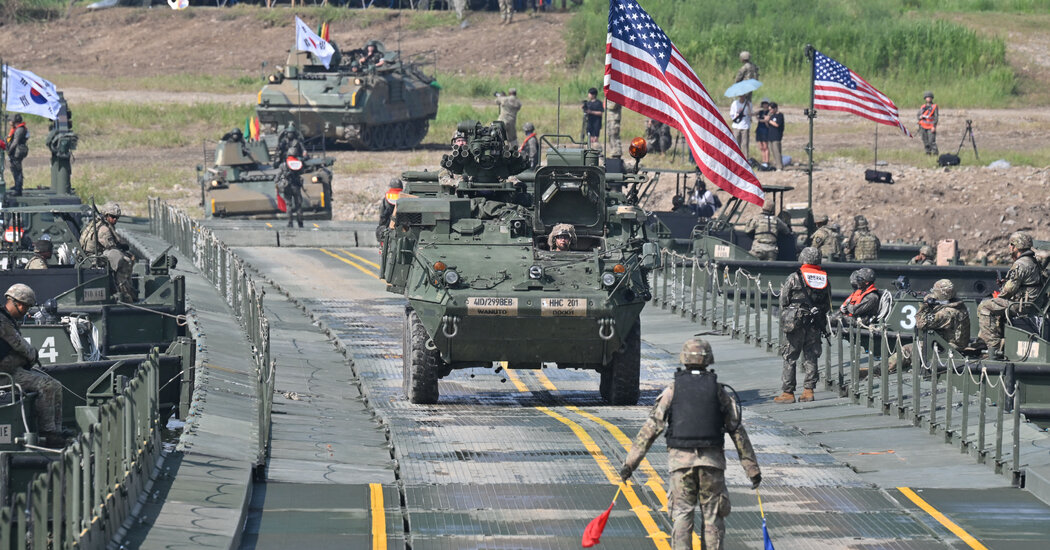
For years, the U.S. and South Korea militaries have participated in one of the largest military exercises in the world, with thousands of troops from both countries preparing for possible North Korea aggression.
On President Trump’s orders, the Pentagon curtailed this year’s exercises and scaled back some live-fire components of the drill, which were already underway.
Current and former military officials say the move is likely to undercut U.S. military readiness in the region at a time when allies are questioning the Trump administration’s commitment to longstanding partnerships and countering China.
The president’s decision is also unlikely to affect the person he hoped to sway: North Korea’s dictator, Kim Jong-un.
The exercises, called Ulchi Freedom Shield, usually run for 11 days and have sometimes included 17,000 or more U.S. troops and 50,000 South Korean troops. In past years, the sessions have featured some computer simulations carried out in a large bunker south of the capital, Seoul, intended to check the allies’ readiness to repel a North Korean attack.
This year, some 18,000 South Korean troops were to take part in Ulchi Freedom Shield. The Pentagon has not said how many American troops had been expected to participate.
While both countries have insisted that the exercises were defensive in nature, Mr. Kim has long called them provocative. North Korea’s Foreign Ministry has condemned the drills as “a rehearsal for an aggressive war.”
The country conducted two ballistic missile tests off its east coast this month, vowing to “respond to a new level of a threat with a new level of a deterrent.”
Mr. Trump seemed to agree with North Korea, saying in a post on Sunday that the country under Mr. Kim had been “unthreatening and respectful” while he has been president.
American troops have been through this before. Mr. Trump abruptly canceled the exercise in 2018 during his first administration, without notifying Defense Secretary Jim Mattis.
At the time, Trump administration officials said they wanted to give negotiations meant to rein in North Korea’s nuclear ambitions an opportunity to succeed. Mr. Trump met with Mr. Kim three times but ultimately failed in that goal.
Back then, officials said the military could weather one big interruption in the exercise schedule but that readiness would suffer if the drills lapsed for several years.
After Mr. Trump’s announcement on Sunday, the Pentagon declined to say which specific training events would be canceled, modified or conducted through computer simulation. But former commanders said two main components would be affected: the testing of high-level command problems and other issues, and training for large scale, on-the-ground live fire and troop maneuvering.
Both are valuable from a military readiness perspective, commanders said. A Pentagon official, who spoke on the condition of anonymity to discuss operational matters, said the American and South Korean militaries would continue training on their own before the exercise ends on Aug. 21, but that they would not train together as had been previously scheduled.
“Of course it hurts readiness,” said Victor Cha, the Korea chair at the Center for Strategic and International Studies. “And readiness relates to deterrence. If the Chinese or North Koreans feel that U.S. deterrence is not as strong, they might think there are opportunities there.”
Mr. Cha also disputed the notion that canceling the exercises would help Mr. Trump to get a nuclear deal with North Korea, pointing to the 2018 talks that ultimately collapsed in Hanoi in 2019 over disagreement about relief from U.S. economic sanctions and the scope of North Korea’s nuclear disarmament.
Gen. Curtis M. Scaparrotti, a retired top commander of U.S. forces in South Korea, said that scaling back live-fire training hurts troops’ ability to hone their combat skills.
“It develops competence and confidence by training just as you would fight an adversary as a team,” General Scaparrotti said in an email. “The use of live rounds and rigorous training standards in training is the most realistic test of unit readiness.”
In a rambling social media post on Sunday, Mr. Trump complained that South Korea had not supported the Trump administration in its war against Iran. He also said the military exercises were expensive, “with much of these costs paid for by the United States of America (as usual!).”
The estimated cost of this year’s exercise was $6.9 million, the Pentagon official said, adding that any savings resulting from the changes have not yet been determined. But former commanders said the vast majority of those costs had already been paid, for expenses like U.S. troop movements in and out of South Korea.
South Korea’s Foreign Ministry appeared to be caught off guard by Mr. Trump’s announcement but pledged to continue coordinating with the United States on the military exercises.
As the war with Iran sinks into a quagmire, Mr. Trump is increasingly refocusing on North Korea, which is now a de facto nuclear power.
Mr. Trump posted a picture of himself with the North Korean leader on social media at least twice in recent months.
“Kim Jong Un and I get along GREAT!” Mr. Trump wrote alongside a photograph he posted on Saturday of their meeting at the border between North and South Korea in 2019.
Mr. Trump said on Wednesday that he planned to meet with Mr. Kim sometime later this year, but he did not offer details. “I get along with Kim Jong Un very well,” Mr. Trump said. “He’s going to be fine. As long as we have a smart president, he’s going to be fine.”
Kim Yo Jong, the North Korean leader’s younger sister and close adviser, told state media on Wednesday that the country’s position toward the United States had not changed despite Mr. Trump’s decision to cut short the military exercises.
