


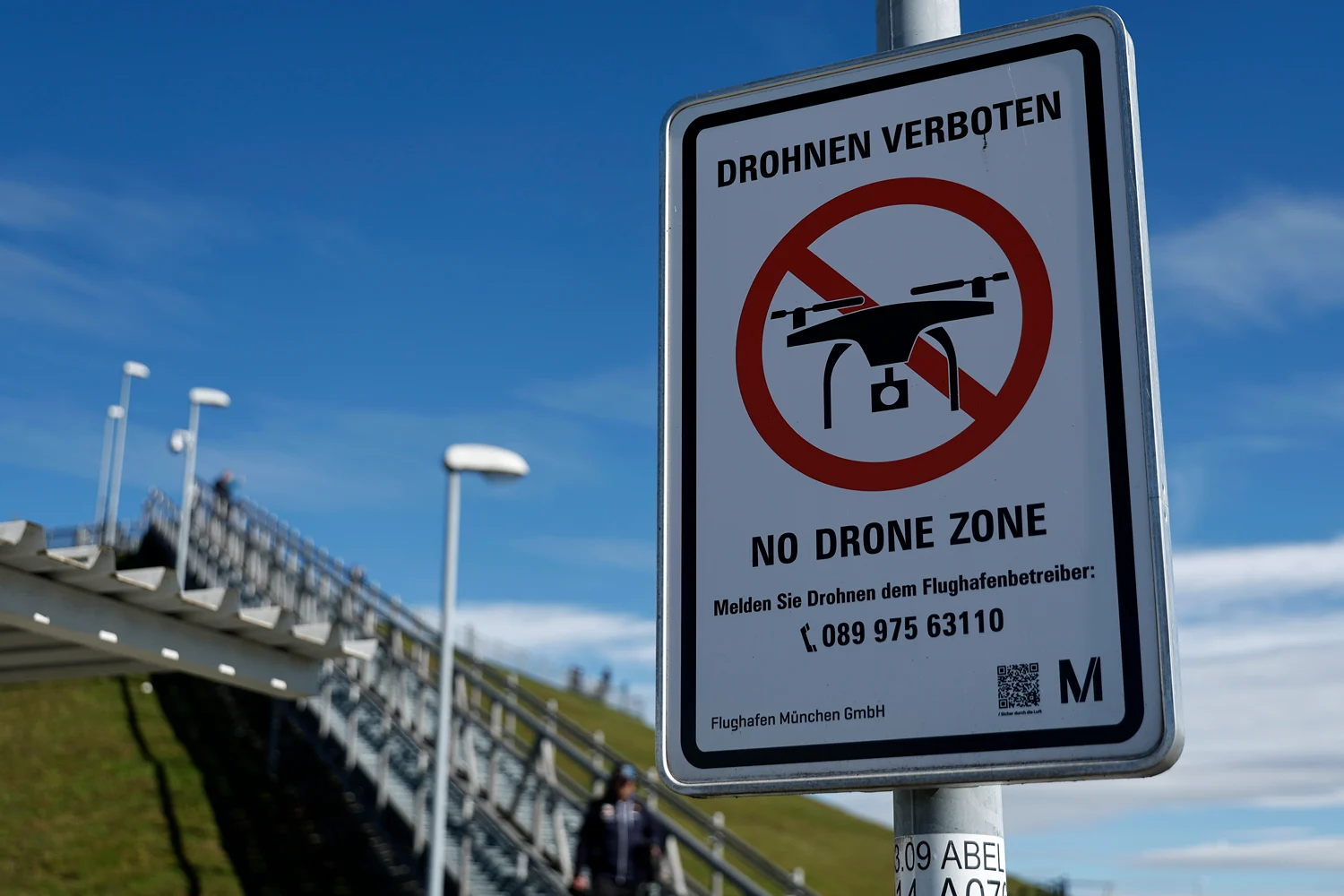
A sophisticated drone discovered inside a German airport. An aircraft colliding with a mysterious object near the same airport. Interference in upcoming state elections. Foreign agents scoping out a little-known defense CEO.
Germany has been the target of a wide range of mysterious activities over the last couple of months—the type that analysts usually label as “gray-zone” (my preferred term) or “hybrid” warfare. Hybrid threats, in Frank Hoffmann’s classic definition, “incorporate a full range of different modes of warfare including conventional capabilities, irregular tactics and formations, terrorist acts including indiscriminate violence and coercion, and criminal disorder.”
A sophisticated drone discovered inside a German airport. An aircraft colliding with a mysterious object near the same airport. Interference in upcoming state elections. Foreign agents scoping out a little-known defense CEO.
Germany has been the target of a wide range of mysterious activities over the last couple of months—the type that analysts usually label as “gray-zone” (my preferred term) or “hybrid” warfare. Hybrid threats, in Frank Hoffmann’s classic definition, “incorporate a full range of different modes of warfare including conventional capabilities, irregular tactics and formations, terrorist acts including indiscriminate violence and coercion, and criminal disorder.”
Gray-zone acts, by contrast, involve no conventional military element; to use military-wonk parlance, they’re not kinetic. In the recent string of such acts in Germany, the very likely culprit is Russia, which has a history of using these techniques against European states. European governments have linked the Kremlin to, among other things, a massive shopping mall fire in Warsaw, an attack on property linked to then-U.K. Prime Minister Keir Starmer, and facilitating migrants arriving at the borders of Norway and Finland.
But targeting Germany has particular significance: It shows that, when it comes to targets for gray-zone warfare, the stance of a state matters far less than its vulnerability. Germany has spent decades calling for peace and cooperation, but those earnest sentiments have not prevented it becoming a target.
What does this look like on the ground? Some of it is perplexing scenarios like the mysterious drone spotted at the Leipzig/Halle Airport in eastern Germany hovering near aircraft belonging to Ukraine’s Antonov Airlines. The drone was equipped with anti-detection technology, but made a clumsy landing, Die Zeit reported, and had accidentally dropped its load of 600 grams of semtex, a high-grade explosive, on the ground nearby.
Leipzig/Halle, it’s worth remembering, is not just the region’s leading airport; it’s also a crucial hub for military supplies bound for Ukraine. The authorities have not yet identified those involved in the drone incident, but the investigative trail will almost certainly lead to Russia.
In Saxony-Anhalt and Mecklenburg-Vorpommern, meanwhile, election campaigns are in full swing for the two states’ parliamentary elections this September. In Saxony-Anhalt, the far-right Alternative for Germany (AfD) is polling above 40 percent, and in Mecklenburg-Vorpommern, it’s by far the largest party, hovering around 36 percent. The AfD is not only far right but also more sympathetic to Russia than other German parties.
An online campaign, almost certainly sponsored by Russia, thus flooded the internet with fake content discrediting other parties’ candidates. The sophisticated campaign features posts that look like they come from legitimate accounts like mainstream news organizations. It also does some personal targeting, including the campaign directed against Stefan Thumann, the CEO of a mid-sized German firm called Donaustahl that supplies drones to Ukriane.
Because Donaustahl is not a high-profile company, Thumann may have assumed this was just another business deal. Not so. This month, German authorities, acting on a tip from a foreign ally, arrested a Ukrainian man and a Romanian woman who had been tracking his daily life, including visiting his home. The German prosecution has accused them of acting on behalf of a foreign intelligence agency.
All this is business as usual for Russia, which has employed similar tools for decades. But what makes this spate noteworthy is that it’s directed at Germany, a country that promotes cooperation and understanding like no other. For German politicians over the past decades, there has been no conflict that could not be tackled through negotiations, no dispute too thorny for multilateral negotiations. It co-founded what is now the European Union. It was a key participant in the Iran nuclear deal negotiations. It tried to solve Russia’s 2014 attacks on Ukraine through diplomatic talks. When the country itself reunited in 1990, it did so after orderly negotiations with World War II’s four victors. For the most part, this constructive approach worked.
Why would anyone want to harm such a sensible and collaborative nation? Because they can. After more than a decade of mapping gray-zone actions, I have concluded that gray-zone aggressors are actors of convenience. They don’t target countries, sectors, or groups because they’re particularly high-profile or combative: They target them because they are low-hanging fruit.
Earlier this year, Russian hackers stole images from CCTV and door cameras across Europe—and then published them to mock Western authorities. For many months now, Russian transmitters have been jamming and spoofing GPS signals in the Baltic Sea region, making it much harder for ships and aircraft to navigate.
Russia is not the world’s only perpetrator of gray-zone aggression. Earlier this summer, residents of small towns across Minnesota were shocked to find that their water plants had been attacked by cyber teams thought to be linked to Iran. Minnesota is a blue state locked in a contentious battle with the Trump administration, but the alleged Iranian actors apparently cared less about political positions than relatively easy targets.
In fact, perpetrators of gray-zone activities can keep testing targets. Some attacks will succeed, some won’t, and if an attack fails, no matter: Since Western countries don’t retaliate eye for eye—or at all—the attacker’s cost-benefit calculus is extremely advantageous. (This is precisely why I called my book on gray-zone aggression The Defender’s Dilemma.)
That has led to the paradoxical reality that Germany, which used to be highly moderate in its criticism of Russia, is as likely to be the target of gray-zone activity as Estonia, which has for years loudly warned of Russian threats. To be sure, Germany these days is as forceful in its criticism of Russia as Estonia is—but it apparently gets no credit for decades of cooperative efforts.
Politicians might hope to avoid making their countries targets of gray-zone attacks, but keeping a low profile doesn’t seem to work. And whatever the country may be, keeping the public informed is indispensable. At Leipzig/Halle Airport, an eagle-eyed airport worker first spotted the drone in the middle of the night. Being nice is good. Staying alert is better.
