


Welcome back to World Brief, where we’re looking at the United Arab Emirates’ economic embargo of Iran, renewed calls for a presidential election in Ukraine, and a potential breakthrough in U.S.-Canada trade talks.
Severing Trade Ties
The United Arab Emirates halted all trade and financial transactions with Iran on Wednesday until further notice. Having long held close economic ties with Tehran, Abu Dhabi’s decision marks a significant shift in Persian Gulf relations, and it places further global pressure on Tehran to surrender its war ambitions.
Welcome back to World Brief, where we’re looking at the United Arab Emirates’ economic embargo of Iran, renewed calls for a presidential election in Ukraine, and a potential breakthrough in U.S.-Canada trade talks.
Severing Trade Ties
The United Arab Emirates halted all trade and financial transactions with Iran on Wednesday until further notice. Having long held close economic ties with Tehran, Abu Dhabi’s decision marks a significant shift in Persian Gulf relations, and it places further global pressure on Tehran to surrender its war ambitions.
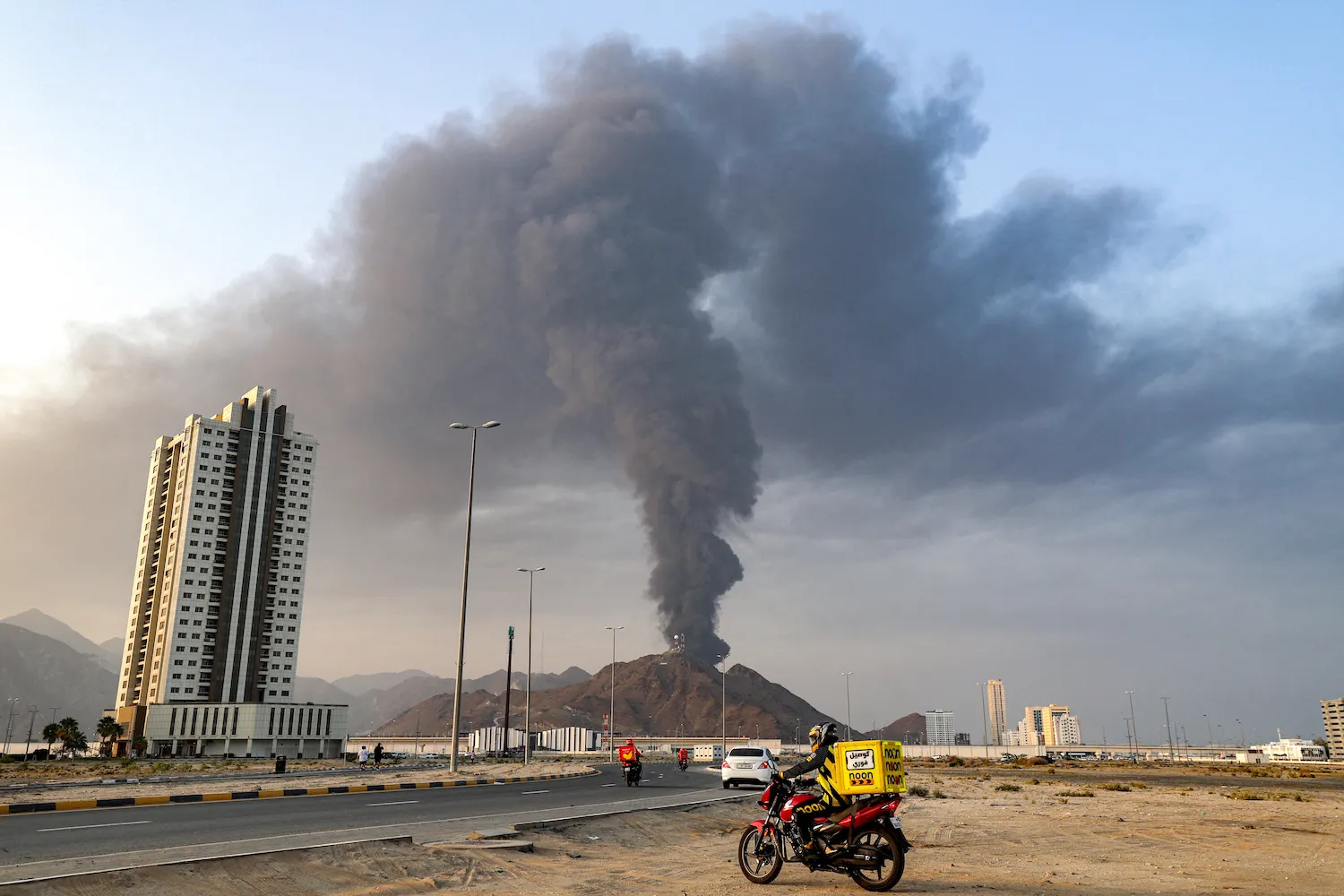
According to an Emirati Foreign Ministry spokesperson, the embargo is in response to “regional escalations that undermine regional and international peace and security.” Last Saturday, Abu Dhabi accused Tehran of attacking an Emirati oil tanker traversing the Strait of Hormuz, and on Tuesday, the UAE’s Defense Ministry claimed that Iranian forces fired two ballistic missiles at “maritime traffic,” one of which fell into Emirati waters. Tehran denied the latter attack.
In the early weeks of the Iran war, the UAE bore the brunt of Tehran’s retaliations against the United States, as the UAE hosts a major U.S. military base, Al Dhafra Air Base, as well as the U.S. Navy’s busiest and largest port of call in the Middle East. Emirati authorities have since reported more than 2,700 ballistic missile and drone attacks from Iran.
The UAE has taken several measures to discourage Iran from continuing its assaults. In March, Abu Dhabi ordered the closure of a cultural club, several schools, and a historic Iranian hospital in the UAE’s largest city, Dubai, that were allegedly connected to the Iranian government. Later that month, the Emirati government began canceling visas of some Iranian expatriates. And in May, the New York Times, citing unnamed senior U.S. officials, reported that the UAE’s military had carried out secret strikes on Iranian territory.
Still, the UAE had stopped short of imposing major economic penalties on Iran for its actions. According to the World Trade Organization, trade between the two countries in 2024—when the UAE was Iran’s largest source of imports—was around $28 billion. Dubai, specifically, has been accused of helping Tehran evade international sanctions by hosting companies that processed millions of dollars for the Islamic Revolutionary Guard Corps and other Iran-linked groups. Anwar Gargash, a diplomatic advisor to Emirati President Mohammed bin Zayed, dismissed such allegations about Dubai on Wednesday as “untrue information and part of desperate media campaigns.”
The UAE “remains firmly committed to safeguarding the integrity of the international financial system, in line with international law and the highest global standards,” the Emirati Foreign Ministry spokesperson added.
It is unclear why Abu Dhabi chose now to impose an economic embargo on Tehran and to what extent the United States played a role in that decision. The Trump administration has repeatedly urged foreign allies to help isolate Iran on the global stage, hoping that such pressure will “force the Iranian government to make substantial concessions in negotiations—or even lead to an uprising that topples the regime,” FP columnist Anchal Vohra argued last month.
Notably, Wednesday’s announcement came mere hours after U.S. President Donald Trump held a call with Mohammed bin Zayed.
Today’s Most Read
What We’re Following
Wartime vote. Ousted Ukrainian Defense Minister Mykhailo Fedorov called for wartime elections on Wednesday, marking the biggest internal challenge to President Volodymyr Zelensky’s rule since the Russia-Ukraine war began more than four years ago. “Democracy cannot be held hostage by Russia,” Fedorov said, just hours after Zelensky asked lawmakers to confirm his new defense minister, Yevhenii Khmara. “We must find a legal, safe, and realistic mechanism that will allow Ukraine to renew its full democratic process even in the conditions of a long war.”
Fedorov’s six months in office were notable for his role in spearheading Ukraine’s drone development program, which has proved instrumental in effectively combatting Russia. However, he was fired last month over a dispute with then-commander of the Ukrainian armed forces, Gen. Oleksandr Syrskyi—sparking rare anti-government protests. Fedorov appears to have capitalized on that momentum, warning that Kyiv faces a “systemic crisis of governance” that fears change. His call also comes as Zelensky is under increasing pressure due to a massive scandal related to alleged corruption, which has engulfed a significant number of the president’s top political allies.
Ukraine is prohibited from holding elections when the country is under martial law, as it is now. And polling consistently shows that the majority of Ukrainians oppose wartime elections. However, Russian President Vladimir Putin has repeatedly painted the lack of such a vote as evidence of Zelensky’s illegitimacy, and several foreign leaders, including Trump, have pressured the Ukrainian president to concede to Moscow’s demand.
Three-day reprieve. Starting on Wednesday, Canada has a 72-hour window to negotiate terms to avoid sweeping U.S. tariffs on roughly $20 billion worth of Canadian goods. The 50 percent duties were slated to take effect on Wednesday, but Trump announced a three-day reprieve less than two hours before they were to go into force, citing a potential last-minute deal.
According to a White House proclamation released on Tuesday, Canada has agreed to several trade concessions. That could include resurrecting talks over the Keystone XL oil pipeline, which the Biden administration scrapped in 2021 to fulfill a campaign promise to reduce greenhouse gas emissions and prioritize green energy. Canadian Prime Minister Mark Carney confirmed that “substantial progress has been made” in talks but that “there is important work still to be done.”
Both sides would benefit from stepping back from the brink. Ottawa has threatened to impose retaliatory tariffs on Washington if it went through with these duties, likely reigniting a trade war. That could prove particularly damaging for the White House ahead of the United States’ upcoming midterm elections, which look to be an increasingly tight race for Republicans.
Ending early. The U.S. and South Korean militaries confirmed on Wednesday that joint Ulchi Freedom Shield drills, originally scheduled to go through Aug. 27, will be cut short. Instead of an 11-day exercise, the annual event will end on Friday to comply with Trump’s recent demand that U.S. involvement be downsized in deference to his “very good relationship” with North Korean leader Kim Jong Un.
Trump’s order, which came mere hours after the exercise kicked off, appeared to be a direct response to North Korean threats calling the drills a “rehearsal for an aggressive war.” Both Washington and Seoul have suggested that reducing Ulchi’s scale could help pave the way for reengagement with Pyongyang on denuclearization talks; on Tuesday, U.S. officials told the Wall Street Journal that Trump is pushing for a meeting with Kim as soon as this fall.
However, North Korea remains unswayed by these actions. “The provocative, aggressive nature of the drills won’t change even though their duration and size were reduced,” said Kim Yo Jong, the influential sister of Kim Jong Un. Meanwhile, many experts have argued that the scale-down undermines Seoul’s defense posture on the Korean Peninsula and damages a long-held alliance with one of Washington’s most powerful East Asian partners.
Odds and Ends
The Belgian city of Malmedy is known for its historic cathedral, sprawling moorlands, and really big breakfast. Last Saturday, the French-speaking city held its 30th annual Giant Omelet Festival, during which chefs cook a massive free meal for all who want to start their day with a little extra protein. This year’s omelet included 7,200 eggs (along with bacon and herbs) cooked in a specially designed 4-meter-wide pan. “It shows that we don’t need much to bring people together,” said Mathieu Kelleter, a member of the omelet group. Bon appétit!
