


Welcome to Foreign Policy’s South Asia Brief.
The highlights this week: The Taliban mark five years in power in Afghanistan, a Pakistani court orders that former Prime Minister Imran Khan be moved to a hospital, and the U.S. ambassador to India breaks decades of policy precedent with remarks about Kashmir.
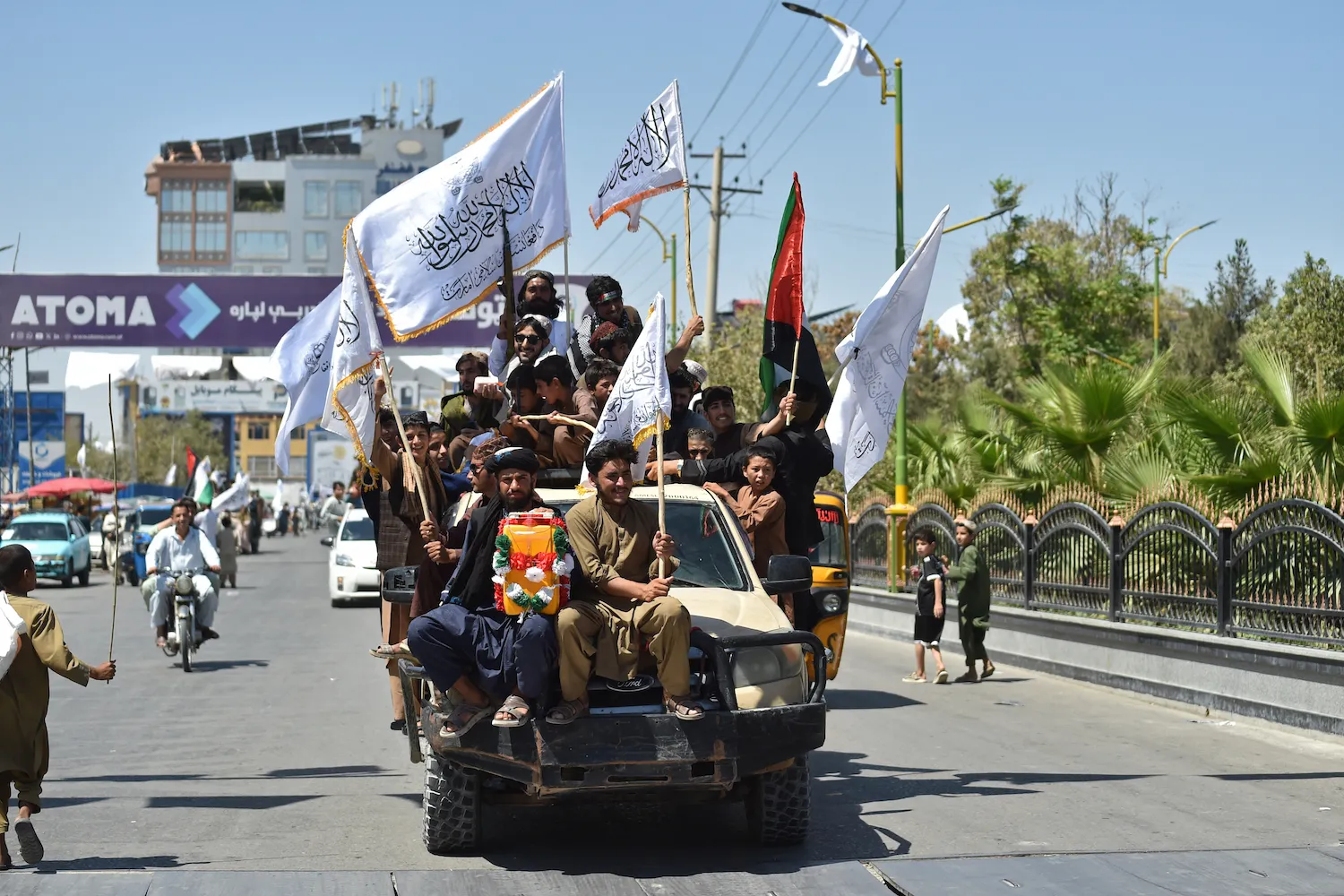
The Taliban’s Surprising Stability
The Taliban, mainly because of their abhorrent treatment of women and girls, arguably constitute the world’s most brutal regime. The group also shelters terrorists, and its leaders are sanctioned and globally isolated; only Russia formally recognizes the Taliban as Afghanistan’s government.
The August 2021 U.S. withdrawal from Afghanistan has left the Taliban—known more for their warfighting than policymaking—saddled with the responsibility of managing a chronically weak economy without the foreign assistance that long helped prop it up.
And yet, today, the Taliban can be regarded as surprisingly stable—albeit through brutish means.
First, the group hasn’t faced real threats to its political survival. To be sure, Islamic State-Khorasan (IS-K)—the local branch of the Islamic State—has periodically targeted the group. But that hasn’t diminished the Taliban’s strength, instead serving up a contrast of an even worse alternative.
By some measures, security has improved. Since August 2021, Afghanistan has not been at war, as it was for the previous four decades. Terrorist attacks have also declined in recent years, following Taliban offensives against IS-K. This doesn’t mean that Afghanistan is secure—especially for women, religious minorities, dissidents, and others threatened or targeted by Taliban violence. But it’s more stable than it was when convulsed by conflict.
Furthermore, Afghanistan’s economy—weakened by decades of conflict, the absence of a diverse private sector, massively diminished foreign assistance, multiple humanitarian crises, and global economic shocks—has performed better than many observers expected. The World Bank earlier this year estimated that the country’s real annual GDP growth would be nearly 5 percent. That is in part due to the Taliban’s success in generating revenue through customs duties and tax collection, and also to robust trade with Afghanistan’s Central Asian neighbors.
The Taliban may be isolated, but the group is not the global pariah it was in the 1990s. Nearly 20 countries still operate diplomatic representations in Kabul—and Taliban diplomats have taken up posts in many Asian capitals. Western governments, including the United States, have periodically held meetings with the group. And the Taliban have healthy trade relations with many of Afghanistan’s neighbors.
The Taliban are even occasionally invited to major global events, such as the 2024 United Nations climate summit. The international community may have no interest in recognizing the Taliban regime, but it has accepted Taliban rule as a reality.
Yet there are growing indications the next five years won’t be as easy for the group.
Earlier this month, Sami Sadat, a pre-Taliban senior military officer, announced the launch of a new armed campaign against the Taliban via his Afghanistan United Front. Sadat’s movement will struggle without external sponsorship, but continued global economic shocks could worsen living conditions, galvanize Afghans, and boost recruitment to the resistance.
IS-K is notoriously resilient. A grenade attack on Tuesday near a school in a Kabul neighborhood with a large community of Hazaras—a Shiite minority—is a reminder that the group, or those allied with it, could resurge. And tensions with Pakistan—the Taliban’s onetime sponsor—could explode into open conflict. Pakistan accuses the Taliban of sheltering anti-Pakistan militants, and it has carried out several rounds of cross-border strikes in Afghanistan over the last year.
Rising external challenges could also put more strain on the group internally, which risks aggravating divides between factions that have flared occasionally in recent years.
What We’re Following
Imran Khan’s illness. On Tuesday, Pakistan’s Supreme Court ordered authorities to transfer imprisoned opposition leader and former Prime Minister Imran Khan to a private hospital for medical tests, following weeks of concern from his family and supporters about his health.
Khan’s ailments have reportedly included vision problems, which the government claims have improved, and fluctuating blood pressure levels. The court said that Khan, once at the hospital, should be examined by a medical board that includes one of his personal physicians.
The order is a major win for Khan’s Pakistan Tehreek-e-Insaf (PTI) party, which has been demanding the move for weeks. Islamabad had repeatedly said Khan was in safe hands with prison medical staff and downplayed reports that his health was declining.
The court also granted another long-standing demand of Khan’s supporters: access to his family. Prison officials must now allow Khan weekly meetings with family members and calls with his two sons, who are based in London.
However, there’s a twist: Soon after the order was announced, Pakistan’s law minister said the court’s decision was “beyond the legal parameters” and that the government will ask the court for a review. If Islamabad defies the order, it could become embroiled in a legal crisis and face a new confrontation with PTI, which was already planning nationwide protests on Sept. 27 against Khan’s incarceration.
Gor visits Kashmir. Sergio Gor, the U.S. ambassador to India and special envoy for South and Central Asia, is visiting India-administered Kashmir this week. On Wednesday, he met two top officials in the disputed region, Chief Minister Omar Abdullah and Lt. Gov. Manoj Sinha.
The major storyline of this visit, however, was not who Gor met with, but rather what he said in brief comments to journalists on Wednesday.
Gor declared that Kashmir is “an important part of India” and he also said his government would consider easing U.S. travel warnings to the region. His first comment, which appears to endorse India’s position on Kashmir, goes against many years of U.S. policy that has refrained from taking a position on the dispute. It also contradicts U.S. President Donald Trump’s public offer last year to help find a “solution” in Kashmir.
Gor’s second comment will also be received well in New Delhi. Ever since India revoked Kashmir’s special autonomous status in 2019, it has sought to project a narrative of normalcy in the region—one that depicts Kashmir as more stable and peaceful than it used to be. If Washington were to ease its travel warning, this would once again signal its support for India’s position.
Bangladesh-India tensions. Last week, Bangladeshi Prime Minister Tarique Rahman said he is waiting for a more “conducive environment” that would enable him to travel to India next month for the 2026 BRICS leaders’ summit. It’s the latest indication of worsening tensions between the two countries.
Prior to this month, the bilateral relationship—which has suffered since former Bangladeshi Prime Minister Sheikh Hasina fled Bangladesh for India in 2024—appeared to be stabilizing. Each side signaled a desire to patch up ties, and New Delhi issued the BRICS invitation to Rahman. (Bangladesh applied to join the grouping in 2023, though it has not yet been admitted.)
But all that changed on Aug. 5, when Hasina spoke virtually at an event sponsored by a foreign correspondents’ club in New Delhi. India’s decision to platform Hasina, who last November was sentenced to death in absentia for her security forces’ use of deadly force against protesters, infuriated Dhaka.
Bangladeshi officials haven’t specifically said what a more conducive environment would look like, but the foreign ministry on Sunday did call on India to take two steps: extradite Hasina back to Bangladesh and hand over two men currently in India who are accused of a deadly attack on Bangladeshi activist (and India critic) Osman Hadi last December.
Because of its deep ties to Hasina and her family, New Delhi is unlikely to give in to the first demand. But it may be willing to consider the second one.
Under the Radar
On Tuesday, Nepalese Prime Minister Balendra Shah met with India’s army chief, Dhiraj Seth, in Kathmandu. Seth was on a three-day visit to the country at the invitation of his Nepalese counterpart, Ashok Raj Sigdel. Shah and Seth discussed how to strengthen military cooperation, according to Shah’s office.
Ordinarily, this would seem like routine diplomacy. What makes it significant, however, is that Shah has taken a highly unconventional approach to diplomacy since taking office in March. He has refused to meet visiting foreign officials—including from key partner governments in Washington and New Delhi—unless they were of a similar or equal rank to him.
However, he met with Seth this week, and last week he met with India’s ambassador to Nepal, Naveen Srivastava. Shah also met with China’s ambassador, Zhang Maoming, and U.S. Chargé d’Affaires Scott Urbom.
It appears that Shah is now taking a more conventional approach to diplomacy, perhaps in recognition of the fact that Kathmandu can’t afford to upset its partners by refusing to meet with key officials.
FP’s Most Read This Week
Regional Voices
Researcher Sidharth Raimedhi argues in The Print that India should not shy away from the principle of appeasement in its foreign policy. “Historical record shows that it has often been used by major and great powers to realign interests with potential adversaries in order to pursue core power and security interests more efficiently,” he writes.
Writer Muhammad Hasnain Raza Khan asserts in Pakistan Today that Pakistan’s approach to cybersecurity needs to become more proactive. “As cyber threats keep getting more sophisticated and also more interconnected, the country’s cybersecurity approach has to change, not just in the sense of reacting when incidents happen,” he writes.
Researcher Syed Faiz Ahmed writes in Prothom Alo about Bangladesh’s recent upset victory over Australia in a test cricket match. “[E]xpatriate Bangladeshis around Australia and across the world will be deeply inspired by this victory. It will motivate them to strive for excellence,” he writes. “[W]e can beat anyone and win. What we need is sound planning, hard work and determination.”
