


- Egypt is famous for ancient ruins but its protected areas and biosphere reserves contain another kind of heritage: Fossil valleys, desert plants, coral-linked coastal systems, migration routes, geological formations and human knowledge shaped by arid environments.
- Deserts expanses are not empty — or merely open spaces between archaeological monuments — but rather are places full of life, and this point matters urgently, a new op-ed argues.
- “If conservation is to work in these landscapes, it must listen more carefully. It must see local ecological knowledge not as anecdote, and interpretation not as decoration, but as tools for making protection more grounded, more understandable and more just,” the author writes.
- This article is a commentary. The views expressed are those of the author, not necessarily of Mongabay.
Egypt’s deserts are often introduced to the world as empty: Wide horizons, silence, heat, sand and stone. In tourism brochures they become dramatic scenery. In archaeological writing they can appear as corridors around monuments. In some conservation documents they are fragile spaces that need technical management from outside.
But these descriptions miss something essential. Deserts are not empty. They are living landscapes, ecological archives and knowledge systems.
For local desert communities, the landscape is not a blank background. It is read through water, plants, tracks, grazing routes, winds, seasonal movement, stories, risks and memories. A valley, a spring, a coastal plain or a mountain pass can hold information about how people and non-human life have adapted to scarcity. This kind of local ecological knowledge is not a decorative addition to conservation. It can help researchers and managers understand how landscapes are used, remembered and explained.
In Egypt, this point matters urgently. The country is known globally for its ancient monuments, but its protected areas and biosphere reserves also contain another kind of heritage: Fossil valleys, desert plants, coral-linked coastal systems, migration routes, geological formations and human knowledge shaped by arid environments. If these landscapes are treated only as scenery, or as scientific sites separated from people, conservation loses part of its evidence base and much of its public meaning.
The problem is visible even in Egypt’s most famous natural heritage sites. At Wadi Al-Hitan in Fayoum, visitors often arrive to see fossil whales, but the wider landscape tells a larger story: Ancient seas, changing climates, desert erosion and the long history of life on Earth.
If interpretation stops at the idea of a spectacular fossil, visitors may miss why the surrounding desert is part of the evidence. The place is not only a display of bones. It is a field archive where geology, evolution and public imagination meet.
Wadi El-Rayan offers a different lesson. Its lakes, desert edges, wildlife habitats and visitor routes show that protected areas are not static objects. They are used, crossed, photographed, explained and sometimes pressured by tourism and local needs. Here, good interpretation can help visitors understand that a desert lake is not simply a beautiful stop on a day trip. It is part of a wider protected landscape where water, birds, mammals, plants, recreation and management decisions are connected.
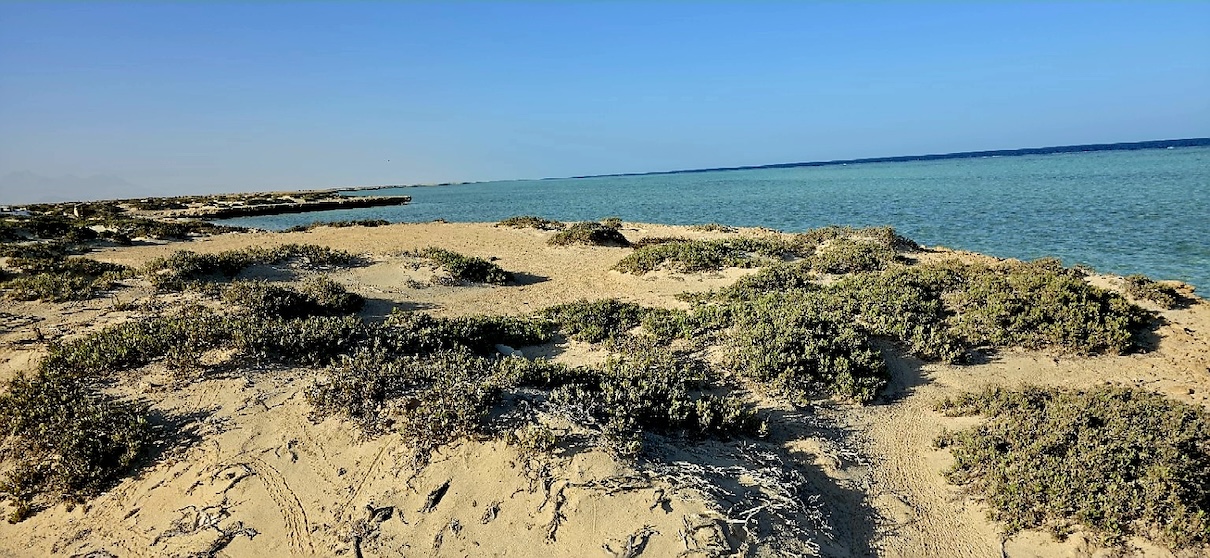
The Red Sea region adds another layer. Along the coast, desert plains meet reefs, coastal vegetation, mangrove habitats, migration routes and Bedouin knowledge of movement and weather. A visitor may see only a beach, a mountain road or a diving destination. Local interpreters and trained eco-guides can help reveal the relationships behind that view: How land and sea meet, why coastal plants matter, how reefs are linked to livelihoods, and why conservation cannot be reduced to one habitat at a time.
This is especially important in arid and coastal-desert settings such as Wadi Allaqi Biosphere Reserve, the Red Sea desert and other Egyptian protected landscapes. These places are often discussed through the language of biodiversity, tourism potential, cultural heritage or resource pressure. All are valid lenses, yet each one becomes weaker if it ignores the people who know how the landscape is navigated and interpreted in everyday life.

Local ecological knowledge should not be romanticized or treated as a substitute for scientific monitoring. It should also not be extracted without consent, credit or benefit. But when it is documented respectfully and compared with ecological, geological and historical evidence, it can strengthen conservation. People who live with the land may notice changes in vegetation, water availability, animal movement, grazing pressure, visitor behavior and seasonal conditions long before such changes appear in formal reports.
Understanding conservation
My current work as an Egyptian researcher in natural heritage interpretation and protected areas has pushed me toward a simple conclusion: Conservation depends not only on what is protected, but also on how protection is understood. A biosphere reserve, for example, is not only a boundary on a map. It is a place where conservation, learning, sustainable use and public communication should meet. If local knowledge remains outside that conversation, the reserve risks becoming visible to institutions but less meaningful to the people who live in and around it.
Interpretation is one way to bridge this gap. In many protected areas, guides are treated mainly as service providers for visitors. They explain the route, manage time and help tourists move through a site. But trained eco-guides and local interpreters can do much more. They can translate scientific and local knowledge into stories that help visitors understand why a plant, a fossil, a reef, a valley or a seasonal pattern matters. They can connect conservation rules to reasons, and reasons to lived experience.

This does not mean we must turn every protected area into a classroom. It means recognizing that public understanding is part of conservation infrastructure. Trails, signs, visitor centers, field guides, community narratives and guide training are not secondary luxuries. They shape how people behave, what they value and whether they see a landscape as alive or merely available for use. In fragile desert and coastal environments, this difference is not minor.
A practical example is guide training. A guide who only repeats the names of sites may help visitors move through a landscape without helping them understand it. But a guide who can explain why a fossil valley matters, how a coastal plant stabilizes sand, why a reef is connected to land-based behavior, or how local people read seasonal change can turn a visit into an act of environmental learning.
This is not decoration added after conservation. It is one of the ways conservation becomes visible and socially useful.
For decision-makers, this requires a practical shift. Local ecological knowledge should be integrated into protected-area planning, visitor management, interpretation programs, educational materials and climate adaptation discussions. It should be gathered through ethical methods, with clear acknowledgement of knowledge holders and attention to how communities benefit. It should be used alongside scientific data, not in opposition to it.
For researchers, it also requires humility. Academic language can make landscapes appear more distant than they are. A good conservation system needs maps, surveys, species records and governance frameworks. But it also needs people who can explain why a place matters in words that visitors, students, managers and local communities can recognize. Without that translation, conservation can become technically correct but socially thin.

Although Egypt’s natural heritage is often overshadowed by its archaeological fame, this is understandable, but limiting. The country’s landscapes hold deep time as powerfully as its monuments do. Wadi Al-Hitan tells a story of ancient whales and changing seas. Wadi El-Rayan connects desert, water and wildlife. The Red Sea region links geology, reefs, coastal vegetation, migration and community knowledge. These places can teach visitors that heritage is not only built by human hands. It can also be written in stone, water, plants and movement.
The idea that deserts are empty has never been neutral. It makes it easier to overlook people, simplify ecosystems and reduce complex places to scenery. A conservation approach built on that idea will always be incomplete. Egypt’s deserts, valleys and coastal landscapes are not empty spaces waiting to be filled by outside narratives. They are already full of ecological memory, human experience and natural history.
If conservation is to work in these landscapes, it must listen more carefully. It must see local ecological knowledge not as anecdote, and interpretation not as decoration, but as tools for making protection more grounded, more understandable and more just.
The desert is not silent. We have often simply failed to hear what it is saying.
Marwan Mahmoud Kamal Hamdoun is an assistant lecturer and Ph.D. researcher in tourism guidance at Fayoum University, Egypt, and is a 2026 UNESCO MAB Young Scientists Awardee and also a member of the IUCN World Commission on Protected Areas.
See related coverage:
Egyptian teens use robots for ‘smarter and more responsive’ way to protect Earth
Egyptian teens use robots for ‘smarter and more responsive’ way to protect Earth
How a Brazilian Indigenous ethnobotanist & elders recorded their people’s medicinal knowledge

