


British wildlife photographer Margot Raggett says she created the book Remembering Elephants after she heard David Attenborough say, “The question is, are we happy to suppose that our grandchildren may never be able to see an elephant except in a picture book?” Her effort was to provoke this question in others and to give the proceeds from its sale to conservation organizations. In a sense, the book went viral and generated a following, prompting Raggett to continue the book series and her nonprofit, Remembering Wildlife.
“Sometimes people get upset with me and say ‘They’re still around,’ but I want people to stop and think,” Raggett says.
In this episode of the Mongabay Newscast, she discusses her journey into photography, the intention behind memorializing still-living species, and details of her 11th book, Remembering Giraffes, which will be published Oct. 12. Raggett has gathered work from some of the world’s most renowned wildlife photographers. To date, Remembering Wildlife has raised more than $1.6 million for 85 conservation organizations in 35 countries.
Publishing the first book was not without its challenges. Not knowing as many photographers at the time, Raggett had to actively solicit photographers for their work. Just as she closed out the Kickstarter campaign to fund the book, Raggett was diagnosed with breast cancer, a moment that she says anchored her to the work.
“During the next three months of my treatment … during my radiotherapy, I would work on the elephant book in the morning and then go and have my radiotherapy in the afternoon. And … it kind of almost bonded me even more to the elephants,” she says.
Raggett remarks on why she chose to go with giraffes for this volume, explaining how the gentle nature of these giants and their relative calm compared with apex predators are often overlooked or taken for granted, even as their numbers have declined by 30-40% since the 1980s.
“Like everything in conservation, the story is not even. So there are some areas where giraffes are doing well, and there are others where they’re down to, you know, hundreds. And I just felt they deserved a story to be told. They are silent, and they deserve a voice like all of the other species we’ve covered,” she says.
Disclosure: Margot Raggett is a grassroots supporter of the Mongabay Newscast. Mongabay maintains full editorial independence from its financial supporters, who have no role in determining our coverage or editorial decisions.
Mike DiGirolamo is the host & producer for the Mongabay Newscast based in Sydney. Find him on LinkedIn and Bluesky.
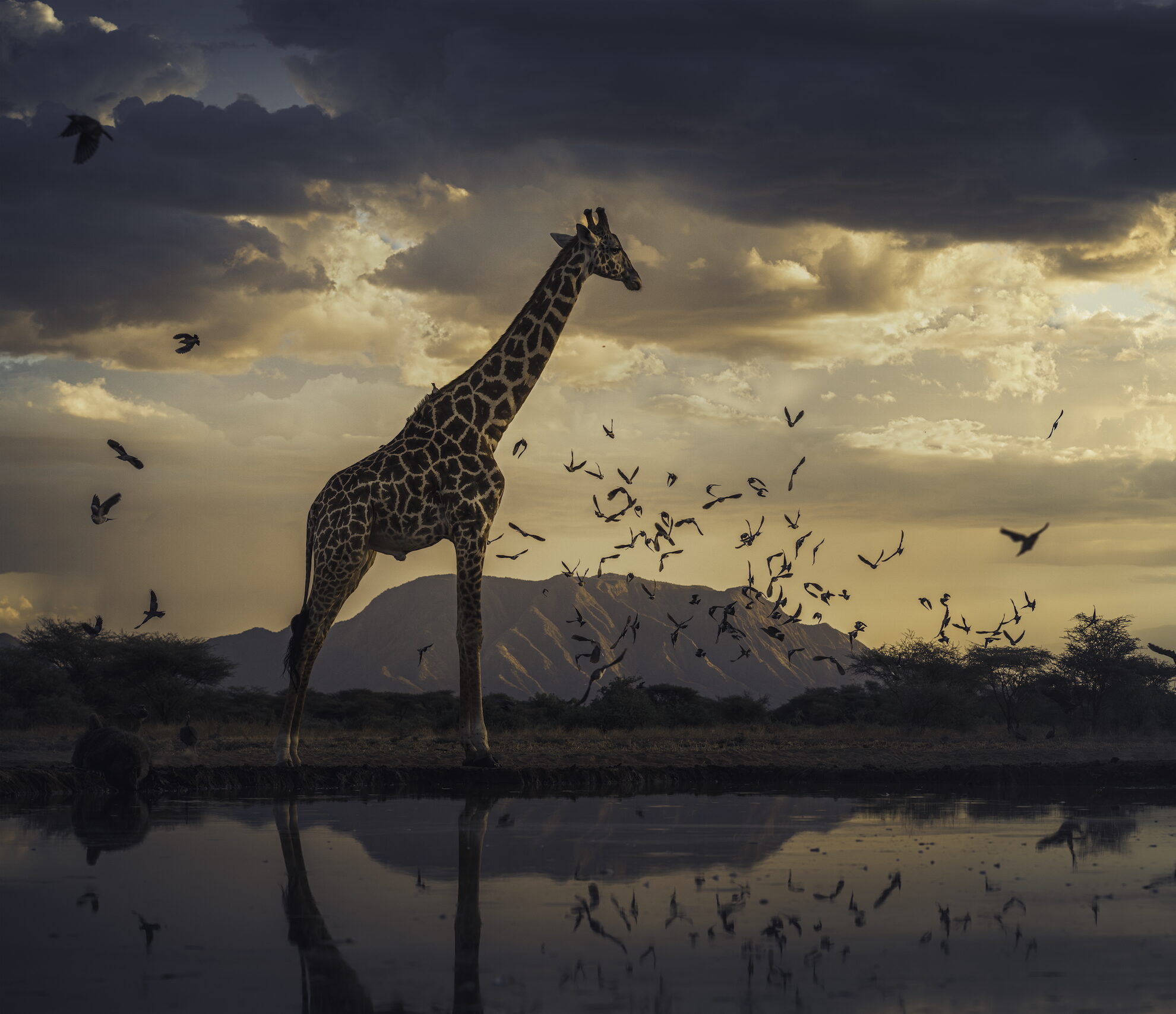
Banner image: As the sun sinks behind the Nguruman escarpment in the west, a solitary Masai Giraffe lingers on at a waterhole after drinking, in the late afternoon heat, as a flock of Wattled Starlings take off. Mt Shompole is in the background and the clouds are slowly building up. It’s the end of the dry season and the rains are not too far away. Photo by Federico Veronesi. Courtesy of Remembering Wildlife.
Notice: Transcripts are machine and human generated and lightly edited for accuracy. They may contain errors.
Margot Raggett: I saw a quote from Sir David Attenborough, which is, “The question is, are we happy to suppose that our grandchildren will only ever see elephants in picture books?” That thought that they could go extinct on our watch, that our grandchildren would only ever see them in picture books, and put that thought into my mind that what you then do is you have a memorial to someone.
You say, remembering, and it’s normally a famous person, but what if it was a species? What if this book was actually a record of what they had been like in the wild on our watch if we hadn’t got our act together and changed things? So yes, it was deliberately provocative. Sometimes people get upset with me and say they’re still around, but I want people to stop and think.
Mike DiGirolamo: Welcome to the Mongabay Newscast. I’m your host, Mike DiGirolamo. , Bringing you weekly conversations with experts, authors, scientists, and activists working on the front lines of conservation, shining a light on some of the most pressing issues facing our planet and holding people in power to account.
This podcast is edited on Gadigal Land.
Today on the newscast, we speak with wildlife photographer Margot Raggett, founder of the nonprofit Remembering Wildlife. It should also be noted that Raggett is a grassroots supporter of this podcast. Her story is quite remarkable. After years of working in the field in Kenya, Raggett witnessed the impacts of poaching on elephants.
Unsettled by the deliberate killing of elephants and a quote from David Attenborough, Raggett gathered high-quality photographs from some of the world’s most renowned photographers and published a book, Remembering Elephants, with the intent of donating the profits to conservation organizations. And the response was so large that demand set in for another book.
And today, Remembering Wildlife is approaching the publication of its 11th book, having raised $1.6 million for 85 conservation organizations in 35 countries. I speak with Raggett about her journey, the intentionality behind memorializing species before they go extinct, and her most recent book, which is on giraffes.
It’s fair to say Raggett’s work features some of the best wildlife photography out there. Some of these photographers have been on this very podcast. What I believe Raggett captures in her most recent book is the diversity of behavior and the context in which giraffes live, their arguably underrated beauty, and the quiet tragedy of humans’ impact on them. Hi, Margot. Welcome to the Mongabay Newscast. It’s great to have you here.
Margot: Thanks for having me. I’m glad to be here
Mike: So I think the first thing we should start with is the name of your organization itself, Remembering Wildlife, which I think is a really, a unique choice. So can you explain when the idea came to you to use that term? Because as you know, we were discussing earlier, it is provocative and it seems to be quite effective.
So when did the idea come to you?
Margot: A couple of things occurred around the time I was thinking about putting the, the first book, Remembering Elephants, together. I saw a quote from Sir David Attenborough, which is, “The question is, are we happy to suppose that our grandchildren will only ever see elephants in picture books?” And I also saw an interview with Jane Goodall, or Dame Jane Goodall a couple of months later where she was talking about the rate of decline at that particular moment, around 400,000 elephants left and 30 to 40,000 being poached a year.
And she was saying, if nothing changes, within a couple of decades, they might not be around anymore, which obviously was oversimplifying things. But even so, that thought that they could go extinct on our watch, that our grandchildren would only ever see them in picture books, and put that thought into my mind that what you then do is you have a memorial to someone.
You say, remembering, and it’s normally a famous person, but what if it was a species? What if this book was actually a record of what they had been like in the wild on our watch if we hadn’t got our act together and changed things? So yes, it was deliberately provocative. Sometimes people get upset with me and say they’re still around, but I want people to stop and think.
And yeah, that’s how Remembering Wildlife came around.
Mike: A-and so then what was the journey to making that first book? ‘Cause that, that was a, a really pivotal moment it looks like. What fell together to make that happen?
Margot: Well, lots of things came around. So I’d been working as a resident photographer in a camp in the Masai Mara for about three or four years at that point, and I’d had a, a wonderful time seeing wildlife every day and taking great pictures. But I had felt an increasing dissatisfaction that I wasn’t giving back to those animals beyond the kind of park fees that, that get paid out to the park and that I was taking from them and not giving back.
And then I had gone to Northern Kenya at the end of one stay, and we were woken up in camp one night by the sound of hyenas going absolutely crazy. We knew something big had happened, and at first light we went to explore and we found an elephant who was about 14 years old. He was dead and the, and the hyenas had started to eat him, and he still had his tusks in.
And, and I said to the rangers, “What’s going on here? Elephants of this age don’t just die.” And they said, “Are you not aware of the poaching crisis? And he’s been poisoned by a poisoned arrow, and what likely would have happened is that the poachers shot him, he bolted and got away but the poison would’ve taken three or four days to seep through his system, and he likely died a, a very painful death.
And it was for nothing. You know, his, His tusks weren’t even taken by the poachers for his ivory.” And I was so shocked at that, and I suddenly had an epiphany that you can go on safari to fancy camps and indeed work in them in the way that I was, and have no idea what’s happening over the hill, down the valley, outside of the protected land.
Everywhere there’s so many threats to wildlife and once I knew it, I couldn’t un-know it. So I thought, “What can I do?” My background is public relations. I worked in London for 20 years for huge companies like Unilever and Boots and Coca-Cola. So I had the skills to think big and think of a big project.
And I started thinking, “Well, maybe it’s a book. Maybe it’s an exhibition. I want to raise awareness, but I also want to raise funds.” And then it occurred to me that if I just did a book of my images, no one but my mum would buy it. So that wasn’t gonna work. But I’ve come to know quite a lot of big-name photographers, ’cause you see the same faces out in the field.
So I approached, I think the first two photographers I approached were Jonathan and Angela Scott and then Federico Veronese, and I said, “I’ve got this idea. Would you give me an image each?” And they said yes and it went from there. I thought, “I need 50 photographers to make that first book,” and that’s what I set out to, to find.
Mike: And I- I mean, obviously I’m, I’m assuming that it was a, a quite a journey from the idea to the actual publication. What were some of the challenges that you encountered in making that first book?
Margot: Well, first of all, I didn’t know 50 photographers. Now, that, that problem has kind of flipped now because people… it’s become quite prestigious to be in our book, so I get approached all the time by photographers offering work. But back then I was- saying to photographers who said yes, and, “Who else do you know?”
Or I would kind of track someone down and see a big name and, and see we had a mutual friend and ask them to give me images. So getting the images, first of all, finding a team to make a book. I’d never made a, a quality photographic book, coffee table book, and I managed to find a team who work with one of the top high-end printers in Italy, so we pulled all that together.
Then we needed funding, so we set out to run a crowdfunding campaign on Kickstarter, and I’d seen actually one of our photographers, Will Burrard-Lucas, had done a successful campaign himself. So I, I picked his brains, and he was very helpful. And I started asking the photographers. I had a good hunch from my PR background that every time someone signed up and said yes, I said, “Please post that on your social media.
Tell your followers that you’re gonna be part of this book so we can build some excitement and anticipation that this is coming along.” So The Poached Elephant was November 2014, and we went live with the Kickstarter September 2015. And all that time was s- spent putting together just the principles of how to make a book, how to get the photographers, how to, to do the crowdfunding.
And I had no idea how it was going to go. I actually… Also, the other problem I had at that point is I, I thought I could do this, but I didn’t know how to spend the money. So I figured I needed to partner with an organization I respected who weren’t gonna let the money go to waste ’cause I was aware that there was a lot of corruption.
And, you could raise all this money, and it could go to the wrong place. So I partnered with the Born Free Foundation, who had been using my images for their marketing. They’d approached me a couple of years before and said would I let them have my work, which I’d said yes. So I said, “I’ve got this idea, and will you partner with me?”
So we went live with the Kickstarter at 9:00 AM on that early September. And by f- I set out to raise £20,000, which is what I had done all my sums to work out would allow us to make 1,000 books. And I figured if we didn’t make the 20,000, ’cause Kickstarter is all or nothing for your target that you set, I’d have just wasted eight months of effort, but no, no money had been wasted.
So, we went live 9:00 AM. By 2:00 PM, we were at £8,000, and I was thrilled, but I also thought it’s still a lot of money to, to get to 20.” But Born Free sent out an email to their database saying, “This project, we’re working with Margot on and get behind it.” And the pledges started coming in.
It was like a fruit machine on my phone. It would flash up every time someone pledged, and in the end, I got a glass of wine and sat there kind of sipping and watching it go up, and we hit the total by 8:00 PM that night. So in 12 hours, we hit the 20,000, and I knew we were going ahead. I might add, this year, and in the last few years, we always set out to raise 20,000 again every year.
This year, we did it in two and a half minutes.
Mike: Yeah I, I saw that. I was, I was uh, I was gonna ask you about it, but uh, thank you for explaining so, I mean, what was the response like after you published that first book?
Margot: It was amazing. I, I will just briefly caveat one other challenge within that ’cause we then took a year to, to make the book. So it came out September 2016. So at that point w- it was a leisurely pace. We now do a book a year, which is a bit more challenging. But the day we finished the Kickstarter, we finished in the morning and I think we raised 58,000 that morning.
At 9:00 PM that night, instead of being out celebrating, I was told I had breast cancer. Um, I’d found a lump the, during that month. And at that point when you first get diagnosed with breast cancer, you have no idea how serious it is what treatment you’re facing. So that was pretty daunting, but I determined that I would just carry on.
I, I, I spoke to the doctors and they were saying, “Well, when people have chemo and radiotherapy and surgery, they still work.” So, so during the next three months of my treatment, I was lucky I caught it early, so I just had radiotherapy and a lumpectomy. But during my radiotherapy I would, like, work on the elephant book in the morning and then go and have my um, radiotherapy in the afternoon.
And I felt it, it kind of almost bonded me even more to the elephants, to the idea. I kind of started feeling like elephants were my talisman. And one really bizarre thing is the day I woke up from my surgery, I turned on the news in the hospital room and the first piece that came on the news was an article saying elephants may be the cure for cancer.
And apparently elephants don’t get cancer because they have 40 genes of something or other that we only have one, and they think that’s why they don’t get cancer. But saying elephants may be the answer, the cure for cancer on the morning you wake up from breast surgery when you’re making a book on elephants, it felt quite fortuitous.
But anyway I’m more than 10 years clear now. It’s all good. But I just kind of mention that because I do want to encourage other people going through that. I always talk about it. I think it’s important to check yourself and not to give up hope, and having a purpose and a focus really got me through it.
So I’m kind of … I’m actually grateful to the, to, that I had the elephants and the elephant book in my life when I was going through that.
Mike: That’s an absolutely incredible story, Margot and, and thank you for sharing that. I um, and I’m, I’m glad that everything worked out obviously and so that must have been really a, a huge celebration and a relief to publish the book. What was that like for you?
Margot: Yeah, it was amazing. So, so we did an exhibition in London, and we did an event at the Royal Geographical Society to launch it, and I was terrified no one would turn up. I remember saying to my friend that night, we, we had all the drinks lined up and the pictures on the wall, and I said, “What if no one comes?”
And then they came. And but not only did people come, but volunteers came. I had another unexpected consequence. I suddenly realized I’d planned this whole exhibition and hadn’t really figured that me, by myself, hanging 60 pictures and everything else was gonna be quite a lot of work. And I put on Facebook, I said, “Is anyone around, like, this morning?
‘Cause I’m in London and I kinda need some help.” And it was like Forrest Gump. They just started arriving, people filing through the doors. And, and we’ve got this amazing band of volunteers now who have stuck through with us through thick and thin. So 11 years later, like, they all have their jobs for this year’s launch of Remembering Giraffes in October already.
They, they all have their particular pictures, and some sell books and some give out bags. And and yeah. Well, well, it just, lots of kind of unexpected consequences, like a sense of community around the photographers. Again, photographers and people flew in from all over the world for it, which staggered me.
I really hadn’t figured that they would. And I- and people started saying immediately, “What,” “What’s next?” And I did at that point kind of qui- say, “Hang on a minute.” I didn’t say I was gonna do another one. I was only ever anticipating one book, and it’s been 18 months of work to get to this point.
But it became increasingly clear to me that we’d alighted on something here that had to continue.
Mike: Yeah, I mean, it’s the traction you gained is incredible and you’ve attracted a, a lot of high-profile endorsements from people like, you know, Ricky Gervais, Michelle Pfeiffer, Russell Crowe, Pierce Brosnan. When did that start to take shape and how was that for you?
Margot: Yes. Again, that’s been absolutely wonderful. So it actually started with Kevin Pietersen, who is a cricketer who is South African born, but played for the UK, so he’s quite a big name over here. And on the day I announced, which was January the 1st, 2017, that we were going to do rhinos as our second book, he announced on his social media he was retiring from cricket and was going to give over his retirement to raising awareness and funds for rhino poaching.
Or as in, and fighting rhino poaching. And I knew him because, again, he’d approached me a few years ago before and asked me for some images for his kids’ bedrooms, and so I’d, I’d been in touch with him. So I wrote to him and said, “Remember me? I see you’re doing this. Funnily enough, I’m also doing a, a book on rhinos this year, so we should team up.”
And he was incredibly supportive. So we did a couple of events together. We… Our volunteers supported him at an event at Lord’s Cricket Ground that he was doing to raise money for rhinos. And he said, “Look, give me your book and I’ll do a video for you, and, you know, I’ll talk about it.” And I figured, actually, that’s a really good way of going about it.
And, and there’s a bit… There’s a a truism with the photographers. Once I had a big name like Jonathan and Angela Scott, it was easier to approach Frans Lanting or Steve Winter and say, “I’ve got these guys.” And then, you know… So once you crack the first big name, other people are more willing to come along, and Kevin Pietersen was that for us with the, with the celebrity campaign.
And then it was a combination. So Born Free had support patrons who were big names. I actually met an amazing lady through something else online who is a, an Australian actress who was living in LA. Um, And she when I told her what I was doing, she said, “Look, my, my husband and I happen to have quite a few famous friends,” and, and it turned out she really did.
So some of the really big names like Michelle Pfeiffer, she was able to just ring up her friend. So you can’t do this through agents. You have to do it through a friend of a friend which is a, a principle that I’ve used for photographers, for celebrities, and also for projects we support as well.
It is something that I really believe in. And actually, just to say that the friend of a friend thing really resonates with me. When we did Remembering Great Apes our advisor on that book was Ian Redmond, who worked with Dian Fossey. Wonderful man. He was our editor for that book. And he told me about a principle that he had realized when he was working with Dian Fossey and the gorillas, that they knew her really well.
So when she went up to see them, they, as he described, they would almost queue up to kind of come and sit in front of her and, and touch her. And if a stranger turned up, they were very wary, but if he turned up with her, they understood the principle of a friend, and he was accepted because he was with Dian.
And so I loved that as a kind of endorsement that, if it works for the, the gorillas it works for what we’re doing too.
Mike: That’s a really, that’s a really cool story. Is there a, um… I mean, , , , you’re on your 11th book now. H- has there been one that has been a particular audience favorite?
Margot: Gosh, it’s ha- I mean, I would say Elephants is an eternally popular book. We’ve just actually reprinted it for the sixth time. And I used some of the crowdfunding from the giraffe book to reprint Elephants because the anniversary will be in September of the 10th year that it came out, and I can’t bear the idea that it would be out of press, and I think we’re down to, like, 20 copies.
So Elephants is always our second best-selling, and I think that’s everyone has a connection with elephants that they love. Probably our second best-selling is Lions. And again, if you think of the l- symbolism for lions, every year when I’m absorbed in a book, I look at the world with different eyes, and there are lions everywhere.
In London, they’re on statues in Trafalgar Square. They’re on gate posts. I went to Italy for a, a photographic exhibition that I was attending, and they were on gate posts there. And, even when you kind of think lions weren’t all around the world, that you just find them on flags and different places.
So I think those charismatic species in particular are the ones that really resonate with people. But as you and I were chatting earlier, I, I kind of think doing books on the charismatic species doesn’t just support them, it actually supports the whole ecosystems that they that they live in. So, it’s a good way to kind of reach people and help some of the less known species as well.
Mike: Right. If through the, umbrella species effect, it’s yeah. And so you’re on your 11th book now, which is Remembering Giraffes. So I guess the question is why giraffes for this one?
Margot: Do you know, I have a queue of species and I- my inbox every day I wake up to suggestions from all over the world for species deserving of a book, and and they’re all valid, and they’re all worthy, so it is very hard for me to to choose. And sometimes I just want to try and mix it up a bit and surprise people and have a, a spread of the type of animals.
And also, ’cause I do think next year we’ll move on from the Africa-centric focus that we’ve had quite a lot in recent years. They’re such an iconic animal. It, it was not right to not talk about them. And also, if you actually look into them and read, you’ll read about this in the book, that the reduction in numbers of giraffes over the years is quite staggering and people don’t realize because they just think they’ll always be there.
And actually, there are pockets of success and, and it, the, the… Like everything in conservation, the story is not even. So there are some areas where giraffes are doing well, and there are others where they’re down to, you know, hundreds. And I just felt they deserved a story to be told.
They are silent and they deserve a voice like all of the other species we’ve covered.
Mike: Hello, listeners, and thank you for tuning in. As I always like to mention, Mongabay is a nonprofit news organization. We rely on the funding from listeners like you, so I encourage you to support the podcast. Go to patreon.com/mongabay to learn more and become a monthly sponsor of the show. If you’d like to pre-order a copy of Remembering Giraffes, which comes out October 12th, please see the link in the show notes
Yeah, we’re gonna come back to the population topic in, in just a bit. But in this book you say, and I love how you say this, you say that giraffes reward patience. And, and from your perspective as a photographer, can you describe how?
Margot: Well, it’s funny actually. I met up the other day with one of our contributing photographers to show him the first copy of the book I’ve got, and he said it made him realize that too often photographers are chasing the the more charismatic, the predators, the lions. They’ll drive past giraffes to get to lions if they know that there are lions there, and yet there are so many different ways to photograph them.
And if you go through the book, the detail of an eyelash, the expression of a mother looking down at a baby, the iconic picture in the sunset against the setting sun or the moon rising. Um, There’s so many different ways to photograph them, but when you first come across them it, it might not look like the best scene, so it, as a photographer, it challenges you to really work your subject.
And this is true for any species, actually, when you’re photographing as a wildlife photographer. Don’t expect to just rock up, take a picture, and drive off and have, something award-winning. Really spend time understanding the species, thinking what you want to show about that animal and how it behaves and different ways of photographing it.
Get your wide angle out and your long lens out and, and try different ways of photographing it. And then they reward you. And, and as I say, I, I think this book is more beautiful than I anticipated it would be. Not that I didn’t think it would be lovely, but there’s just so many different ways to photograph them, and some of what our photographers allowed us to use is just remarkable.
So yeah, they deserve our attention. And and, they’re overlooked too often, I think.
Mike: Yeah, and the images are really incredible. I, I am so curious as to how some of these were were captured. I, I guess I’m just, like, really always curious to hear the perspective of, of a photographer. We’ve actually had a photographer who is featured in this book I believe his name is Marcus Wes- Marcus Westerberg.
I think he was… Yeah he was on here. And he talked about, the process of photography, but photographing giraffes seems like I- I’m just curious. The, it seems a little bit different than other species, the, like, the larger predators as you described, because giraffes are somewhat gentle from what I read.
Ca- can you describe behaviorally how they are when you’re out in the field?
Margot: Yes. I should say actually Marcus is speaking for us at our launch at the Royal Geographical Society this year. So, he of all of the photographers has the most diverse portfolio of giraffe images, and a lot of that he’s got from kind of being embedded with conservation organizations like African Parks.
So going to some pretty remote and not necessarily safe places, and like South Sudan and getting images. So I think there’s an aerial shot from South Sudan that he’s got of pockets of giraffe that people didn’t even know were there, because the area is so difficult to get to and so war-torn that you can’t get in, and yet there are giraffes who’ve adapted to kind of swampland in that area.
So, so aerial shots is one of the, the type that Marcus has got from helicopters with conservation organizations. But when you spend time with giraffes, a- again, they, they, they just seem to be standing there or maybe grazing a bit, and so people just kind of move on. But actually, there is a peacefulness to them which a- is a really good exemplification for me of, of how I f- came into wildlife photography, which I find it therapeutic almost d- just spending time calming down, calming your breathing, watching them.
It is meditative watching giraffes. And as I say, when you start to then see the detail of them, so I particularly love mothers and babies and my shot is of a baby looking up at his mother, and I spent the whole afternoon with that baby. I was so entranced by it. So I literally, at a distance with my long lens, we just followed it, and I got different moments of when it was nuzzling, when it was trying to to feed when it was looking up at its mom, when its mom was looking down at it.
And again, it’s just, you know, that to me, the kind of moment of getting totally absorbed in, in, in wildlife and how it’s living its life takes you away from the day-to-day world and all the stresses and strains that we’re worried about. And, And that’s what I’m so grateful to, to get the chance to do for-
Mike: Yeah, I have to say those images are some of my favorite in the book especially the one from, I believe, photographer Tom Way. It’s in black and white, and it’s an incredible image. Something that I think is really cool that I think a lot of people might not be aware of is that, is how evolutionarily unique giraffes are.
And you , you write about it in the book that , they separated from other hoofed mammals around 20 million years ago, which is a really long time. And the current, the Giraffidae family only has two members, gira-giraffes and okapi. But just over the past 10 years, it has been confirmed, I believe, that there are actually four different species of giraffe.
I was wondering if you could talk about this unique evolutionary chain that giraffes occupy.
Margot: Yes. I mean, I think obviously if you think about natural selection and they think that what happened is that giraffes that could reach the highest branches of trees to feed where others couldn’t find anything to eat, perhaps during droughts or difficult times, that benefited those animals.
And so they were the ones that then went on to breed and, and so gradually over time, the necks got taller and taller and, and, they found their specialism and they’re able to reach branches that no other animal can and can survive in areas that no other animal can. So it is quite remarkable as a, an example of evolution as to what they’ve achieved.
And, and obviously to say I’m, I’m not a scientist, so I can’t go into the detail, but I know that, what’s required for their blood pressure in order for the blood to get up to their brain is quite a challenge in itself. And if they have to bend down to drink, they can… If they bend down for too long, they can’t get up again ’cause all the blood goes to their head.
So, it’s not the ea- easiest body to have evolved, but they’ve made it work. And it truly is remarkable and, and worthwhile. You know, We just take things for granted nowadays. But think about it, you know, that, that that’s how they have overcome the challenges of where they particularly live to, to get where they are now.
Mike: Yeah I, I uh, I found it , really interesting is I didn’t know this either, but, like, their- apparently their tongues are really adapted s- for ultraviolet light from the sun because they spend so much time, reaching for, for branches with their tongues. So I just thought that was incredible. How is it that you go about selecting images for these books?
E- especially this one because I, I mean, you’ve got some, again, incredible photos from, from 20 different international photographers. And one of them is, you know, one of them is actually Australian, I believe. But how do you go about selecting those images?
Margot: Well, it’s actually 65 photographers, but the 20 you’re referring to I think are the competition winners, of which one was uh, an
Australian winner. so so we have two routes, and as I said, it’s going back to that first challenge. That first year we wanted 50 photographers, and then we thought we would open it up to 10 competition winners that first year because we figured although my aim that year was to get the biggest names I could because I figured from a kind of PR and word of mouth perspective, bigger name photographers, more people would be interested in the book.
We knew that there would also be lots of photographers out there who don’t have big names but could have remarkable images. So we always wanted a, a route in for those. And over 11 years it’s evolved. We’ve now worked with more than 320 photographers, I think, so… And there’s only space for 65 images, so I have to try and control it a little, ’cause I don’t want to invite all 320 to submit and then have to let down whatever it is, 260 of them and, and hurt their feelings.
So, I actually nowadays for this book, I invited photographers who’d been in at least six books I think. So that narrowed down the pool from the kind of pros as it were that we were selecting from. And then we also in recent years have increased the competition to 20 places. So from the pros, the way it works is I have a, an art director and actually one of our other photographers whose eye I really rate a lot, Tristan Dix, worked with us this year.
And we have an image selection day. So photographers might send two images or they might send 200 and we work through it folder by folder on Zoom for a day. And we go through and say, “Okay, here’s, here’s Tom’s folder,” and I flick through them. And then we all say which one we preferred, and often we’re in alignment and we say, “Yeah, that black and white,” the, the one you’re referring to with the, the baby’s head through the legs is quite remarkable.
So we kind of shortlist per folder as we go through, and then we come back at the, what selection we’ve made. Sometimes we might do two or three for a photographer and then try and make sure we’ve represented all the behaviors as well. So we might say, “Actually, we don’t have yet one of a giraffe stretching its neck up to to reach,” or, we don’t have one of it drinking, for example.
And so again, the kind of behavioral knowledge, the fact that I’ve, I know giraffes well and I’ve spent a lot of time photographing them myself, I’ve got a good mind for all the different behaviors we want to reflect. We work with the top kind of organizations each year. So this year it’s Giraffe Conservation Foundation who’ve written the behavioral essay.
So I look through that and make sure that we’ve represented pretty much everything that they’re talking about that we want to have. So it’s a, it’s a lot of juggling and then, then we do a first kind of run-through just to see how they all look. The competition winners get slotted in pretty much the same process.
But we have external judges for the competition who are photographers. So, this year we had very experienced photographers, Daryl Balfour and Wim van der Heijden, who’s actually the current reigning Wildlife Photographer of the Year, so he’s got a good eye as well. Um- So yeah, a lot of input from different people.
But I’m spoiled for choice is the answer, and I could choose an entirely different set of images and still have a beautiful book because we’re d- photographers send us uh, their best work, and I, I get to choose from it. So i- it’s, it’s like a kid in a candy shop going through wonderful images and sometimes we’ve had to not run things that we wanted to ’cause there just isn’t room.
Um, And I have… You know, I can’t make a 500-page book. I have to keep it to a size for economic reasons and, and things like that. So, so yeah, it’s… We’re very
lucky
Mike: It must’ve been, it must’ve been a difficult task. There’s, and speaking of like, capturing different behaviors, there’s a, the photo from one Australian photographer, I, I believe his name is Ivan Glaser. And there’s an image of what appears to be three Masai giraffes being chased by, I, I believe it’s a cheetah, but I’m not, I could be incorrect.
And it’s just a, it’s just an incredible photo. D- can you tell us anything about that photo? Because it is a really remarkable image.
At the end of our conversation, Margot pulled up a description, which Ivan Glaser appears to have written, describing the moments before, during, and after this particular shot was .
Margot: After hours of tracking the cheetah Oloty as he searched in vain for prey, we turned to a distant group of giraffes with calves in good light. Moments later, our guide shouted. Oloty was sprinting straight towards us.
Expecting a gazelle, we scanned the plains until it became clear his target was the giraffe calf. The adults reacted instantly, closing ranks to shield the young. Outmatched by their size and powerful hooves, the cheetah’s bold gamble was quickly shut down. A fleeting display of instinct, risk, and survival
Mike: It’s a really incredible shot. And like you s- and like you said before, I think it highlights the diversity of the instances of behavior of this animal. And so, congrats to, to Ivan. That, that’s a very masterful shot. So, right now giraffes, they’re considered vulnerable by the IUCN. And something interesting that I encountered in my research for this episode is that they declined by about 30 to 40% in numbers since the 1980s. And then they hit a low point in 2010, dipping below 100,000, and now there’s about 117,000, so to speak because of an increase in conservation efforts and improved counting methods.
But I was wondering if you could comment broadly on the population of giraffes, and also what are some of the more inspiring conservation efforts that you see helping to keep giraffe populations stable?
Margot: I think that giraffes are a good example for all of conservation species. Where there are focused efforts, they can often be brought back from seemingly catastrophic situations. And so, actually, the, the Nubian giraffes is one example, which they used to be known as Rothschild exam- giraffes.
In Kenya, their numbers have got down to less than 100 at one point, I think, in the ’70s, and then there was a, a very focused effort by a couple who owned a property in Nairobi, which has gone on to be the, the hotel Giraffe Manor. But they had a breeding program there, and then re-released them back into the wild from that, and actually the numbers of Nubian giraffes have now gone up.
So I think that, again, southern giraffes are doing really well at the moment in, in South Africa, but again, as I talked about Marcus Westberg’s picture, where you have some of the kind of West African giraffes, their numbers are down to the hundreds. But Giraffe Conservation Foundation, again, have done a lot of work and done translocations of them to try and bring them back.
So, you just can’t take them for granted, and you have to have focused effort on what numbers are doing for individual species. One of the challenge we had this year is that the IUCN data is pretty out of date, so since these, they’ve been reclassified as the four species, there isn’t up-to-date information on the numbers of each of those.
So, and the, and the kind of classification for those is out of date. And I had long debates with Giraffe Conservation Foundation as to what we would do, because normally we just say, you know, “This one is endangered. This one’s critically endangered,” and we just couldn’t for this. But say that there are pockets where there are, the, the numbers are down, and then there are pockets where they’re doing just fine.
But the bigger picture is that, their areas where they can live, they’re are getting more isolated, more highways are being built. The kind of, the ability for them to migrate in the way that they used to is under constant pressure, just like almost every other species that, that we’ve covered so far.
So, they need effort and concentration. You can’t take for granted that they will still be here unless organizations like Giraffe Conservation Foundation, carry on their great work
Mike: Yeah, this is a, this might be a good segue into there’s an image in the book that’s really quite provocative, and it’s called uh, The Giraffe in Red Sneakers by Charlie Hamilton James. This is a very, a very provocative image.
Can you talk about it?
Margot: Sure. And it is indeed provocative, and I thought long and hard about using it, but I felt it was quite an important thing to do. So Charlie was photographing a drought in Kenya and taking drone pictures of animals that had passed away from the drought. And as he describes in the essay that we continue he had a picture of a, a giraffe that was prone, lying dead.
And he said it was, a, a poster for the drought and what was happening to species. But something nagged at him that it wasn’t quite telling the whole story. We don’t know exactly what had killed that giraffe. We just know it’s cumulative drought, and whether it’s not enough water or not enough food or, what other factors had come into play there.
And so he, he said he spent time thinking about and nagging away in his head what he could do to elevate the picture and tell more of a story and, and he had a, a, an epiphany, and he rang a friend in Nairobi and said, “I need you to go and buy the biggest, most garish red sneakers that you can find. And I need you to get them kind of biked down to me where I am.”
And he put these red sneakers on the giraffe and did a drone shot of it. And it, it is such a shocking image to see a, a dead animal wearing bright red But what he goes on, and I’d encourage everyone to read the essays, he said, that these, this giraffe died of consumption. And actually it’s all of the factors that lead to droughts that are causing species to decline.
Too much buying and consumerism from humans is having a knock on in so many ways, including climate change. And we need to stop and think about that. So he, he had quite a lot of, kind of, feedback, put it that way, when, when that image came out, and so… But I remember it at the time and thought it was such a brave image for him to take.
And, he, he’s a big name. He’d worked for Nat Geo for many years. He’s won lots of awards for his filmmaking as well. And so he really kind of put his neck on the line um, excuse the pun to, to make a point here, to make people stop and think. And, say, it’s quite hard to show what’s happening with decline in giraffe numbers in an image.
It, with elephants with rhinos, you know, we’ve all seen the pictures of rhinos with their horns cut off, so you kind of know that’s the picture of what’s going on. But you don’t really see giraffes that have passed away in a way that resonates and makes us think humans are connected to that.
And that’s what I think he achieved in that picture, and that’s why I wanted to use
it
Mike: I really felt like he took the step to connect the dots for the viewer about the systemic contribution to the decline of our planet, our climate, our wildlife, and it was, it was pretty brave of him to do that. We’ve had a number… I mean, as I’ve explained, we’ve had a number of wildlife photographers on the podcast before, and I, and I’m, and I really am always curious to hear what, what surprises you or has surprised you the most in the field?
Like, was there, is there anything that occurred, this could be several things if you’d like, but is there anything that occurred that really surprised you and struck you?
Margot: Well, I can give you two examples. One, a lovely wildlife moment that was just very special. But but the bigger thing is and I recently wrote a, a an article on Substack about this, is human behavior and tourism and wildlife photographer behavior in some instances around wildlife. And again, you, you think that, it’s all like a Garden of Eden when you go out there and the giraffes are, d- crossing the horizon against the sunset and it’s beautiful, and you don’t think about the 500 cars that are racing towards a cheetah because they’ve heard that there’s a cheetah there or, i’ve been in situations where I’ve seen cars surrounding cheetah cubs in places that they shouldn’t be off road, but they do. In India where, tiger tourism is frenetic and people are shouting at the tiger as it kind of looks terrified and tries to dash between vehicles. And I think we need more thought and photographers and, it, I’m not there for every single image that’s taken in our books, obviously, so I can’t, I can’t endorse that, that every single picture was taken ethically.
But I just encourage every photographer we work with and, and beyond to, to think about a situation and think, “Do they feel comfortable in that situation?” And I, this isn’t just a wildlife issue, it’s a tourism issue generally, isn’t it? We’re seeing so many stories of cities being overrun and popular tourist kind of selfie moments over spoiling places and, but for wildlife it’s, it, it’s then impacting the animals as well, and I’ve certainly heard of I wasn’t witness to it, but I’ve heard of a cheetah dying because a photographer vehicle pa- parked itself deliberately in the route of a cheetah chasing an animal so that they could get a shot of the cheetah running towards camera.
And it smacked into the vehicle and died. And even the pictures of cheetahs on rooves in vehicles which people think are super cool and some safari companies still use to market themselves, that cheetah falls off or that cheetah swipes, one of those tourists inadvertently, then that cheetah is dead.
And, we have to realize it’s a privilege to be there. So actually, more often than not nowadays, I leave sightings rather than stay at them. Which, when I was working in the Mara back in 2010, it was busy. It’s nothing like it is now. But I, again if it, in any way I felt the animal was being impacted, was looking at vehicles or photographers, I would want to pull away.
So that, that’s the bad side of what I’ve seen that surprised me. It wasn’t something I imagined before I moved into this world. But then a, a really positive moment I was in Botswana a few years ago. It was 40 degrees, the sun was burning down, and I was in an open vehicle for an afternoon game drive, and it was hot and dusty, and we weren’t finding anything, and I just figured everything was asleep in the shade.
So I said to the guide I was, was with, “Let’s just go and park at a waterhole in the shade, and I’m gonna do some birding.” So I had my camera set up, my long lens set up at 800 mil resting on the bonnet. I was in the passenger seat next to the driver. And I was looking through binoculars, and we’d, we’d sat for about 20 minutes in silence while I was just kind of referring to my bird app and looking at the birds, and suddenly through the long grass, a single leopard tentatively crept forward.
And she clearly knew we were there, but we were a good kind of 40, 50 foot away from her on the other side of the waterhole, so she decided she was safe, and she started drinking. And so I was able to pick up my camera without scaring her- And this was in a, an area that is so remote. It was the central Kalahari.
The leopard density there is tiny, so people just never see leopards there at all, certainly not in daylight. They might at kind of water at hides at night, and this was in daylight about 6:00 PM. So she started drinking, and I picked the camera up and started photographing her. And then I was so absorbed in the lens that, or in the, the viewfinder rather, that I suddenly kind of was blinking ’cause I thought, “I’m seeing double here.”
And her sub-adult had come in, it was about 18 months old, and started drinking next to her. And they’ve got different colored eyes, and they’re both their pink tongues looking at me. And that was one of those moments where I was pinching myself thinking, “Don’t mess this up. Make sure that the camera is actually on, that, that your settings are correct,” because I could not believe it.
I could not believe it. And there were some guys who are friends of mine who’d been in camp with me, but they’d actually gone to a hide that afternoon. And I did say to the guide who was with me, “Radio them to tell them we’ve got leopards.” And, and he couldn’t get ahold of them. They’d left the radio in the car.
So when we got back to camp, they were like, you know, “How was your afternoon?” I was like how was yours?” And they said, “Oh, nothing really. And how was your… ” I was like, and showed them. And the, the guy’s a very experienced camp owner. He said, “You’ve no idea how special what you’ve just captured is.”
And I said, “Oh, no, I, I really do.” So that was a, like, once in a lifetime moment. And again, it was, just because it was us, we were silent, we didn’t scare the leopards. You know, How many leopards are hiding away, because humans are too loud and too busy and too frenetic that they wouldn’t come through?
But, to be that lined up in that way for that moment will stay with me forever. So that picture is actually in Remembering Leopards. And yeah, that, that’s probably my all-time favorite sighting ever.
Mike: That’s an incredible story. Thank you for sharing that. I, I I hesitate to ask this, but I’m gonna. Are you in the process of deciding , the next book? And if so, can you share anything? Can you hint at anything?
Margot: Well, I’ve already given you one hint earlier on, so, as I said, I, I suspect we’ll move away from Africa, but I’m not gonna say any more than that at this point. Well, one of the reasons is because there’s so much work to get to the launch of the current book, Giraffes, that if I, if I give it away, I will start being approached by organizations and photographers wanting to be part of the next book, and I, I can’t…
I physically can’t cope with, with um, you know, doing more than one. So w- moving on to the next one. So I… And we have a bit of a tradition now. I, I tease people, and then on the 1st of January, I always announce um, what the next one’s going to be to get going on that book. But I do, I do have a fair idea at this
point, yes.
Mike: Uh,
Where would you, where would you like to direct people to, to learn more about the book or perhaps purchase a copy?
Margot: Thank you. Well, our website rememberingwildlife.com we have a shop on there, so if you buy direct from us on the shop we get to keep all of the money. If you buy through online retailers or any bookseller, they take a slice. If that helps with postage and delivery, then, absolutely understood, but if you’re able to buy from our website, that’s the best way to go to us.
And at the moment Remembering Giraffes is on pre-order. It comes out on the 12th of October, so b- books will be posted out from the 12th of October if you order ahead of that date, and then, and then it’ll be on sale
Mike: Well, Margot Raggett, it has been a pleasure speaking with you. Thank you for joining me today
Margot: My pleasure. Thank you so much for having me
Mike: as always, if you’re enjoying the Mongabay Newscast or any of our podcast content and you want to help us out, we encourage you to spread the word about the work we’re doing by telling a friend and leaving a review.
Word of mouth is one of the best ways to help expand our reach. But I also encourage you to support us by becoming a monthly sponsor. You can do so by going to our Patreon page at patreon.com/mongabay. We’re a nonprofit news outlet, so even when you pledge a dollar per month, this makes a very big difference, and it helps us offset production costs.
So if you’re a fan of this podcast series, I encourage you to go to patreon.com/mongabay to learn more and support the podcast. But you can also read Mongabay’s news and inspiration from nature’s frontline at mongabay.com or follow us on social media. Find Mongabay on LinkedIn at Mongabay News and on Instagram, Threads, Blue Sky, Mastodon, Facebook, and TikTok, where our handle is @mongabay and on YouTube at MongabayTV.
Thank you as always for listening.
