


- Malawi’s maize harvest has barely grown in two decades even as its population has surged, leaving millions vulnerable to food shortages each year.
- Small farmers struggle to produce enough food on tiny plots because of high fertilizer costs, degraded soils, erratic rains, and unreliable access to government subsidies.
- Many farmers sell much of their maize to pay for basic necessities, then depend on risky vegetable crops or scarce seasonal jobs to buy food during the lean months.
- After two decades of maize-focused agricultural policy, experts and farmers say Malawi needs stronger support for diverse, resilient farming and rural livelihoods rather than simply producing more maize.
GOLIATI, Malawi — All that’s left to eat in Tapiwa Ligomeka’s one-room home is stored in a small plastic basin in one corner. Two days earlier, her husband came home with 2 kilos of maize meal, about 5 pounds — all he could afford to buy after a day hustling for casual work carrying traders’ goods at a nearby market, here in southern Malawi’s Thyolo district.
On the day Mongabay visits her home, Ligomeka has just returned to her thatched-roof house in the village of Goliati, clutching a bundle of dry maize and pigeon pea stalks to make a fire later, her 8-month-old baby strapped to her back. It’s coming up to noon on a Sunday; her husband is still out watering his tomato crop near the river.
“I’ll wait for him,” says Ligomeka, 18, dropping her bundle by the cold fireplace on the verandah. “This flour cannot make enough nsima for us to eat separately.” Nsima is the Chewa term for Malawi’s staple dish, a stiff porridge made from maize flour and usually eaten with vegetables, legumes, and, for those who can afford it, meat or fish.
“It also means there won’t be anything for us to eat this evening,” Ligomeka says, measuring the flour with scoops of her right hand. “Sometimes, that goes on for two days.”
She says the couple harvested 178 kg (392 lb) of maize from their small farm in March. They couldn’t afford fertilizer for their plot, which measures less than half an acre, or a fifth of a hectare, and have had to sell some of their maize to earn money to buy sugar, soap, and cooking oil for the home.
Now that maize is all gone.
A national reliance on maize
In Malawi, maize defines food security. It’s grown on nearly 90% of land allocated for cereal production.
The government estimates Malawi’s 2026 maize harvest at 3.3 million metric tons, a 15% increase over the previous year’s. This still falls short of the national maize requirement of 3.5 million to 3.7 million metric tons. The government says this deficit will expose as many as 2.6 million people to hunger in the lean period between October and the next harvest in March 2027. Most of those affected, ironically, will be among the more than 4 million smallholders who form the backbone of the country’s maize production.
Every year over the past four years, somewhere between 3.8 million and 6.2 million Malawians have suffered food shortage, government data show.
In 2014, Malawi and other African governments “recommitted” to an earlier set of policy prescriptions to strengthen agriculture. The African Union’s Malabo Declaration put agriculture-led growth forward as a strategy to achieve prosperity and food security, aiming to double the continent’s farmers’ productivity by 2025. Governments were to allocate 10% of their national budget to the sector, and build partnerships involving agribusiness, civil society, and farmers to expand access to quality seeds and fertilizers at affordable prices; strengthen irrigation and water management; improve access to mechanization and energy to more farmers; and broadly improve knowledge, information, and skills.
For a variety of reasons, these pledges have not come to pass.
Soon after the original Comprehensive African Agriculture Development Plan was adopted in 2003, Malawi’s government began subsidizing fertilizer and maize seeds for poor farmers. Each year, around 1 million farmers are meant to be allocated two 50-kg (110-lb) bags of fertilizer, and 5 kg (11 lb) of hybrid maize seeds.
In the decade before the farm input subsidy program was launched, Malawi’s maize harvest ranged between 1.3 million and 1.6 million metric tons. The subsidy made an immediate difference: In the 2005-2006 season, when the program started, Malawi produced 2.7 million metric tons of maize — a half-million-ton surplus over the country’s estimated need that year, and more than double the previous year’s 1.25 million metric tons (admittedly Malawi’s lowest harvest in a decade, due to bad rains).
Government records show the 2007 harvest rising again, to 3.4 million metric tons. Between 2005 and 2011, maize yields averaged 3.6 million metric tons. Encouraging, but 20 years on, output has remained at roughly this level — even as Malawi’s population has grown by more than a third, and now stands at more than 21 million.

A subsidy that stopped delivering
Back in Ligomeka’s village of Goliati, village chief Chimwemwe Matiza (known, in accordance to local custom, by the name of the village, Chombo), says increasingly erratic rains, acute land shortage and degraded soils remain primary drivers of hunger here.
“In this village, you can’t find 20 homes that harvest 20 sacks [roughly 1 metric ton] of maize every year,” she tells Mongabay at her home.
“We don’t have land here, and those with small parcels have no fertilizer. It’s expensive on the open market and government’s cheap fertilizer doesn’t come,” she says.
Several reports, including from the government itself, have found the program fraught with corruption, procurement inefficiencies, and rising prices as years have passed, depriving many farmers of the inputs.
The land shortage in Thyolo district has commercial origins. Forty-two percent of the land in the district has poor soils or topography unsuitable for cultivation. On the land that remains, the district hosts an expanse of tea plantations. Thyolo is one of Malawi’s two largest tea-growing districts, alongside neighboring Mulanje. Established by the colonial administration in the early 1900s, these estates now cover more than 1.4 million hectares (3.5 million acres) of land in southern Malawi, an inquiry in 1996 found.
Ten years ago, with a population of 721,000, the average size of a family’s farm in Thyolo was 0.4 hectares, or about an acre.
According to Chombo, persistent hunger in her area is aggravating social challenges, such as child marriages and rampant theft, as well as environmental ones. Unregulated sand mining for income is rising, damaging riverbeds and linked to increasingly destructive floods during the rainy season, and painful water scarcity when dry spells fall. Illegal charcoal production has largely razed natural forests.
“I’m struggling to address these issues,” Chombo says. “How do you punish someone who is destroying a community forest so he can feed his children?”

‘If it fails, I have no idea what happens’
Outside of the maize season in Goliati, households grow vegetables, planting mostly tomatoes and cabbage in riverbanks and dambos, the shallow wetlands unique to this part of Malawi. They sell this produce to urban markets in Blantyre, the capital, about 40 kilometers (25 miles) away.
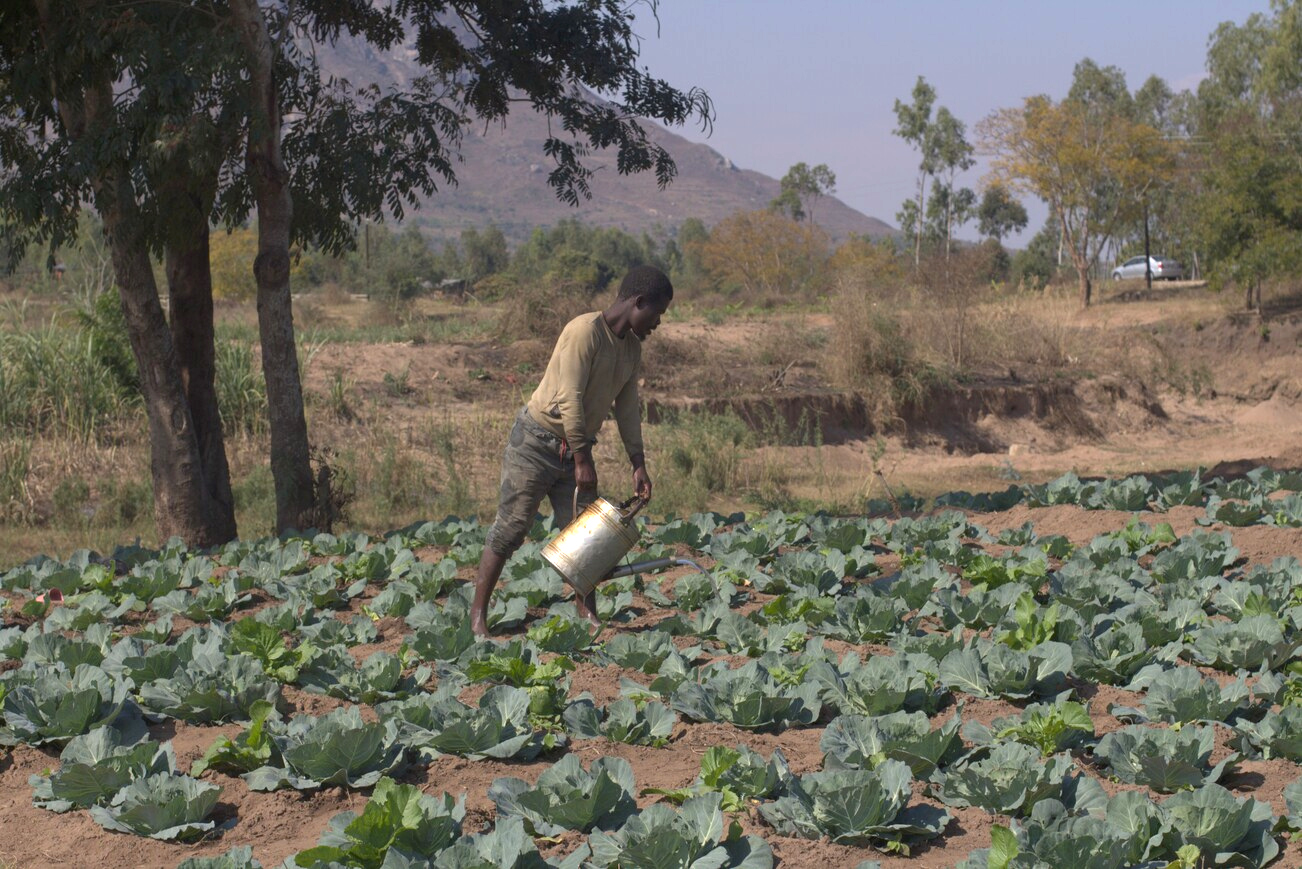
Beneath a blazing midday sun, Laston Mchiswe dips two watering cans into a pool in the mostly dry bed of the Lichenza River. Barefoot, he strains up the riverbank carrying the cans to water his 400 head of cabbage. In April, he harvested 260 kg (573 lb) of maize, but like Ligomeka, that’s all but gone now. This cabbage is meant to provide income for food for his family through the next few months.
“If it fails, I have no idea what happens,” says the father of four.
The vegetable crop looks promising in many fields along the river this year, but the farmers say oversupply often causes prices to drop, reducing their income. This can leave growers in debt, a prospect that Ligomeka says she dreads. She and her husband borrowed the equivalent of $120 from a produce trader to invest in their tomato production. Their agreement is that they will repay the debt in tomatoes. If prices crash, this could claim their entire harvest.
There are few other options for income in the district away from the vegetable fields. The tea estates offer seasonal picking and processing work between November and April. A tea pickers’ union member says many earn between $150 and $170 each month. But this seasonal labor coincides with the maize-growing season, which is also when the maize shortage is at its worst.
There are also some jobs for cleaners and gardeners on the palatial, Chinese-funded campus of the Malawi University of Science and Technology, built in Thyolo district in 2014. Some locals have set up stalls selling food and other groceries to students at the gates, but residents say the university’s impact has mostly been a scramble to buy up precious land to build student hostels and accommodation for staff.

Looking beyond the maize monoculture
The Malabo Declaration’s preamble expressed concern over “the heavy and growing dependence of our production systems and consumption patterns on external factors,” including weather, global markets, and climate variability. For too many people in Africa’s countryside, the policy and practice governments adopted has not built the promised resilience of rural livelihoods and food systems.
Timothy Wise, a U.S.-based researcher and author who has closely studied the unfolding of agricultural policy in Africa over the past 20 years, says governments, donors, and international institutions like the World Bank and AGRA (formerly known as A Green Revolution for Africa) have pushed Africa’s smallholder farmers off some of the most productive lands and encouraged them to adopt unsustainable, high-input farming practices that leave them vulnerable to climate and financial shocks.
“When you find yourself in a hole, the first rule is to stop digging yourself deeper,” Wise tells Mongabay in an email
“Africa needs to climb off the technology treadmill of green revolution monocultures and look at the inspired models offered by their own farmers, who are growing a diversity of food crops, restoring soil fertility, increasing resilience to climate shocks, and doing so at far lower costs.” he says.

‘We know what is food for us’
Back in Thyolo, Chombo says calls, albeit irregular, by some government and NGO officials for Malawians to break away from dependence on maize are a cover for failing to adequately support farmers.
“They tell us on radios that maize is not the only food,” she says. “That’s convenient for them. They contradict themselves. That subsidy program is built on maize because they know that maize is food security in Malawi.
“So they should not create excuses for their failure to support us with land, inputs and extension services for us to produce enough maize by telling us about [eating] sweet potatoes, sorghum and pigeon peas”, she adds. “We already produce these crops and we know what is food for us.”
Banner image: Malawian farmer Laston Mchiswe watering cabbage that he will sell to markets in the nearby city of Blantyre to earn money for food for his own family. Image by Charles Mpaka for Mongabay.
Global hunger levels fall but Africa still lags behind, UN report finds
In Malawi, one woman’s farm shows what’s possible with land and support
Feedback: Use this form to send a message to the author of this post. If you want to post a public comment, you can do that at the bottom of the page.
Cite this article
Charles Mpaka (2026). Land crisis and ‘green revolution’ practices trap millions of Malawi’s farmers. Mongabay Conservation news. DOI: https://doi.org/10.66709/news-326364

