


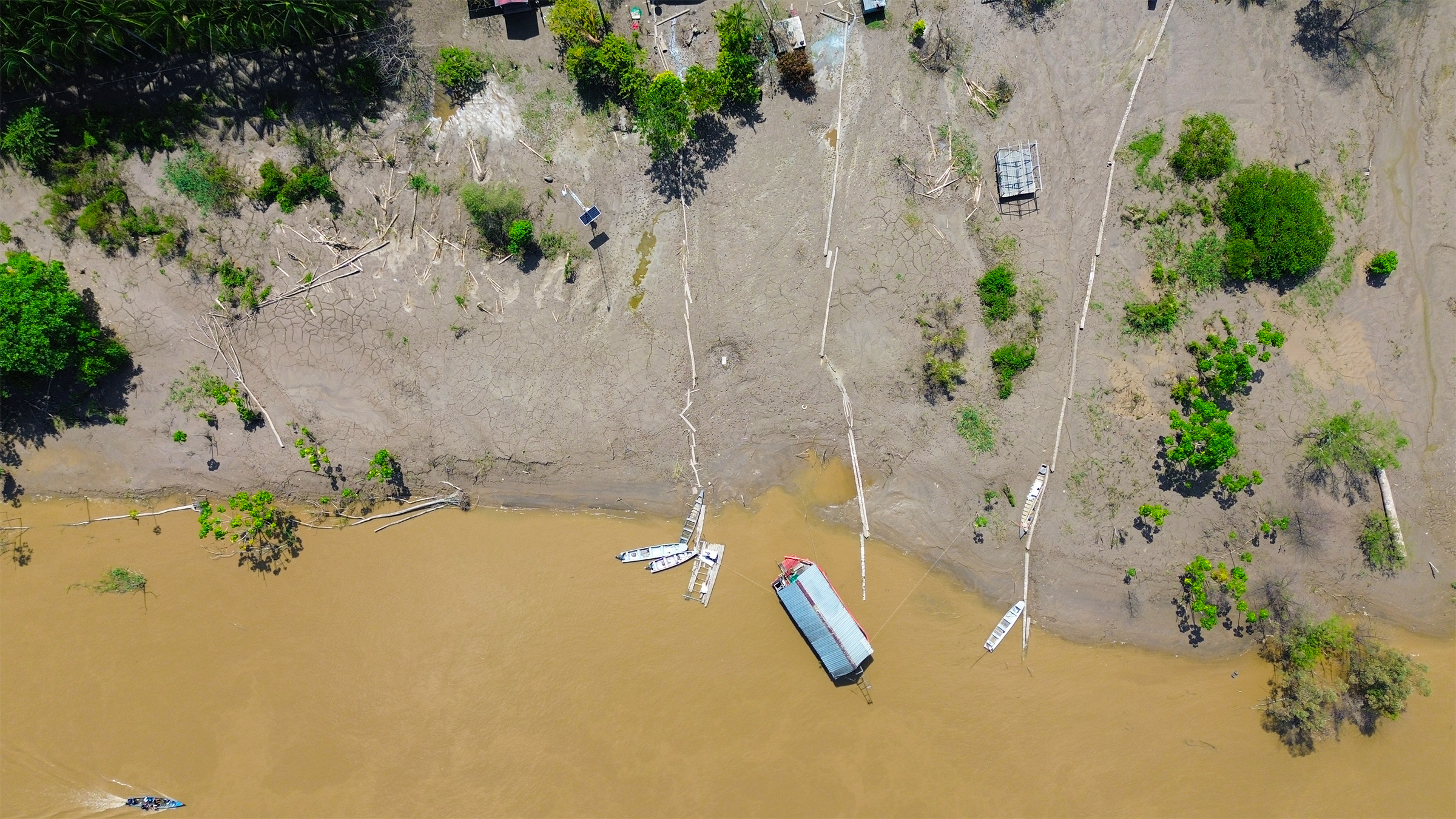
- Brazil is planning to dredge the Madeira River to boost grain exports despite recent fatal barge collisions and poor dialogue with local communities.
- In addition to accidents, expanded traffic and dredging pose risks of erosion, water pollution, harm to aquatic species and fishing.
- As national elections approach, communities worry that politicians will prioritize agribusiness over the safety of those who rely on the river to access doctors, schools, work, trade and daily routines.
CALAMA AND PARAÍSO GRANDE, Brazil — A mother and her three kids died after a barge loaded with soybeans collided with a floating structure and completely destroyed their stilt house on Jan. 17, 2025, in the Urumatuba riverine community along the Madeira River, in the Brazilian Amazon. Four months later, another freight vessel hit three mining barges anchored in the neighboring Nova Catarina riverine community, in the Manicoré municipality, in Amazonas state. The owner of one of the mining barges was the husband of the woman and father of the three kids who died in the January accident, according to a local news outlet.
Mongabay was reporting in riverine communities in the region of the city of Humaitá, 190 kilometers (118 miles) southeast and downstream from Manicoré, when the second accident happened. All those interviewed on that day and the following days said they were terrified by the event — and knew someone who suffered losses or even died in collisions involving grain barges in the Madeira River.
“We are very worried here in our community about these vessels,” smallholder Maria Delci Barros de Morais, 59, told Mongabay on the balcony of her house in the riverine community of Paraíso Grande, located 30 minutes by fast boat from Humaitá. “They’ve already run over someone we know.” The barge smashed the boat used by the family as a home, she recalled. “Thank God no one died.”
According to Morais, the risk increases during the Madeira River’s high-water season, between December and May, when its banks are flooded. A few days before Mongabay’s visit to her community, a grain barge passed very close to her house, although it could “easily divert” because the river was quite wide, she added. “I was scared that day.”
Stretching 1,060 km (658.65 miles) over 11 municipalities in the northern states of Amazonas and Rondônia, the Madeira River waterway is one of the most important routes to transport soybeans, corn, sugar and other grains within the so-called Arco Norte logistics corridor. The waterway accommodates convoys ranging between 440 meters (1,444 feet) and 9,900 meters (32,480 feet) wide, carrying up to 18,000 tons, even during the dry season, according to Brazil’s department of transport infrastructure, DNIT.
In August 2025, Brazilian President Luiz Inácio Lula da Silva ordered the inclusion of the Madeira waterway in the country’s privatization program aimed at bolstering cargo capacity through private management and regular dredging. However, it was revoked in February, following an outcry from Indigenous groups due to the lack of prior consultation, as required by law, for the inclusion of the Tapajós River waterway in the privatization plan, which also included the Tocantins River waterway.
Despite the setback, the federal government unveiled a 123.6 million reais ($24.17 million) plan in May for dredging operations on the Madeira River, aiming at enabling navigation during the dry season. A tender to choose the company that will manage the waterway is expected in the first half of 2027.
The communities visited by Mongabay in Amazonas and Rondônia states said they weren’t consulted about the expansion of the Madeira waterway. The upcoming elections have added an extra layer of concern, they said, given the unknown fate of the project, which they fear will increase the risk of accidents.
In October, Brazilians will elect a new president, governors and state and federal lawmakers. Lula, a leftist going for a fourth non-consecutive term, is expected to face a second round, according to recent polls, against far-right senator Flávio Bolsonaro, one of the sons of former president Jair Bolsonaro (2019-2022), who can’t run after being sentenced in a coup attempt trial. If Flávio wins, his father’s anti-environmental and anti-Indigenous policies could come back, favoring infrastructure projects over nature or people’s rights.
Lula’s administration has been promoting infrastructure projects in the Amazon as well, agreeing to pave a critical road and promoting riverways and railroads.


‘I’m terrified here when the barges go by’
“One of our main concerns involves those large barges passing very close to the riverbank,” said Nun Ivonete Aparecida Paes, facilitator for riverside communities in the region of the Diocese of Humaitá, in a voice message. “They are striking people’s rafts, boat motors, and boats causing significant damage and putting lives at risk.”
In charge of a local Catholic mission, Paes works with more than 60 communities on the banks of the Madeira River, where accidents keep happening, she said, citing one from July that destroyed three mining barges in the Vila dos Bahianos village, in the Humaitá area.
A greater awareness and reflection “is needed,” she said, to ensure that these major upcoming projects actually benefit and help riverine communities.
“There is a lot of uncertainty for the elections,” she added. “People have doubts, they’re worried. Some are disheartened, while others just don’t want to believe in politics anymore.”

A former researcher at the Federal University of Amazonas, Igor Hister Lourenço said he feared for his life while living on a research vessel. “I’m terrified here when the barges go by,” he told Mongabay at the boat, on the banks of the Madeira River, in Humaitá, during Mongabay’s May 2025 visit. “When we were bringing the boat up from Manaus, we had to keep our lights on — a standard procedure — but even so, they passed excessively close. And you have to steer out of the way, they don’t like to steer out of your way.”
The Madeira River is a key route for riverine communities in the region. In many cases, it’s the only way to get to the closest town for doctors, work, schools, travel or markets.
During the reporting trip, Mongabay witnessed heavy traffic of small boats coexisting with the big convoys on the river.
“I’m concerned about this situation,” said Maria Madalena Laborna, 67, general services assistant at a municipal school in Calama community, one hour by fast boat from Humaitá. “What will happen to the smaller boats? Because even if the towboat wanted to steer clear, it’s very long — some tugboats haul 16 barges. So, there’s no way for it to maneuver around a small vessel.”
Barge operators also complained about the lack of consultation and criticized how the government has been conducting dredging contracts and the Madeira waterway, which is expected to be conceded to private companies. “For a project of this nature to succeed, it should first consult the people who actually navigate the waters, to understand the challenges,” said Raimundo Holanda Cavalcanti Filho, head of the National Federation of Waterway Shipping Companies for 16 years, by phone.

The companies that win the government bidding process will be responsible for maintaining the river for transport in exchange for collecting toll fees.
Cavalcanti Filho said he’s “skeptical” about what will really be done because, over the years, promises to improve the Madeira navigability never occurred. “There has never been any actual improvement in seaworthiness or safety compared to what is claimed to have been done. That is why I am very skeptical that privatization will end up charging for a service that won’t actually be delivered,” he said. “In the end, the people are the ones who will foot the bill. I’m going to build the cost of the tolls right into the freight rates — there’s no doubt about that.”
A technical report warned of socio-environmental risks associated with expanded dredging on the Madeira River waterway, including weaknesses in environmental licensing, a lack of consultation with communities, and potential impacts on Amazonian communities and ecosystems. Published in June by the REPAM-Brasil, a Catholic Church network aiming to promote life by caring for Amazonian peoples, territories and ecosystems, the report highlights the absence of up-to-date studies on the hydro-sedimentological impacts of the new areas slated for dredging and the lack of detailed information regarding potential effects on the dynamics of rivers and lakes connected to the Madeira River.
Environmental risks of dredging include ecosystem disturbance, increased erosion, water pollution and harm to aquatic species.
In an emailed statement to Mongabay, Nun Maria Irene Lopes, REPAM-Brasil executive secretary, said the Madeira River is a “living territory” and, regardless of the outcome of the presidential elections, it is essential that the Brazilian State “commits to conducting adequate environmental studies, ensuring free, prior, and informed consultation with potentially affected populations, and assessing the cumulative impacts of the planned interventions on the waterway.”


Historically, the regions visited by Mongabay voted for leftist parties and supported Lula, whose policies helped them by opening up credit lines to buy motors and aluminum boats and by granting fishing subsidies, said Luciomar Monteiro da Costa, member of the collegiate coordination in Rondônia of the Pastoral Land Commission (CPT), an organization affiliated with the Catholic Church that advocates for the rights of family farmers and agriculture workers in Brazil.
Although they are disappointed with Lula’s Madeira waterway project, he said, the fear of having a right-wing political party back in the presidency would be much worse. “The Bolsonaro family’s four years in power were very complicated,” Costa said. “There were many crises, money was harder to come by, they couldn’t access resources properly, there was a lot of bureaucracy involved in accessing their rights. So, they’re afraid things will go back to the old ways,” he noted.
“The community is viewing the situation with great concern. There is a real fear of losing control over the river — losing rights to it — and, furthermore, of losing the river’s potential. Fishing is already poor, and it could get even worse. So, there is deep concern.”
Banner image: Residents at Paraíso Grande riverine community, located 30 minutes by fast boat from the city of Humaitá, say the risk of accidents with big convoys increases during the Madeira River’s high-water season, when its banks are flooded. Image by Karla Mendes/Mongabay.
Karla Mendes is a staff investigative and feature reporter for Mongabay in Brazil and the first Brazilian to win the John B. Oakes Award for Distinguished Environmental Journalism. A member of the Pulitzer Center’s Rainforest Investigations Network, she is also the first Brazilian and Latin American ever elected to the board of the Society of Environmental Journalists (SEJ); she was also nominated Diversity, Equity and Inclusion (DEI) chair. Read her stories published on Mongabay here. Find her on LinkedIn, Instagram, Threads, Bluesky and 𝕏.
Amazon Indigenous groups fight soy waterway as Brazil fast-tracks dredging
FEEDBACK: Use this form to send a message to the author of this post. If you want to post a public comment, you can do that at the bottom of the page.

