


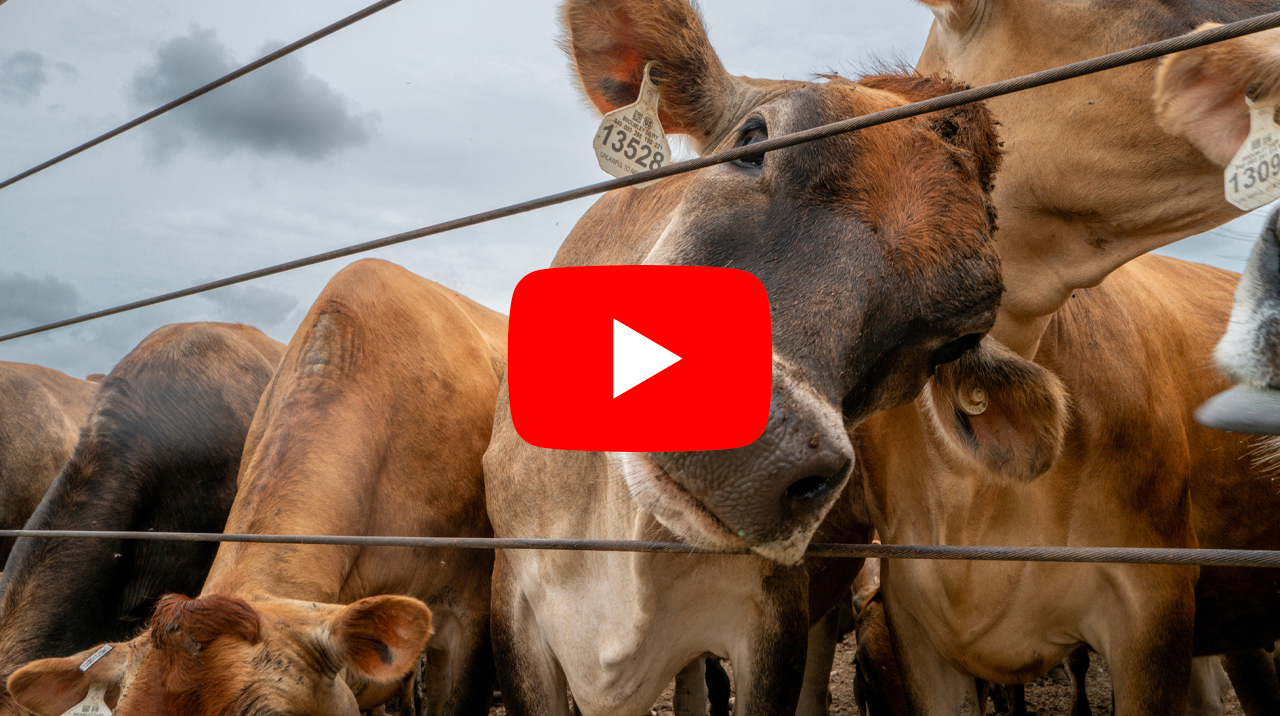
Welcome to Inside Climate, a podcast from the staff of Inside Climate News. In this episode, co-host Jake Bolster sits down with reporters Georgina Gustin and Lisa Sorg to talk about the wide-ranging impacts of how America fattens animals to become the meat that people eat.
Listen and subscribe on YouTube, Spotify, Apple Podcasts, Amazon Music, and iHeart.
JAKE BOLSTER
This week on Inside Climate, we’re heading to the farm.
GEORGINA GUSTIN: Tens of thousands of animals being fed and fattened for slaughter in one place.
Concentrated animal feeding operations, called CAFOs for short, are the backbone of America’s livestock industry. But they are also major sources of pollution and greenhouse gas emissions.
GEORGINA GUSTIN: Globally, 15 to 20 percent of total greenhouse gas emissions come from the livestock sector.
These massive facilities operate with minimal oversight by local, state and federal officials, leaving nearby neighbors few options when the industry impacts their homes.
LISA SORG: That waste was entering their drinking water supply because a lot of these folks were on wells.
That’s coming up on Inside Climate.
Welcome to Inside Climate, I’m Jake Bolster.
Hamburgers, hot dogs, chicken nuggets—foods that are ubiquitous within American culture and appetite. The average American purchased roughly 226 pounds of red meat and poultry per person in 2025, according to the USDA, totaling more than $112 billion in sales.
To keep up with the demand, millions of cows, chickens and pigs are raised and fattened at huge facilities across the country called concentrated animal feeding operations, or CAFOs.
It can be hard to wrap your head around the amount of waste these farms generate, from millions of pounds of manure to animal carcases. The environmental hazards and health concerns can be overwhelming for neighboring communities.
To better understand the climate issues at stake, we’ll talk to Georgina Gustin, who recently traveled to Nebraska to report on what could be the largest cattle CAFO in the country.
Then, we’ll pivot to North Carolina and speak to reporter Lisa Sorg, who has been focused on hog CAFOs and has spent time covering federal nuisance trials brought against the industry.
It’s all part of a new series Inside Climate News is publishing. So let’s get started.
Cash Cows
JAKE BOLSTER
Hey Georgina, how you doing?
GEORGINA GUSTIN
Jake, how are you?
JAKE BOLSTER
I’m doing really well. I’m excited to have you on the show. So this is Georgina Gustin. She covers agriculture for Inside Climate News. And you’ve been reporting on the intersections of farming, food systems and the environment for almost 20 years now. And lately that’s included CAFOs. Let’s start very basic. What does CAFO stand for?
GEORGINA GUSTIN
Thanks for having me. CAFO stands for concentrated animal feeding operation. And basically what that means is thousands and thousands, sometimes tens of thousands of animals being fed and fattened for slaughter in one place. It’s become sort of the backbone of the American and global meat production industry. These are how most animals that we eat are raised. They’re raised in these confined facilities.
JAKE BOLSTER
Wow. And these are just one stop in this larger chain that you’re outlining, or is this where everything happens?
GEORGINA GUSTIN
In the case of beef cattle, they’re raised on grass initially after they’re born, and then at a certain age they get moved to these facilities where they are fattened very efficiently on grain, which is more fattening than grass, and it gets them to market weight faster and more efficiently. But of course they cause a lot of problems too.
JAKE BOLSTER
Right, well what are some of those problems?
GEORGINA GUSTIN
Well, when you put a lot of animals in one place, they generate a lot of manure. There’s often no place to put that manure. They also generate, you know, odors, allure flies. That manure that they generate can run off into streams and waterways. In fact, in parts of the epicenter of the CAFO industry, the water is well beyond what regulators say is safe to drink
JAKE BOLSTER
How does this waste get managed with so many animals in one place?
GEORGINA GUSTIN
With difficulty. But usually what happens is it all gets sort of swept away with water into huge lagoons or big pits. What doesn’t get disposed of in this way or somehow on the farm often gets sprayed as fertilizer on fields around the CAFO or trucked off the property. And that’s become a problem because that is often not regulated very well. And that leads to a lot of water contamination. And in the case of, you know, in some areas leads to leaching into waterways that then basically deprives those waterways of oxygen and leads to toxic dead zones where the fish can’t—marine species are dying and it’s undrinkable and unswimmable.
JAKE BOLSTER
Geez. OK. Wow. And help me understand the scale. How many of these kinds of facilities in the U.S. are we talking roughly, like animals at each? Let’s just focus on cattle for right now.
GEORGINA GUSTIN
The EPA, the Environmental Protection Agency, says that there are about 21,000 CAFOs in the country. That is probably a huge, huge undercount because states, which are responsible for tracking CAFOs, often don’t know where they are, and there are a lot of smaller CAFOs, too. So in the case of beef CAFOs, the EPA designates a CAFO, as a thousand animals, just a thousand animals. But they’ve gotten to be now 85,000, 100,000 animals. Critics would say regulators really don’t have a handle on how to manage or to regulate these facilities that have gotten so large.
JAKE BOLSTER
CAFOs are producing, you mentioned this, the vast majority of the meat we have in the United States. They account for 99 percent of chickens and over 90 percent of pigs and 78 percent of beef cows. Does that sound right?
GEORGINA GUSTIN
That sounds about right, yeah. And you average it out, it means that about 95 percent of the animals we eat in this country are raised in confinement.
JAKE BOLSTER
Going back to the waste question here, can you give us a sense of the numbers behind the just volume of waste that raising animals this way produces?
GEORGINA GUSTIN
The estimates are around 133 million tons of manure a year, which is 13 times more solid waste than the entire human population. It’s huge. in the that is in the U.S., yes.
JAKE BOLSTER
On Earth or just in the U.S.? OK. OK. Still, that’s, I mean, that’s astonishing.
GEORGINA GUSTIN
Yes. And this kind of manure overload, as I talked about before, there’s no way to get rid of it safely and without polluting waterways. And so when you have these giant numbers in singular places, it creates, basically, a pollution source that’s not really regulated as a pollution source.
JAKE BOLSTER
Wow. OK. So what does the industry do right now to dispose of it? What’s the best way that they’ve come up with?
GEORGINA GUSTIN
So they put the waste in manure lagoons and there’s a growing trend of capturing the methane that’s generated in those lagoons and turning it into natural gas. And then there is basically trucking the manure off the property or spraying it on fields as fertilizer. But that has led to all these problems because it’s led to a lot of nitrate pollution and pollution in waterways.
JAKE BOLSTER
You mentioned methane. Let’s talk a little bit about the greenhouse effect of CAFOs. So I think maybe most people know, but if you don’t, when a cow burps, it is releasing methane, which is this potent greenhouse gas that has more warming potential than carbon dioxide. With all these cattle in one place in a CAFO, how bad are the greenhouse gas emissions from the industry?
GEORGINA GUSTIN
The shorter answer is we don’t completely have a handle on it because the EPA doesn’t measure greenhouse gas emissions from CAFOs at a facility level. That’s not required. There are estimates, and for beef, for example, it’s about 4 percent of the U.S. total greenhouse gas inventory coming just from cattle, which doesn’t really sound like a lot. But it’s basically approaching the greenhouse gas emissions of many developed countries, including Spain. We basically don’t do anything to measure or regulate greenhouse gas emissions, let alone the water and manure problems and the local sort of toxic air quality issues.
JAKE BOLSTER
It sounds like CAFOs are getting bigger and bigger.
GEORGINA GUSTIN
Yeah, so I think that with the efficiencies at scale, there’s more money to be made. And that is driving what I call the gigantification of American CAFOs and CAFOs globally. And at least in this case with this CAFO that I’m writing about in southwestern Nebraska, it’s going to have 200,000 animals. It’s run by an operation called Blackshirt Feeders, which is a trio of Canada-based investors. This is almost twice as big as any other beef CAFO that I’m aware of. And it’s in a county of less than 2,000 people and is by far the biggest feedlot that anyone there has ever seen.
This story is funded by readers like you.
Our nonprofit newsroom provides award-winning climate coverage free of charge and advertising. We rely on donations from readers like you to keep going. Please donate now to support our work.
JAKE BOLSTER
And I’ll just note that name, Blackshirt Feeders. I believe that’s a reference to the state’s football team, the college football team in Lincoln and their black shirts. And that’s, know, yeah, beef football, two big drivers in Nebraska.
GEORGINA GUSTIN
Correct, the defensive line, yes. I think they chose that name strategically, for sure.
JAKE BOLSTER
Right, right. So then how has the state and the local community responded to this project?
GEORGINA GUSTIN
The state has welcomed it, as far as I can tell, with open arms. A U.S. senator was at the grand opening, the governor was at the grand opening. They both said that this represents good economic development for the state, a good infusion of cash, very positive.
At the local level, there was initially a lot of pushback. People did not want this. So this is a small community, 145 people live there. Everybody knows everybody. I rolled into town to do some reporting. I went to the local bar, which is called Jake’s. It’s got Cornhusker memorabilia all over it. It’s a classic old-timey, you know, country bar. And of course, nobody knew who I was. And I said I was a reporter, I’d just flown in from New York and I was there to write about the feedlot. And the bartender said, Well, you can take the feedlot back to New York with you. So right away I knew that there was, you know, angry sentiment about this place.
And they’re particularly unhappy because they feel like they were sort of promised jobs. They felt like they were kind of sold on this idea that this would be good for them economically. And it hasn’t turned out that way. Plus they have all the traffic, all the trucks going back and forth, they’ve got the smell, they’ve got concerns about the water.
JAKE BOLSTER
If the people behind this, Blackshirt Feeders, are Canadian or they’re Canadian investors, why are they looking to the United States and Nebraska for this project?
GEORGINA GUSTIN
Yeah, good question. One of the three investors is actually from Bankleman, the county seat. And so he kind of knows the lay of the land. It’s pretty clear that they felt like the kind of permissive regulatory environment in Nebraska was going to be conducive. In fact, one of the investors told a Canadian trade publication last month, he said something to the effect of, we never could have gotten this done in Canada.
JAKE BOLSTER
Yeah. So this is western Nebraska. And when I hear that, you know, immediately in my head, I think water, because we’re in a region of the United States that’s arid. There’s not a lot of rainfall. What is happening? Are there concerns about water contamination or overuse? What have you found in your reporting?
GEORGINA GUSTIN
For sure. I would say that that is the number one concern that people have. So much of Nebraska is on top of the Ogallala aquifer, which is this hugely important water resource, provides drinking water for millions of people, irrigation water for a quarter of the country.
And where this feedlot is, in Dundee County in the southwest corner, is in a part of the state that has seen among the highest levels of depletion of the aquifer. The state is also in an ongoing drought and summer heat is getting hotter and hotter every year. So you have potentially 200,000 animals on a big square of concrete in the baking sun.
JAKE BOLSTER
So in addition to the drinking water for the animals, are there other concerns when it comes to water?
GEORGINA GUSTIN
It’s not just the water use, it’s the potential contamination of the aquifer. And already Blackshirt, which is only in its second year of operation, has been cited for a nitrate violation there. And so people are concerned about water pollution.
JAKE BOLSTER
So we’ve got methane, waste, water issues. Are there any issues that really jump out at you when you survey the industry at this moment?
GEORGINA GUSTIN
Yeah, I think it’s an ongoing issue really of agricultural exceptionalism that this industry just does not ever get regulated. Under the Trump administration there have been continued rollbacks that affect agriculture across kind of a wide swath of areas, including regulated waterways and agricultural chemicals.
I think there’s just an absolute lack of willingness to take responsibility for its role in the climate crisis and an ongoing acceptance of the status quo. So unless there’s real regulation, there’s very little that will rein in the greenhouse gas emissions of this industry. They found this model that makes a lot of money. I think we have a problem, not just in the U.S. but globally, that is is not gonna go away until regulators start to take it seriously. This industry is huge, it’s very powerful.
JAKE BOLSTER
Yeah. OK, Georgina, thanks so much for joining us and I’m looking forward to reading more of your work on CAFOs and agriculture.
GEORGINA GUSTIN
Thank you, Jake.
JAKE BOLSTER
Our next guest is Lisa Sorg, who’s been reporting on CAFOs from North Carolina, primarily investigating hog and chicken facilities. She’s been focused on some of the legal action around CAFOs, so we’ll jump in with her next.
A North Carolina Legal Battle
JAKE BOLSTER
Lisa, how you doin’?
LISA SORG
I’m doing great, Jake. Thanks for inviting me.
JAKE BOLSTER
Of course. It’s great to see you. So Lisa, you have been our reporter in North Carolina and you’re a journalist for over 30 years. You’ve covered energy, climate change, the environment, agriculture, and you have a social justice impact to a lot of your work.
So we just had a nice conversation with Georgina about the cattle CAFO industry in Nebraska. I’m curious what it looks like in North Carolina.
LISA SORG
North Carolina has predominantly hog CAFOs. So there are roughly 9 million hogs in North Carolina. And to put that in perspective, there are 10 million people. So almost one hog per person here. And there are 2,200 or so CAFOs that house hogs in them in eastern North Carolina.
JAKE BOLSTER
And how about chickens?
LISA SORG
Chicken CAFOs are different in North Carolina because we really don’t know how many there are. We can see from the air or we can smell them, but the records of where these are are considered confidential. They are not public record. The only people who know where they are are the farmers themselves and the Department of Agriculture, and they are not required to disclose their locations.
JAKE BOLSTER
Is it considered confidential by the state or at a federal level? How is that being determined?
LISA SORG
The state legislature passed a law that makes it confidential. And we don’t have a constitutional right to information here in North Carolina, which is why it’s never been litigated.
JAKE BOLSTER
So what is it like to live near one of these places in North Carolina?
LISA SORG
Well, I spent a lot of time in eastern North Carolina covering CAFOs, and I can tell you that the stench is overwhelming. On a humid day, even if you’re miles and miles away from one of these facilities, it’s overwhelming. And you have to know that a lot of these facilities are close together. So you may have five facilities within 10 miles, a 10-mile radius.
So for example, when I’ve been with people down in eastern North Carolina who’ve given me what they call toxic tours and they show me where these facilities are, there are dead boxes, there are vultures, there are flies.
JAKE BOLSTER
Sorry, a dead box? What’s a dead box? What is that?
LISA SORG
A dead box, gosh, it is exactly what you think it is. It is a box full of dead hogs. Because not all of them make it. And that’s where they dispose of them until it’s time to haul them off. So when you have the stench, the vultures, the dead boxes, the trucks, the spray fields, the dust, it is hard to imagine until you’ve been there.
JAKE BOLSTER
And these communities that are living with those facilities, do they have the political tools to get out of that?
LISA SORG
No. These farms are clustered in low-income neighborhoods or communities of color. That’s by design. And these folks don’t have the political or social capital to fight off these farms, especially considering the pork lobby and Smithfield Foods is so powerful here.
JAKE BOLSTER
It sounds like in your reporting you’ve spoken with people who have gone through some steps to try to get scientists to document some of what the repercussions are. What did they find?
LISA SORG
Yes, so I have covered five federal trials where the plaintiffs, which were the neighbors of these farms, had sued Smithfield Foods for nuisance. And what that means is that all those things that I just described, all those living conditions, they said prevented them from having the full enjoyment and use of their property. And a scientist testified in those trials that he swabbed the outside of some of their homes and was able to trace the bacteria that he found back to the hog farm.
JAKE BOLSTER
So let’s talk now about health impacts of these facilities. How do they affect humans who live near them or work in them?
LISA SORG
Well, the air pollution is terrible. So there are higher rates of asthma, cardiovascular and kidney disease, deaths, higher rates of preterm births. And this is largely because of the air pollution. These facilities emit ammonia, sulfur dioxide, which is that rotten egg smell, very fine particulate matter that can burrow deep into your lungs.
That’s what people can’t see, but they can smell the farms and sometimes from miles away. I recently read some state records where there was a complaint from people who said they were actually throwing up because of the stench. And recent 2026 data analysis also indicates an association between CAFO exposure and higher cancer rates in states like California, Iowa and I believe it’s Texas.
JAKE BOLSTER
Georgina was saying earlier that these facilities have managed to elude regulation under the Clean Air and Clean Water Act. Is the same thing true for hogs and chickens?
LISA SORG
The EPA has done very little here about CAFOs. State environmental officials can find the CAFOs, but it takes an egregious spill or negligence on part of the farm for DEQ to levy a significant penalty. A couple farms have shut down after repeated incidents where they basically put millions of gallons of waste into waterways. And in those cases, what has happened, at least in one case, Smithfield removed its hogs from a farm, which essentially shut it down. But these are very rare.
JAKE BOLSTER
Well, I’m just trying to wrap my head around what triggers a lawsuit here and whether or not lawsuits are the only way to hold an industry like this accountable or or ask for change.
LISA SORG
Well, once upon a time in North Carolina, that’s exactly what people did. They sued Smithfield for nuisance. And there were dozens and dozens of plaintiffs, but there were five cases that went to the federal district court against Smithfield. It’s important to distinguish, though, that the litigation was not against the contract farmers. It was against Smithfield, the corporation. In the first five cases juries found overwhelmingly in favor of the neighbors, to the tune of half a billion dollars in compensatory and punitive damages
The amount of punitive damages was capped in North Carolina, but still it was an amazing decision. And even when Smithfield took it to the appeals court, the U.S. Court of Appeals gave a scathing opinion and found in favor of the neighbors. So that was a win, right? However, while that was happening, the state legislature passed a law that essentially prohibited nuisance suits from being filed against CAFOs.
JAKE BOLSTER
What did that do?
LISA SORG
Well, after Smithfield settled out of court with the other plaintiffs after the first five trials—they understood that they were not going to win—the state legislature responded by passing a bill to essentially outlaw nuisance suits against CAFOs. Governor Cooper, at the time, he’s a Democrat, he vetoed that bill, but the legislature overrode it. So what that means now in the state of North Carolina, you cannot realistically sue Smithfield for nuisance because of the state law.
JAKE BOLSTER
When the North Carolina legislature passed this law that prevented people from suing these CAFOs, how did they justify it?
LISA SORG
They would say that these lawsuits threaten the pork industry in North Carolina, threaten the livelihoods of farmers everywhere. There was a lot of spin about how this was going to put the quote unquote family farmers out of business. I don’t believe that would be true, but that was the justification. We have to save the family farm. When in fact, what was happening is that the corporation, Smithfield, was being sued, they had the money.
JAKE BOLSTER
So let’s go back to the 2000 Smithfield Agreement. How did that come about and what was it supposed to accomplish?
LISA SORG
So how the Smithfield Agreement came about was we had two major hurricanes, Fran and Floyd, in North Carolina in the mid to late 1990s. And these were historic storms. They ravaged the state. And it breached and over topped a lot of the hog lagoons and the farms. It just sent millions and millions of gallons of waste into the drinking water supplies. Dead pigs were floating down the rivers and in the roads. These were environmental and public health disasters. So, as a result, the legislature passed a temporary moratorium on new farms. In the meantime, the attorney general at the time, Mike Easley, brokered an agreement with Smithfield Foods to try to improve how these farms operated in order to prevent this from happening again.
So the Smithfield Agreement, which was signed in 2000 as the result of all these disasters, it had two prongs. One, Smithfield had to pay $2 million a year toward an escrow account, which the attorney general and a panel of experts then would disperse to nonprofits that applied for these grants. And these were called environmental enhancement grants.
These environmental enhancement grants were used to repair riparian buffers, to restore wetlands, to close hog lagoons on corporate farms that often were in the floodplain. The other prong of the Smithfield agreement, Smithfield paid $15 million for research into what was called environmentally superior technology to replace, ostensibly, the spray field and lagoon system. There were academics and private companies that did all this research trying to figure out a way to wean Smithfield off this environmentally harmful way of disposing of the waste.
There were two technologies that emerged. One of them in particular was particularly promising. It’s almost like it was a wastewater treatment plant for the waste. It would separate the solids from the liquids. According to the science and the papers that came out of that, it was a remarkable success in removing a lot of the pathogens and the odor and the nitrogen and the phosphorus from this waste. So it was amazing.
However—there’s always a however—the technology was never deployed, in part because the Smithfield Agreement grandfathered the existing farms from having to use this technology. So it would only have been used at new or expanded farms. But North Carolina has a permanent moratorium on new or expanded farms. So there are no new farms to put this technology in.
JAKE BOLSTER
Interesting.
LISA SORG
And then there was another aspect of the Smithfield agreement where this technology also had to be considered economically feasible. Critics would argue that anything is more expensive than digging a hole in the ground. In that sense, unfortunately, the Smithfield Agreement, that part of it failed.
JAKE BOLSTER
So it sounds like in the 25 years or so since this agreement, you have on the one hand the company’s done a great job of providing these environmental grants, but on the other hand, there was this promise of a technology that would make a real difference for the people who live near these facilities, and that seems to have fallen short, is that right?
LISA SORG
That’s correct, yes. The environmental enhancement grants were wonderful and a lot of good things came from them, but the environmentally superior technology never took off and so folks’ lives are not any better for the agreement if you live near one of these farms.
JAKE BOLSTER
So what have you heard from people who live in these places that are impacted by these farms? How do they think about the last 25 years and the legacy of this agreement?
LISA SORG
Well, they’re very frustrated. The people who live near these farms, these are folks who, the land has gone back generations. They were there before the farms. And they want to hand their land down to their children. Who knows if their children will want them? They are definitely still stirred up about the injustice of this.
JAKE BOLSTER
Help me understand where North Carolina fits in relation to its peers. Would you say they’re doing a good job, compared with other states, of regulating these CAFO operations?
LISA SORG
Hmm, that’s a great question, Jake. I think North Carolina is probably on par with its peers. California is probably tougher because California tends to be tougher on everything. North Carolina, the pork lobby here, I cannot overstate how powerful they are.
There’s just not a lot of transparency. The Department of Agriculture and the commissioner of agriculture is very supportive of Smithfield Foods. Until there is some kind of political change, and it would have to be a sweep, and also the power of the pork lobby, unless that is somehow weakened, I don’t see it changing, sadly.
JAKE BOLSTER
I know we’ve got a project in the works here with you and Georgina and then two of our other fabulous reporters, Anika Jane Beamer and Steven Rodas. Anika Jane’s based in Iowa, Steven’s out in California. What are they digging into?
LISA SORG
Well, Steven is focused on California’s inconsistent enforcement of dairy CAFOs, especially when it relates to groundwater protections. Groundwater is obviously very important if you’re on a drinking water well or if you use irrigation. And Anika Jane is focused on how few hog CAFOs in Iowa even have permits required under the Clean Water Act. So without those permits, it’s kind of the Wild West.
JAKE BOLSTER
Haha, yes. Well that’s a topic we know all about here at Inside Climate News. Lisa, thank you so much for being here and sharing your reporting with us. You’ve done a fantastic job and I bet we’ll be having you back on to talk about it soon enough.
LISA SORG
Thank you so much, Jake. It’s been a pleasure.
Final Thought
JAKE BOLSTER
Every summer, the ICN newsroom temporarily expands as it welcomes collegiate and post-collegiate journalists to join its ranks as reporting fellows.
Over the past few months, 13 fellows have been working in California, New York, Washington D.C., Montana, Colorado, Massachusetts, Pennsylvania and Florida. It’s the largest group of fellows the program has ever accepted as it looks to develop the next generation of climate journalists.
Kate Waxman, a Florida-based fellow from Columbia Journalism School, reported about a contentious bill that would ban shark-dive operators from feeding sharks.
Mosabber Hossain, a graduate student from the University of Montana, has been reporting on wildfire risk, logging and concerns over data centers from Big Sky Country.
More than 90 summer fellows have rotated through the program since it was started in 2020, with several joining Inside Climate News as full-time staff.
KILEY PRICE
Thank you so much for listening to Inside Climate.
For more of our reporting, please visit insideclimatenews.org and sign up for our newsletters, all of which are free to read because we want to make our work available to anyone, wherever they are.
You can also follow us on your favorite social platforms and share our podcast with others.
If you love what you read, see and hear, please consider donating to support our nonprofit newsroom because we rely on the support of our audience to make our reporting and this podcast possible.
We’ll be back in two weeks with more climate stories from our reporters all across the world.
About This Video
Perhaps you noticed: This video, like all the news we publish, is available for free. That’s because Inside Climate News is a 501c3 nonprofit organization. We do not charge a subscription fee, lock our news behind a paywall, or clutter our website with ads. We make our news on climate and the environment freely available to you and anyone who wants it.
That’s not all. We also share our news for free with scores of other media organizations around the country. Many of them can’t afford to do environmental journalism of their own. We’ve built bureaus from coast to coast to report local stories, collaborate with local newsrooms and co-publish articles so that this vital work is shared as widely as possible.
Two of us launched ICN in 2007. Six years later we earned a Pulitzer Prize for National Reporting, and now we run the oldest and largest dedicated climate newsroom in the nation. We tell the story in all its complexity. We hold polluters accountable. We expose environmental injustice. We debunk misinformation. We scrutinize solutions and inspire action.
Donations from readers like you fund every aspect of what we do. If you don’t already, will you support our ongoing work, our reporting on the biggest crisis facing our planet, and help us reach even more readers in more places?
Please take a moment to make a tax-deductible donation. Every one of them makes a difference.
Thank you,
