


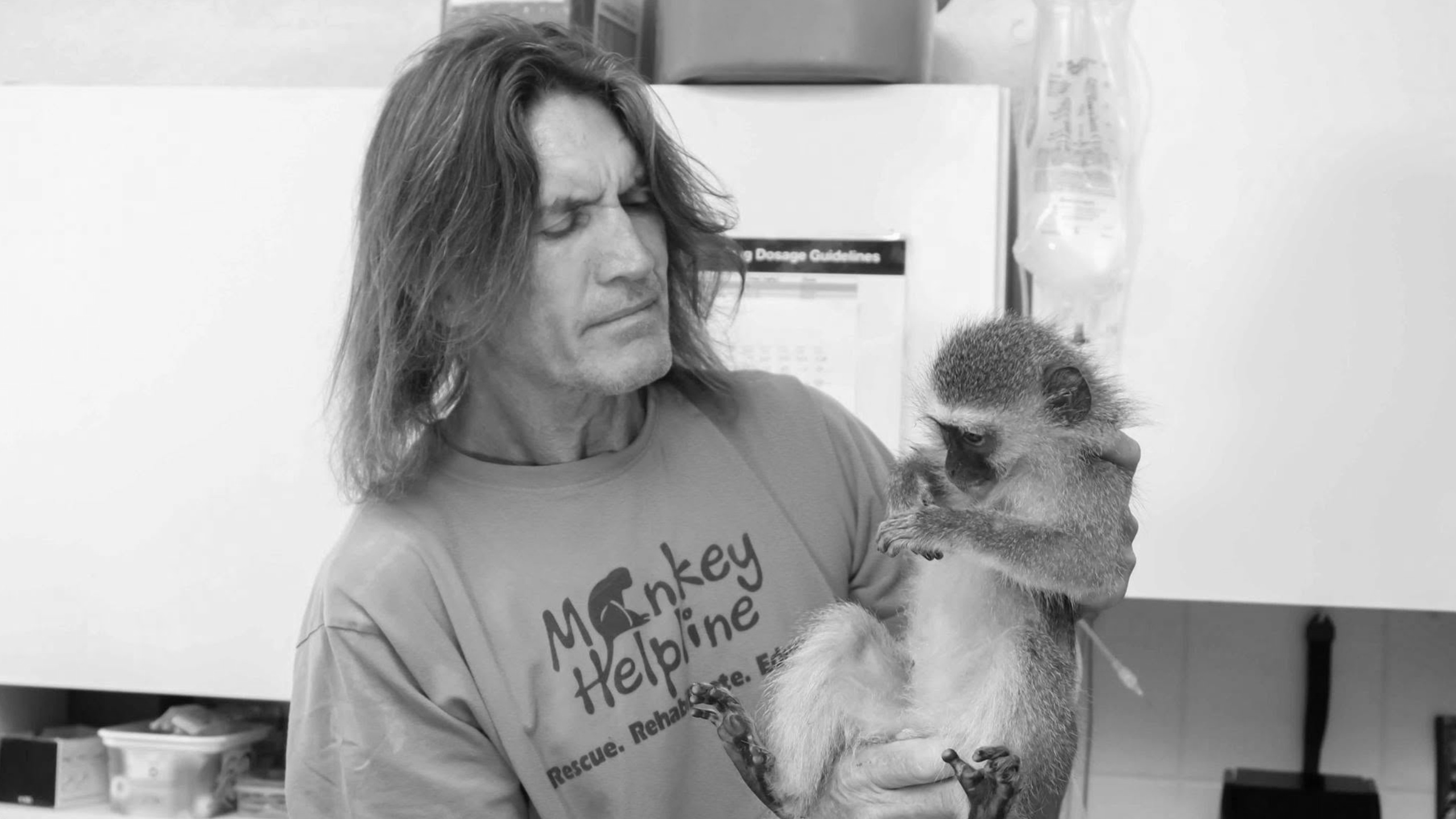
- Steve Smit, known in KwaZulu-Natal as the “Monkey Man,” spent three decades rescuing and rehabilitating vervet monkeys and other urban wildlife.
- Before becoming a full-time rescuer, he spent roughly 25 years in South Africa’s intelligence services and helped build the country’s early animal-rights movement.
- Through FALCON, Justice for Animals, and later Monkey Helpline, he challenged elephant culling, wildlife trade, vivisection, and other practices he believed sacrificed individual animals.
- Smit, who died on August 12 at 70, became known for an uncompromising defense of animals that many people regarded as common, troublesome, or expendable.
In 2015 Steve Smit badly injured his right eye while trying to round up rescued chickens in his garden in Westville, near Durban. A branch struck him and almost cost him his sight. Doctors told him to rest. Within weeks he had gone on more than 20 wildlife rescues, wearing an eye patch.
For three decades Smit climbed trees, crossed roofs, crawled under buildings, and entered gardens to retrieve vervet monkeys that had been shot, shocked on power lines, hit by cars, bitten by dogs, or caught in wire. Around KwaZulu-Natal he became known simply as the “Monkey Man.” He died on August 12th after a battle with cancer. He was 70.
Before rescuing monkeys became his full-time occupation, Smit spent roughly 25 years in South Africa’s intelligence services. He had first joined the police after objecting to military conscription, and later moved through the Bureau of State Security and National Intelligence Service. In an oral-history interview in 2007, he recalled being troubled by the conduct and culture of some of the institutions in which he worked.
His involvement with animals began while he was still in government service. In 1985 he founded FALCON, the Front for Animal Liberation and Conservation of Nature, described as South Africa’s first animal-rights organization. It later became Justice for Animals. Smit campaigned against vivisection, recreational hunting, circuses, wildlife trade, and other uses of animals that he regarded as exploitation.
His position often put him at odds with conservationists. Smit was concerned not only with whether a population or species would survive, but also with what happened to individual animals. In a submission to Parliament in 2003, he argued that animals deserved protection regardless of whether their species was endangered or abundant. A vervet monkey, in his view, did not matter less because there were plenty of other vervets.
In 1995 FALCON helped bring about a public debate over elephant culling in Kruger National Park. The National Parks Board subsequently reviewed its policy and suspended culling. Smit continued to oppose the killing of elephants and the international ivory trade, arguing that financial incentives could distort decisions about wildlife.
He could be combative. In a BBC World Service exchange in 1999, a conservationist accused him of being emotional and unwilling to accept the trade-offs involved in managing fenced ecosystems. Smit responded sharply. He rejected the idea that elephants should be treated chiefly as numbers in a management plan and accused his opponents of treating wildlife as commodities.
His campaigning extended well beyond protest. He debated officials, appeared before Parliament, proposed transboundary approaches to elephant management, negotiated, litigated, and tried to persuade. He rarely yielded on the moral status of animals, though he was prepared to pursue their protection through several different channels.
Monkey Helpline, which he started in 1995, gradually took over his life. Carol Booth became his partner in the work. By the following decade it had become a full-time, unpaid occupation for both of them. On an ordinary day Smit might respond to several call-outs. On a bad one there could be ten.
Some rescues required as much diplomacy as physical effort. Vervet monkeys live readily alongside people, and the arrangement often produces conflict. They raid kitchens, steal fruit, cross roads, and appear unexpectedly on roofs and balconies. Smit spent countless hours explaining to nervous homeowners that the animals were neither rabid nor likely to attack them. Human settlement, he pointed out, had expanded into their habitat.
He had little patience with deliberate cruelty and considerable patience with frightened animals. Younger rescuers came to regard him as a mentor. He watched how monkeys moved through a troop, how mothers responded to infants, and how injured animals reacted to people. He placed great weight on direct observation and believed that wildlife policies were sometimes made by people who had spent too little time watching the animals concerned.
The work also consumed much of his money. Smit drew no salary from Monkey Helpline and, during a serious illness in 2021, had no medical aid. In hospital he remained preoccupied with the same causes. A strict vegan, he persuaded staff to arrange suitable meals, talked about veganism with those around him, and entertained nurses and patients with rescue stories.

After his eye injury in 2015, a supporter in Britain sent him a surprise parcel. Smit was too curious to wait until he got home and opened it in the car. Inside was a stuffed monkey with a patch over its right eye, like his own. He and Booth named it Stephanus, and made it Monkey Helpline’s mascot.
Over the years he campaigned for elephants, laboratory primates, hippos, and baboons. Vervets remained the animals with which he was most closely identified. They were common, adaptable, and often treated as a nuisance. Smit’s argument was that none of those things made an individual animal disposable.
For 30 years, when a monkey was bleeding in a garden or stranded on a roof somewhere around Durban, people knew whom to call.
Header image: Steve Smit. Photo from his Facebook page.
