


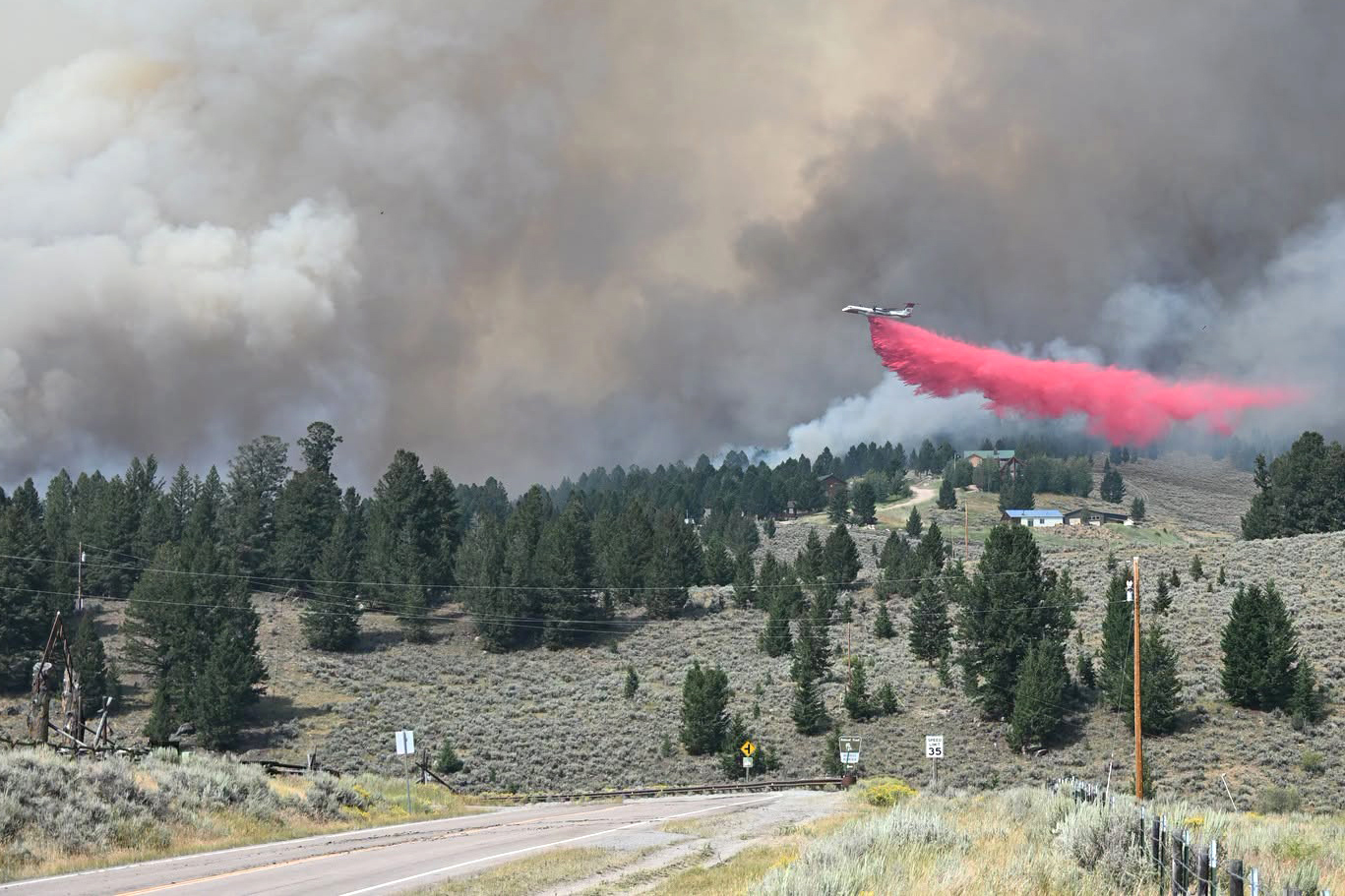
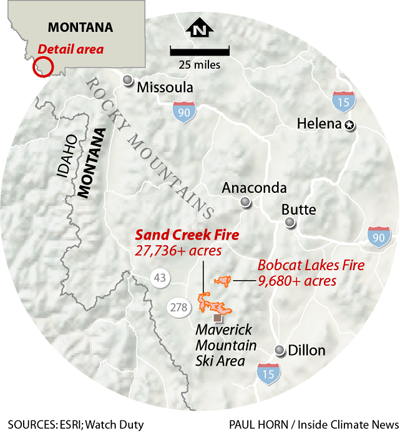
The Sand Creek Fire had grown to 27,736 acres on Thursday after burning through parts of Maverick Mountain Ski Area in southwestern Montana, but firefighters succeeded in protecting the ski lodge and nearby Elkhorn Hot Springs as the blaze pushed through the area.
Philip Knaub, operations section chief for the inter-agency Northern Rockies Complex Incident Management Team 3, said Thursday that Elkhorn Hot Springs was fully intact and no structures had been lost in the resort’s main facility area. The Maverick Mountain ski lodge and surrounding buildings also remained standing.
The fire did burn through parts of the ski area. The ski runs had been affected, although officials were still determining the severity of the damage and were optimistic that some live trees remained. A structure at the top of the mountain was lost, he said, but officials had not yet determined the extent of the damage.
Firefighters continued working around Maverick Mountain and Elkhorn Hot Springs, cooling residual heat near structures. Crews had built a direct handline from the top of Maverick Mountain to Grasshopper Creek to help hold the fire north of the ski lodge, while dozer line construction continued along the western side of Grasshopper Valley.
Active fire remained nearby, and firefighters maintained pumps, sprinklers and other structure-protection measures in Elkhorn Hot Springs and the ski area. Crews hoped to establish a direct fire line below the ski lodge, which Knaub described as a key objective for the day.
Aircraft and ground crews also succeeded in deflecting the fire away from structures in the Wellman Creek area as it pushed east. There were no reports of structures lost along the southern edge of that eastern growth.
Crews were building indirect control lines along the fire’s western perimeter and preparing for possible burnout operations, in which firefighters intentionally burn vegetation between a control line and the main fire to remove fuel and strengthen the line. Structure-protection measures were also being maintained and expanded throughout nearby Grasshopper Valley.
Firefighters could get some help from the weather Thursday, with a 50 percent chance of showers and thunderstorms, mainly after 3 p.m. Officials said wetting rain could slow the fire’s spread, though heavy fuels remained dry because of snow and rainfall deficits. Winds were expected to be calmer.
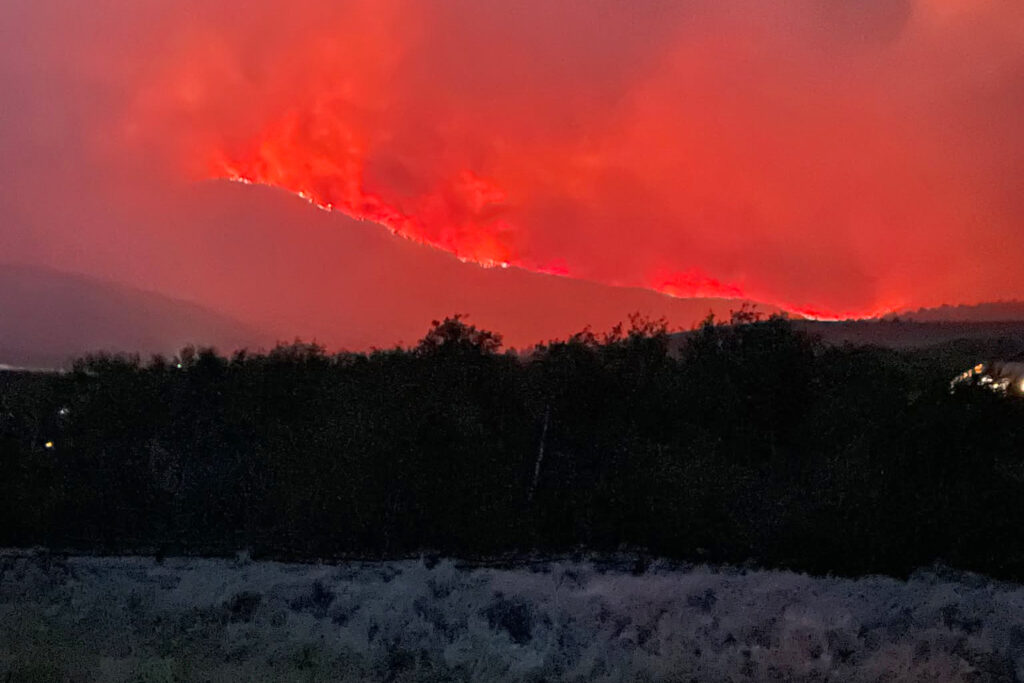
Maverick Mountain said Wednesday in a social media post that the fire had crossed into the ski area and damaged the Maverick chairlift, though the full extent of the damage was initially unknown.
“With heavy hearts, we are sad to say the Sand Creek Fire is actively inside the ski area boundary,” the ski area said. “The Maverick chair has sustained damage, but further details are unknown.”
Earlier, as the fire spread into the resort on Tuesday, Maverick Mountain co-owner Erik Borge told Inside Climate News that he could not speak at length because his employees were busy cleaning up the property.
Maverick Mountain, a small and historic ski area in southwestern Montana, is an important recreational and tourism destination in the Grasshopper Valley area and, together with nearby Elkhorn Hot Springs, plays a vital role in the local economy.
The resort is more than a recreation area for many local residents; it is a place tied to memories, traditions and a strong sense of community.
Montana Commissioner of Securities and Insurance James Brown, whose family has deep ties to the area, wrote on social media that watching the Sand Creek Fire spread had been “difficult for me personally.” Brown said his family homesteaded in the area and that his grandfather and uncles built the Elkhorn Lodge and its original cabins.
“Unfortunately, reports are that the upper part of the ski hill has burned and many friends and neighbors have been displaced and evacuated,” Brown wrote. He thanked firefighters and first responders for their efforts to protect lives and property.
Skylar Rispens, a Missoula resident, said Maverick Mountain represents a kind of skiing that has become increasingly rare as the sport has grown more commercialized and expensive.
“Maverick is one of a handful of independent ski areas in Montana where skiing still feels like it did when I was a kid,” Rispens said. “You can learn to ski, take your whole family, have a meal and meet new people without breaking the bank.”
“Regardless of what the damage is, I am confident that Maverick will come back from this stronger than ever,” she said, adding that the support from across Montana and the country had been “really heartwarming.”
The University of Montana Western echoed that sentiment, saying Maverick Mountain, Elkhorn Hot Springs, the Pioneer Mountains and surrounding areas hold deep meaning for the wider Beaverhead County community. The university described them as places where memories are made, traditions are shared and people come together, while also offering support to residents, families, business owners, firefighters and first responders affected by the blaze.
The Sand Creek Fire is being managed alongside the nearby Bobcat Lakes Fire, which started in late July about 13 miles southwest of Wise River. By Wednesday, the Bobcat Lakes Fire had grown to 9,960 acres and remained zero percent contained. Knaub said fire activity and growth there had been limited Tuesday, with crews making progress along portions of the fire’s perimeter.
This story is funded by readers like you.
Our nonprofit newsroom provides award-winning climate coverage free of charge and advertising. We rely on donations from readers like you to keep going. Please donate now to support our work.
Earlier in the summer, Montana fire officials and meteorologists warned that weak winter snowpack, a warm and dry spring and periods of strong wind could set the stage for an active fire season. By late July, the National Weather Service was issuing Red Flag Warnings and fire-weather alerts across parts of the state amid extreme heat and continued hot, dry and windy conditions.
Montana recorded 2,424 wildfires in 2025, burning 75,099 acres. Separately, the Montana Legislative Fiscal Division estimates that annual wildfire suppression costs have averaged about $30 million, adjusted for inflation, over the past 22 years.
Alex Lukinbeal, a National Weather Service meteorologist, said that Missoula recorded its second-warmest winter since records began in 1893. Temperatures from December through February averaged 7.3 degrees Fahrenheit above normal.
Kalispell recorded its fourth-warmest winter since records began in 1899, averaging 5.7 degrees above normal. Butte experienced its warmest winter on record since 1895, with temperatures 9.9 degrees above normal. Snowpack conditions varied sharply by elevation.
By the end of April, many low- and mid-elevation sites had no snow remaining, while high-elevation sites above 7,000 feet generally had near-normal to above-normal snowpack, Lukinbeal said.
The fires are also unfolding amid significant change in the federal government’s wildfire workforce and management system. The Trump administration has moved to consolidate federal wildland firefighting functions, while broader federal workforce reductions have raised concerns about staffing and preparedness for the ongoing fire season. It is not yet clear whether those changes have affected the response to the Sand Creek or Bobcat Lakes fires.
For now, Northern Rockies Complex Incident Management Team 3 reports 591 personnel assigned to the two fires, along with 47 engines, 11 crews and seven bulldozers. and two graders.
The Beaverhead-Deerlodge National Forest did not immediately respond to Inside Climate News’s questions about staffing levels and whether fire managers were receiving all the personnel, aircraft and other resources they had requested.
The fires in Beaverhead County come as wildfire activity intensifies across the West. Nationwide, 46,509 wildfires had burned more than 6.4 million acres this year as of Aug. 12, according to the National Interagency Fire Center. The number of fires was 126 percent of the 10-year average, while acreage burned was 155 percent of the 10-year average. NIFC listed nine large fires in Montana.
Conditions around the Sand Creek and Bobcat Lakes fires remained capable of driving additional fire growth Wednesday, but Knaub said crews were optimistic about the day’s operations. Firefighters were preparing for possible southward movement while strengthening control lines and maintaining structure protection throughout Grasshopper Valley. Knaub said weather conditions were expected to improve heading into the weekend.
The weather in the coming days could offer both relief and another hazard.
Joe Messina, a meteorologist with the National Weather Service in Missoula, said that the smoke is likely to linger because of fires burning to Montana’s west.
“It’s gonna stay smoky,” Messina said.
Messina predicted temperatures would reach almost 90 degrees before dropping into the lower 80s Thursday and Friday. Thunderstorms were possible Thursday afternoon, followed by a roughly 60 percent chance of rain Thursday night.
Rain and cooler temperatures could help firefighters, but thunderstorms also carry the risk of lightning igniting additional fires, Messina said.
This fire season follows an exceptionally warm winter across parts of western Montana.
Those figures provide important context for the conditions leading up to Montana’s fire season, but they do not establish that the warm winter caused the Sand Creek Fire.
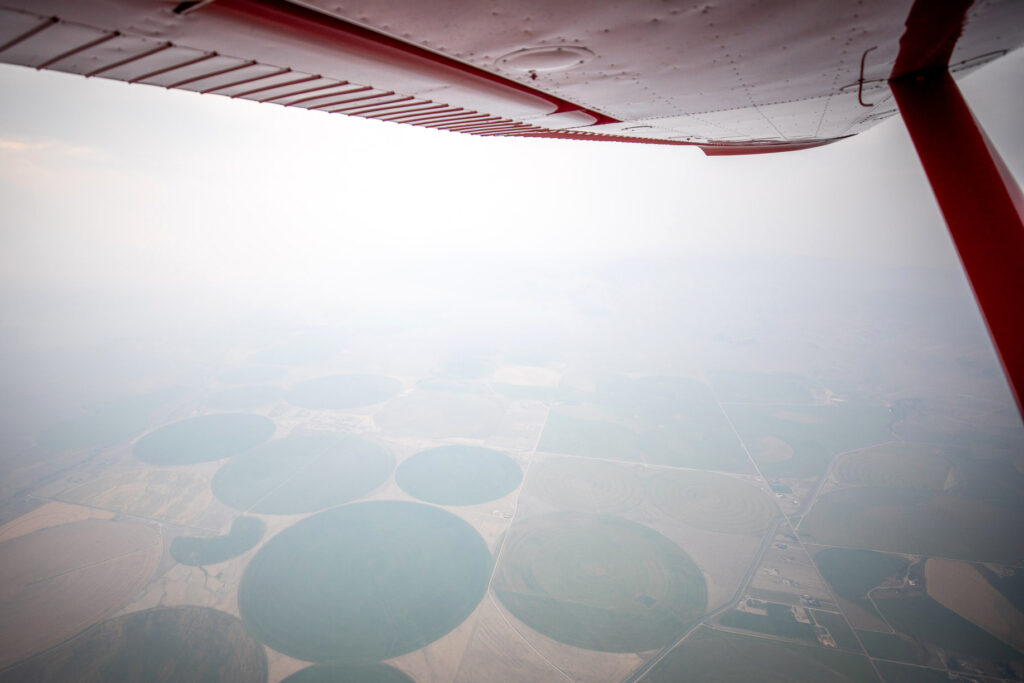
Smoke has plagued residents far from the fire lines, with Montana contending with fumes from its own fires as well as large fires burning farther west in Oregon, Washington and Idaho.
Amy Cilimburg, executive director of non-profit Climate Smart Missoula, cautioned that wildfire itself is not unusual in Montana. Many of the state’s forests are fire-adapted ecosystems where fire is part of the natural landscape.
What has made recent weeks particularly difficult, she said, is the combination of fires, smoke arriving from other states and persistent hot, dry conditions.
“It’s felt, I think, here in Missoula like it’s never gonna end,” Cilimburg said. “We just keep having smoke, smoke, smoke.”
For many people in Missoula, she said, the immediate concern has been less about flames than the combination of smoke and heat.
Residents have had only limited periods of clean air for more than two weeks, Cilimburg said, and the persistent smoke is beginning to wear on people physically and emotionally.
“There’s a lot of stress and anxiety with these fires,” she said.
Cilimburg also cautioned against treating every forest fire as evidence of catastrophe. Fire is natural and necessary in many Western forest systems. But hotter, drier conditions in mid- and late summer are part of what climate change means for the region, she said.
The possibility of rain in the coming days offers some hope, but also uncertainty.
“We may get some rain,” Cilimburg said, “but I’m fearful that we could get some lightning, and more fires, and not enough rain.”
About This Story
Perhaps you noticed: This story, like all the news we publish, is free to read. That’s because Inside Climate News is a 501c3 nonprofit organization. We do not charge a subscription fee, lock our news behind a paywall, or clutter our website with ads. We make our news on climate and the environment freely available to you and anyone who wants it.
That’s not all. We also share our news for free with scores of other media organizations around the country. Many of them can’t afford to do environmental journalism of their own. We’ve built bureaus from coast to coast to report local stories, collaborate with local newsrooms and co-publish articles so that this vital work is shared as widely as possible.
Two of us launched ICN in 2007. Six years later we earned a Pulitzer Prize for National Reporting, and now we run the oldest and largest dedicated climate newsroom in the nation. We tell the story in all its complexity. We hold polluters accountable. We expose environmental injustice. We debunk misinformation. We scrutinize solutions and inspire action.
Donations from readers like you fund every aspect of what we do. If you don’t already, will you support our ongoing work, our reporting on the biggest crisis facing our planet, and help us reach even more readers in more places?
Please take a moment to make a tax-deductible donation. Every one of them makes a difference.
Thank you,

Fellow
Mosabber Hossain is an Inside Climate News Fellow and an award-winning climate and environmental investigative journalist from Bangladesh. His reporting focuses on climate change, biodiversity, environmental justice, adaptation and corruption. His work with Reuters and other international outlets has been republished globally, and some of his reporting contributed to discussions featured on the agenda of the World Economic Forum. Mosabber is a graduate student at the University of Montana studying environmental science and natural resource journalism. Previously, he was a fellow with the Institute for Journalism and Natural Resources and Investigative Reporters and Editors. He is a recipient of the South Asian Investigative Journalism Award from the Thomson Foundation and was featured among eight journalists during the organization’s 60th anniversary for the impact of his investigative reporting. Mosabber is also a wildlife and nature photographer whose work has been published internationally.
