


From our collaborating partner Living on Earth, public radio’s environmental news magazine, an interview by Jenni Doering with author Craig Childs.
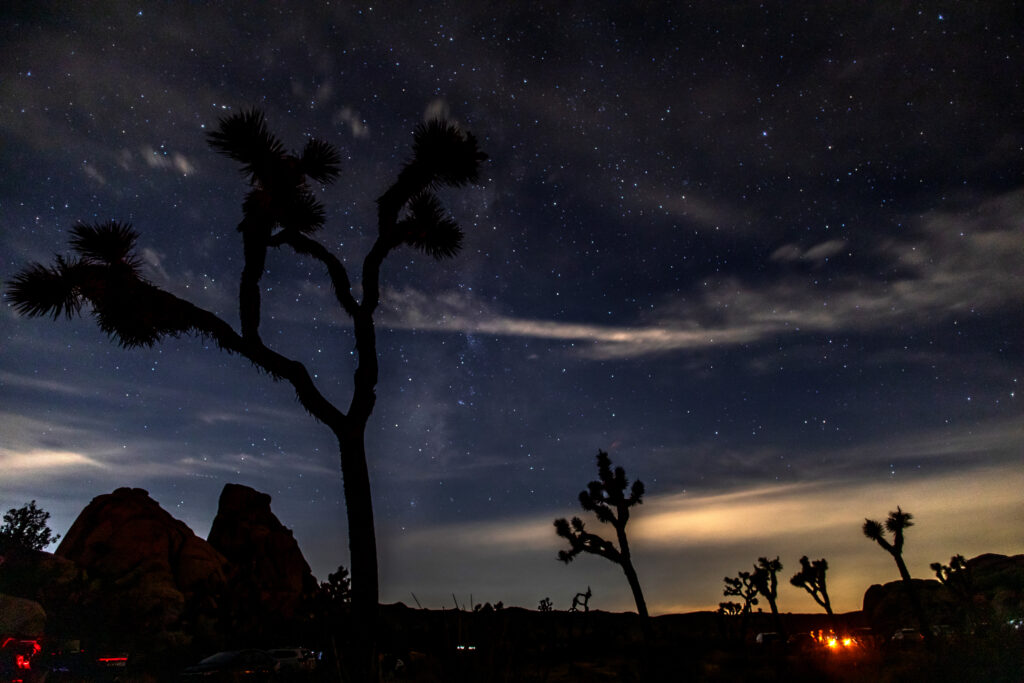
Think about the darkest sky you’ve ever seen. Did you see the Milky Way? Did starlight cast shadows?
This kind of experience is becoming rare in our brightly lit world, but the stars are still out there, waiting for us to rediscover them.
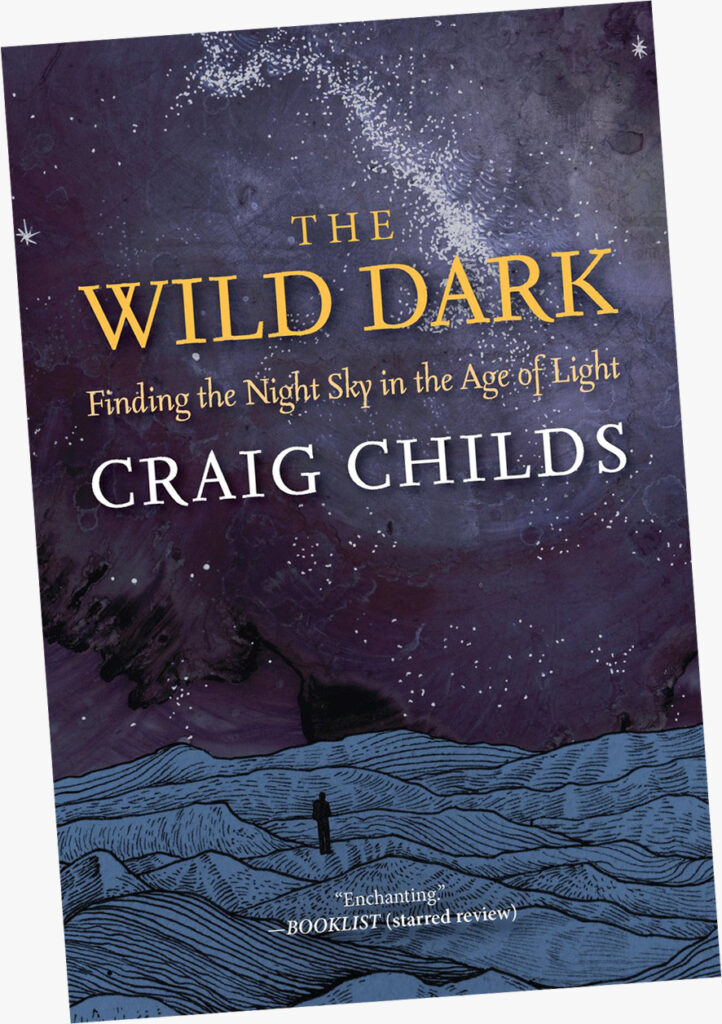
That’s the focus of the 2025 book “The Wild Dark: Finding the Night Sky in the Age of Light,” by naturalist, wilderness explorer and award-winning author Craig Childs, who lives on the remote Colorado Plateau. This interview has been edited for length and clarity; the full interview is available in the audio link above.
JENNI DOERING: What attracts you to the night sky and the stars? And when did you first feel this pull to reflect more on the mysteries above us?
CHILDS: It’s impossible not to be attracted to the night sky. I think everybody is. That was a nice thing about writing this—I thought, “Oh, here’s something that everybody loves, even people who are disconnected from it, who don’t see it.” There’s something intrinsic about looking up and seeing a sky full of stars. Something I wrote about in the book was when I was five years old, I was camping out in the woods with my mom and her boyfriend, and they took off into the night and left me on this mattress. They’d carried a full mattress out into the woods, and I was under all these blankets, and I was terrified of the dark. But then I saw the stars, and I remember that. I remember how clear they were, and how much it calmed me down to look up and see, really to see infinity for the first time, or at least to recognize it for the first time … there was something just deeply calming about it. To know that there was infinity that you could see forever, and it wasn’t empty. It was full.
DOERING: In this book, “The Wild Dark,” we follow you on this journey from one of the brightest places on Earth, Las Vegas, to one of the darkest. Why did you and your companion Irvin choose to bike through the desert to take on this quest? And what questions did you want to ponder while you were on this trip?
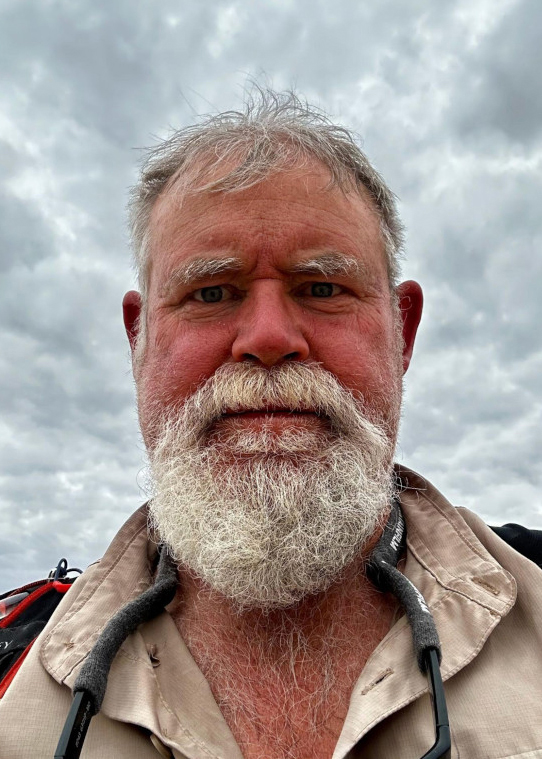
CHILDS: A bike made sense—human-powered speed—because driving out of Las Vegas, if you wanted to get to the darkest of the dark, you’d be there in three hours. I was much more interested in the transition, in letting my eyes adjust and seeing what the different nights are like.
That took us about 200 miles through the backcountry on fully loaded mountain bikes, self-supported. We were going maybe 20 miles a day, and that was enough to make every night significantly different for nine nights. The question I had was: What are each of these skies like? Not just the darkest, not just the brightest, but the ones in between. And how different are they?
DOERING: You picked nine days and nine nights because there are nine different levels on the Bortle scale, which we use to delineate the quality of the skies at night. What is the Bortle scale for people who haven’t heard of this funny-sounding thing?
CHILDS: I love the word “Bortle” because it sounds like it should be a space word, but it’s actually somebody’s name. John E. Bortle is an amateur astronomer who identifies comets, and he needed a way to express the night sky in non-technical terms, in naked-eye terms. He came up with the nine levels, Bortle One being the darkest, and Bortle Nine being that lemony sky over Las Vegas … We were still getting shadows from Vegas 170 miles out.
DOERING: The climate crisis is rapidly changing our world, but what about what’s happening with light? How fast is artificial light expanding, and how is it reshaping the way we live?
CHILDS: Writing this book, I hesitated to say, “Oh, here’s another problem.” Like, add this to your load. Except, it’s a different kind of problem than climate change or heavy metals in a river. These are all long-term generational difficulties that take a lot of thinking, whereas light is something where you turn off the switch, and the night sky is there immediately.
But the Earth has never had this much light in its history. It changes our circadian rhythms, changes how we relate to the world and it takes away the night sky.
When the LED boom came in the late ’90s, early 2000s, lighting around the world increased dramatically, but I have talked to some lighting engineers who say that they think we are over the hump of peak lighting, that we’re actually going to be changing in decades to come, where we understand light more, we understand how to place it more, we understand that it doesn’t need to be everywhere, and it doesn’t need to be lighting up the skies. And we don’t need it to be safe, as in we don’t need it to be blinding to be safe. We need it to be strategic. They’re seeing the possibility that the world might actually darken, that nights might go back to the stars, and that’s a future that I really am interested in because this is a problem we can solve very easily.
DOERING: What relationship does wildlife have to the night sky? To what extent are animals and plants being affected by this currently bright planet?
CHILDS: In a big way, it’s navigation. When I was looking at Las Vegas, I was looking at these swarms of grasshoppers, millions upon millions of grasshoppers that sweep into the city at certain times. They’re drawn from the surrounding desert to the light. Animals are drawn to light, and birds are drawn to stationary light. Birds that are navigating spring and fall pay attention to where Polaris, the North Star, sits, because it’s the one star that doesn’t move, and that defines their north-south migrations. When you have cities sitting along their major flyways, you have all these stationary lights, and they are pulled toward them.
I was down at the memorial lights for Ground Zero in Manhattan the year after the [Twin Towers] fell. What I noticed when I got down right beneath them, looking up, was that they were full of thousands and thousands of birds. I hadn’t expected that, and, and at the time I was just mesmerized and amazed by it. But since then I’ve learned that that’s killing birds. They’re exhausting themselves. It’s throwing off their biological sequences. They’re flying into windows. So now, the Audubon Society is keeping an eye on it. When the memorial lights are up in September, they turn them off for 20 minutes. Radar looking at those lights pick up 500 birds in the area when the lights are off, and when the lights are on, they’re picking up about 16,000 birds. So you can see what it does. It changes their lives.
DOERING: It turns out that the human body is also deeply influenced by what you say is actually a lack of access to darkness. What’s going on there?
CHILDS: We need both. We need light and we need dark. That’s the nature of this planet, right? We have day. We have night. We’ve had it for 4 billion years. Every organism, or most organisms that are up on the surface, they react to this change, and that is built in from the first organisms. There is a circadian rhythm that says, “Okay, everything is about to change, so adjust all your metabolic levels, adjust your chemistry.” In the beginning, when organisms were under a thin atmosphere and getting burned by the sun at night, they could reproduce, they could repair their cells. So that’s just continued throughout evolution to the point where we have a circadian rhythm not only in certain parts of our brain that run our hormonal systems. We have circadian rhythms in every cell. We have day, we have night, and we adjust to it. When we don’t adjust to it, when we turn on the lights at night, then we start misfiring. We start producing melatonin or serotonin at the wrong times, and it changes our physiological structures.
One thing that I found really notable as I was writing the book was the prevalence of breast cancer in women working night shifts. They had lights at night and they had light during the day, so they never got darkness. Light at a certain point becomes a toxin, and to balance that toxin, you need the darkness.
This story is funded by readers like you.
Our nonprofit newsroom provides award-winning climate coverage free of charge and advertising. We rely on donations from readers like you to keep going. Please donate now to support our work.
DOERING: During your journey with Irvin across the desert, biking across from Bortle Nine to One, you guys were using green headlamps and red headlamps to try and reduce your exposure to artificial light. Have you kept up that practice after this journey?
CHILDS: Oh yeah, I’ve done it for a long time, and what it’s doing is it’s getting you away from white light, which is a blinding light. Green, red, those softer, warmer lights are easier on the eyes, and I just do it out of habit in the backcountry. I spend a lot of time out there, and what I found with Irvin is that we did this religiously for nine days. We didn’t use any white lights, and our eyes adjusted. Until the end, we weren’t using lights at all, which is partly your eye adjusting, and it’s partly your mind adjusting, where you behave differently at night. You know, when you put your knife on the ground where you’re cooking, you remember where you put it, so you don’t have to go get a light and find it. You behave differently when it’s dark.
DOERING: You’re bringing attention to the night sky—almost a religious practice of night after night for nine days, nine nights, letting yourself adjust, letting your brain adjust to the reality that’s out there.
CHILDS: I spend a lot of time in places that are equally as dark, but I don’t see the sky like I saw it there. I saw it that way because I had been there for the transitions, and I adjusted and I paid attention. When the Bortle One sky finally came, my eyes were open to it, and I saw a sky that I’d never seen before.
DOERING: You don’t even need to be in a Bortle One to see the Milky Way, right?
CHILDS: Yeah, you can see it in a [Bortle] Five. You can start to pick out its structure. It’s such a powerful entity in the sky to see the disc of your own galaxy.
It’s different than the stars. Having a Milky Way up there gives you an even more powerful perspective. One statistic I picked up is that 80 percent of people on this planet cannot see the Milky Way from where they are, and it’s probably actually higher now—that statistic is maybe 10 years old. And Jenny Ouyang, who studies the effects of changes on animals, grew up in a city in China where she thought that stars were not real. As a kid, she thought it was just some magical fantasy. When she was in graduate school, she went to Joshua Tree, and she saw the Milky Way for the first time, and, and she said she started crying when she saw it. It was such a powerful experience. Everybody needs to see it somehow. There’s got to be a way.
DOERING: Even though we have this problem of light pollution and the loss of dark skies, you’re focused on solutions. You give us perspective that this can be reversed, that there are some things that we can do. So, what are some of the solutions here?
CHILDS: They range in a spectrum from what you can do yourself, which is just paying attention to your lights. You know, the lights that are leaving your house, going out a window. Where are they going? Where are they landing? Are they going in somebody else’s window? That’s called light trespass—light unintentionally being sent to somebody else.
Then there’s the community scale, the cities, night sky communities, dark sky communities that have joined together and are changing their local requirements on lighting, like Flagstaff, Arizona. Right now, they’re replacing a lot of their colder lights, street lights, with warmer lights, and they’re using LEDs that are more reds or oranges that are softer on the eye.
One thing that was really inspiring for me is that Boulder City, Nevada, which is right next to Las Vegas, is a dark sky community, which seems odd because Vegas you can see for 200 miles, and this place is right next to Vegas, so it has an effect. And yet they are a dark sky community because they are not as bright as Vegas, and they’re saying, “Okay, we’re going to hold the line here. This isn’t the darkest of the dark, but we have a little bit of dark here. Let’s protect it.” That’s heartening to me to see a place that has light around it that is recognizing the value of the dark. So it’s not just protecting the sheer darkness of a Bortle One. It’s protecting whatever dark you’ve got.
About This Story
Perhaps you noticed: This story, like all the news we publish, is free to read. That’s because Inside Climate News is a 501c3 nonprofit organization. We do not charge a subscription fee, lock our news behind a paywall, or clutter our website with ads. We make our news on climate and the environment freely available to you and anyone who wants it.
That’s not all. We also share our news for free with scores of other media organizations around the country. Many of them can’t afford to do environmental journalism of their own. We’ve built bureaus from coast to coast to report local stories, collaborate with local newsrooms and co-publish articles so that this vital work is shared as widely as possible.
Two of us launched ICN in 2007. Six years later we earned a Pulitzer Prize for National Reporting, and now we run the oldest and largest dedicated climate newsroom in the nation. We tell the story in all its complexity. We hold polluters accountable. We expose environmental injustice. We debunk misinformation. We scrutinize solutions and inspire action.
Donations from readers like you fund every aspect of what we do. If you don’t already, will you support our ongoing work, our reporting on the biggest crisis facing our planet, and help us reach even more readers in more places?
Please take a moment to make a tax-deductible donation. Every one of them makes a difference.
Thank you,
