


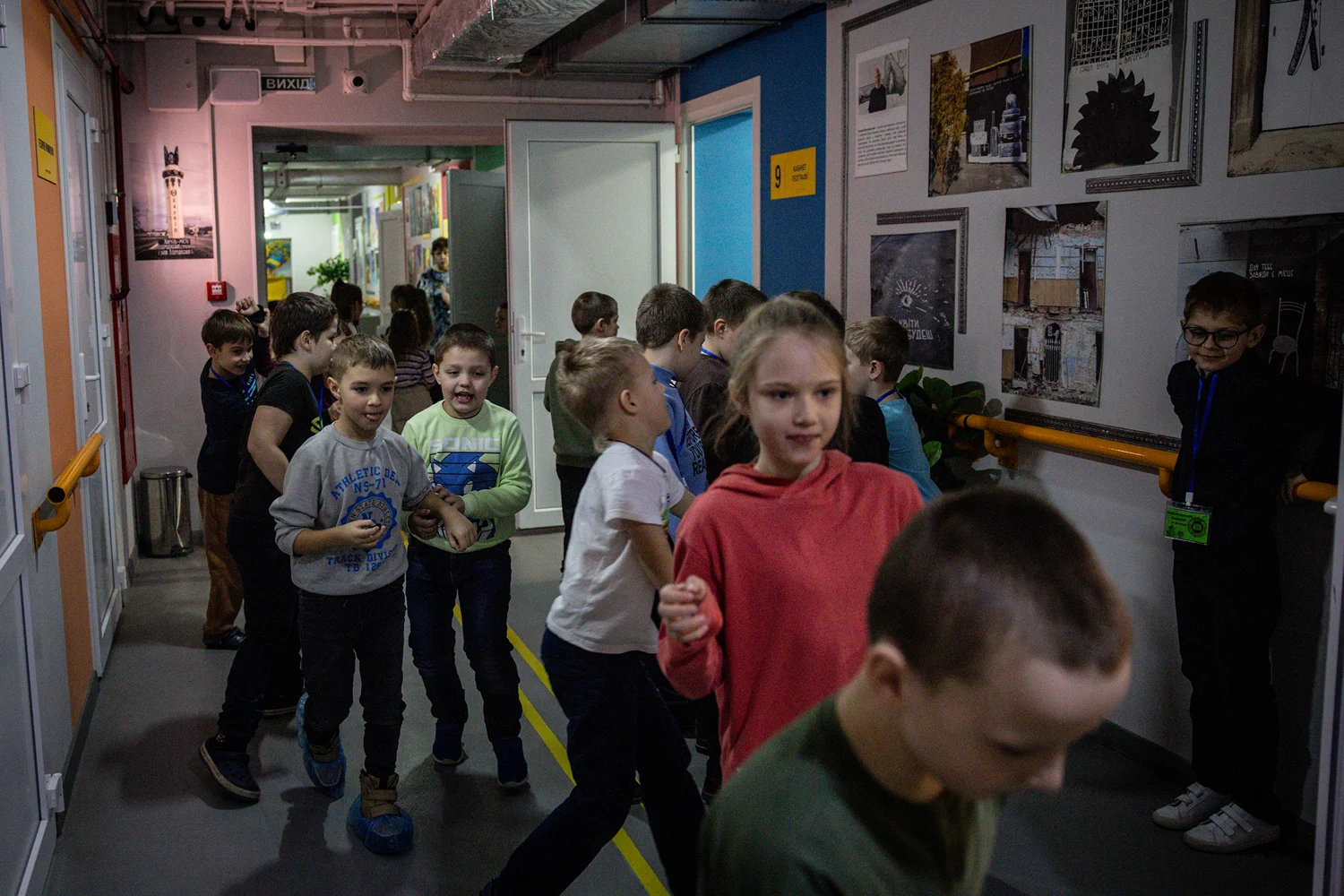
As Russian strikes pummel Ukrainian cities, a quieter, systemic crisis also threatens Ukraine’s future. For Russia, targeting Ukrainian youth is not merely collateral damage; it is demographic warfare aimed at erasing Ukrainian identity. For the millions of children forced to grow up in a war zone, the trauma extends far beyond the front lines, stretching from occupied reeducation camps to disrupted homes across the country.
Children kidnapped by Russian forces in the occupied territories have received the most global attention. Since Russia’s invasion of Crimea in 2014, and the full-scale attack on Ukraine in 2022, a huge number, possibly into the millions, of Ukrainian children have found themselves living under Russian rule—either in Ukraine or relocated to Russia. There, they have been forced to attend Russian schools and facilities, where they are bombarded with pro-Russian propaganda and drip-fed stories intended to eventually turn them into soldiers for their kidnappers.
As Russian strikes pummel Ukrainian cities, a quieter, systemic crisis also threatens Ukraine’s future. For Russia, targeting Ukrainian youth is not merely collateral damage; it is demographic warfare aimed at erasing Ukrainian identity. For the millions of children forced to grow up in a war zone, the trauma extends far beyond the front lines, stretching from occupied reeducation camps to disrupted homes across the country.
Children kidnapped by Russian forces in the occupied territories have received the most global attention. Since Russia’s invasion of Crimea in 2014, and the full-scale attack on Ukraine in 2022, a huge number, possibly into the millions, of Ukrainian children have found themselves living under Russian rule—either in Ukraine or relocated to Russia. There, they have been forced to attend Russian schools and facilities, where they are bombarded with pro-Russian propaganda and drip-fed stories intended to eventually turn them into soldiers for their kidnappers.
“One of the first messages they receive is that they have been abandoned by both their parents and their country,” said Myroslava Kharchenko, chief legal specialist at Save Ukraine, a charity that supports people under Russian occupation. “They are repeatedly told that their parents will never come to take them home.”
Kharchenko explained that over time, this reeducation evolves from anti-Ukraine propaganda to something more overtly aggressive.
“School lessons and textbooks portray Russia as fighting not Ukraine but the collective West, NATO, and Europe while presenting Ukraine merely as a tool used in that broader conflict. We have repeatedly heard from children who have returned … that teachers told them a future war with NATO was inevitable and that they needed to prepare for it. … Some children also reported that individual teachers openly advocated the use of nuclear weapons against Western countries.”
Rescuing children who were kidnapped from this radicalization is essential but dangerous work. Children and their families are contacted on messaging platforms like Telegram by a team in Ukraine using Russian SIM cards. They communicate mostly through voice notes that are immediately deleted after listening—phone calls and typed messages are too traceable and dangerous. The Russian authorities have a particular interest in those trying to rescue Ukrainian children.
The number of Ukrainian children currently living under occupation—either kidnapped or with parents in the territories—is unknown, although there are rough estimates based on prewar population figures. It is impossible to track how many have been born, escaped, become Russian citizens, or died.
But even for Ukrainian children living at home, the war is a constant trauma. Thousands have had their lives turned upside down after losing one or both parents.
Sofiia Hromakova was 15 years old when her father was killed while serving in the territorial defense of Ukraine. She learned of his death after moving from the now-occupied Mariupol to Poland via Zaporizhzhia. Her family ended up living in England, where Hromakova could return to her education.
“When I started at an English school, people would ask questions like, ‘You are here with your mother, where is your father?’ I would cry,” she said. “Most teenagers are thinking about their exams, not ‘oh, god, where is my father’s body?’”
Hromakova said that Children of Heroes, a Ukrainian charity, helped her rebuild her life after suffering such enormous trauma. “They helped us right at the start when we only had a couple of bags and needed clothes,” she said. “They helped me get back to school and pass my exams. They helped me paint and get back to doing hobbies. I felt like I was in a cage and they helped me get out.” She is now back in Ukraine and studying for a university degree.
Children of Heroes is currently registering around 15 children a day, said Yuliya Sotska, the charity’s head of communications. “Some of them want to tell their story and some don’t, but we collect stories from every family that joins the fund, with their consent, so that those stories exist and the world doesn’t get to forget them. One girl who lost her entire family, everyone except her dog, told me her story the way you’d read aloud from a book, completely flat, and that distance is sometimes what trauma sounds like in a child’s voice.”
Russia’s first modern invasion of Ukraine came in 2014, which means the foundation is already working with a second generation. “We have children whose parents joined the armed forces after losing their own parents in 2014, so the people who enlisted were once the children we exist for, and now, unfortunately, their children are,” Sotska said.
The Ridni Foundation, a charity that helps orphans find new homes, noted that as of March 2025, almost 26,000 children were living full-time in institutions across the country. “What tends to surprise people most is that only 18 percent of them, 4,568 children, are actually orphans or legally without parental care,” Mariana Romaniak, Ridni’s CEO, said. “Roughly four in five children in institutional care have at least one parent alive—they’re there because their family didn’t get the support it needed in time, not because they have no family at all.”
Ridni works with government bodies to reform the system and fix the problems behind this. “Together with the Lviv Regional Military Administration, we initiated the transformation of a former residential institution into the Lviv Regional Centre for Social Support of Children and Families,” Romaniak said. “Instead of long-term institutional care, children now receive temporary protection there while specialists work with their families to overcome the crisis and, whenever it’s safe, reunite them.”
Romaniak explained that some children withdraw and have behavioral problems. Others attach to particular adults and struggle when separated. And, in some cases, children who have lost everything they knew struggle to accept help. “It can look like defiance, but underneath there may simply be a question: ‘Can I trust you, and will you still be here tomorrow?’” she said.
Even if the conflict ends, Ukraine’s war generation will continue to cause problems for the country, Sotska said. “Even if the war ended tomorrow, an entire generation of Ukrainian children will carry it. … As a fund, we can’t erase the loss of a parent,” she said. “What we can do is show them there is a future and support that child until they can see that future for themselves.”
