


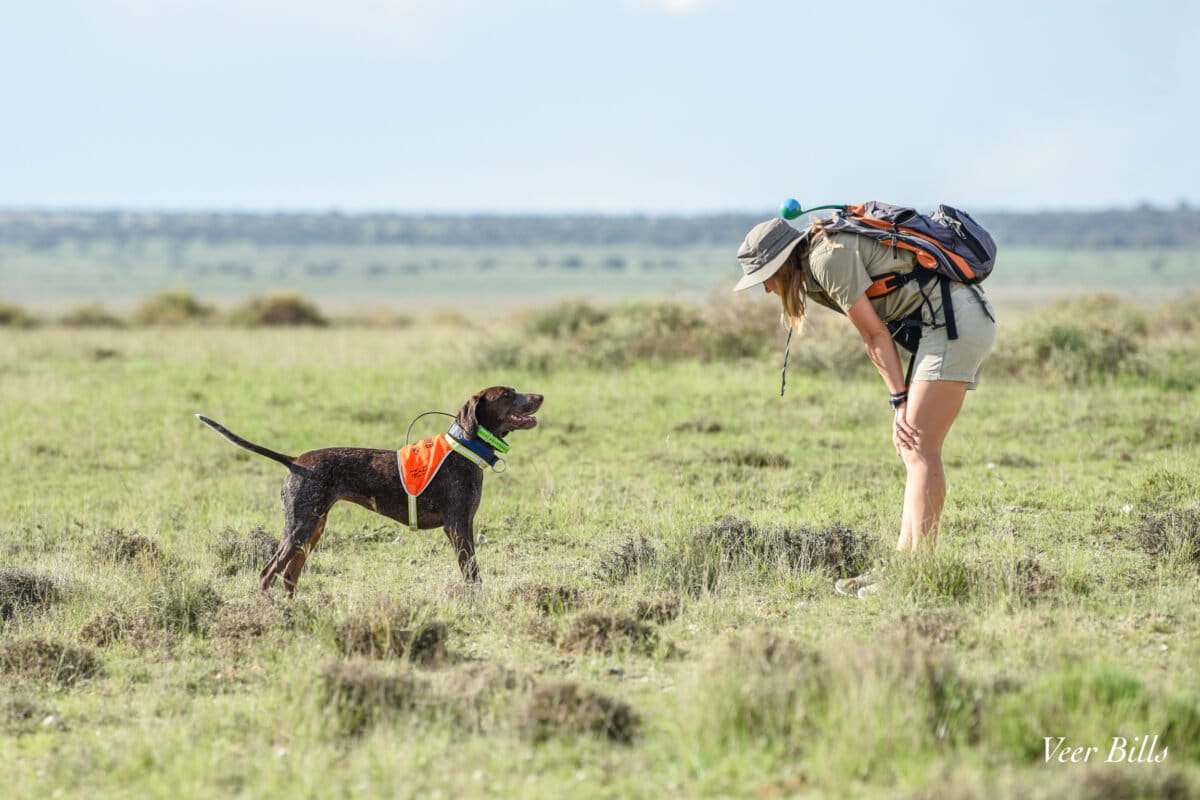
- Dogs trained to detect scat are helping conservationists detect and research hard-to-study species in South Africa’s Karoo region.
- From the black-footed cat and Temminck’s pangolin to riverine rabbits, the scat samples contain ‘nuggets of genetic data’, according to scientists.
- The research and fieldwork has also helped uncover evidence of wildlife crimes and identify habitats in need of protection from development.
In the grassy dwarf shrublands of South Africa’s Karoo, Michelle Marie Schroeder is looking for a very specific kind of poo. Black-footed cats spend most of the day hidden in burrows and emerge mainly under the cover of darkness, making them notoriously difficult to study. That’s why the conservation biologist relies unconventional assistants: Lyka and Sebala, two German Shorthaired Pointers trained to detect the cats’ scat by scent.
When the dogs find a sample, they lie down and remain still to alert Schroeder, who works with the non-profit Canines for African Nature. Working on her own, Schroeder found just four scats in more than a year. Ten-year-old Lyka, by contrast, has located hundreds of samples in just a few months, providing the basis for non-invasive genetic monitoring of Felis nigripes.
“I probably wouldn’t have found more than 90% of the scats without help,” she tells Mongabay. “And it’s also very difficult to distinguish them from those of other small carnivores. The dogs are much more accurate.”
On the trail of the black-footed cat
Hal Brindley, a researcher at the Institute for Communities and Wildlife in Africa at the University of Cape Town, also studies these small, cryptic predators.
“Studying the black-footed cat is incredibly difficult without resorting to invasive methods like trapping and collaring,” he says. “More common non-invasive approaches, such as camera trapping, are often ineffective. Fecal detection, on the other hand, offers a valuable alternative without the need for direct intervention.”
Even so, black-footed cats can be particularly difficult to track in this way. Unlike other carnivores, which usually leave their scat along trails or at elevated points to mark territory, F. nigripes seems to do so almost at random: inside an aardvark burrow, beneath shrubs or in other inconspicuous spots.
“In a way, every scat is a surprise,” Schroeder says. “That makes me completely dependent on the dogs.”
Even a small scat sample in good condition allows researchers to determine the animal’s sex and, in some cases, identify individual cats. With enough samples, scientists can estimate how many cats live in an area and understand how individuals or populations are related. Lab analysis is also beginning to reveal what the cats eat and which intestinal parasites they carry.
“Scats are little nuggets of genetic data,” Schroeder says.
So far, the results offer encouraging news: Analysis of samples from two sites, about 700 kilometers apart, in Namibia and South Africa show relatively healthy levels of genetic diversity.
“We found very little genetic differentiation between populations in this part of the Karoo, which suggests there is still some gene flow here,” Schroeder says. In other words, in the surveyed areas, black-footed cats are still able to move and mix across the semi-arid landscape. However, she says, this is only one small portion of the Karoo and the researchers don’t yet know if these patterns hold elsewhere, in locations where populations may be more isolated amid higher levels of human activity.

Tracking pangolins and rabbits
Lyka and Sebala’s success tracking black-footed cats led Schroeder to set up a pilot project to track another species that’s notoriously difficult to observe due to its camouflage and nocturnal habits: Temminck’s pangolin (Smutsia temminckii).
Here, the goal was to obtain genetic material from pangolin scat to build a georeferenced DNA database that could help trace the origin of scales seized from illegal trafficking operations.
The pangolins presented new challenges. “Unlike carnivores, whose droppings can persist for weeks, pangolin droppings — composed mainly of termites and sand — degrade very quickly and disappear within one or two days, especially in dry environments,” Schroeder says.
In addition, pangolins defecate just once a day, making the number of available samples extremely limited.
Schroeder devised a different strategy: Her dogs began searching for feeding sites, following the strong scent pangolins leave behind while digging. At these sites, researchers could collect fresh biological traces, including droppings and other material left behind by the animals, from which they recovered DNA.
“Their main defense mechanism is to curl into a ball, protected by their scales,” Schroeder says. “This is effective against predators like hyenas, but not against humans: That same strategy makes them easier to capture in the context of illegal trafficking. In fact, many hunters are believed to use dogs to locate them. The challenge is to use that same tool for conservation purposes.”
The pangolin project, however, was put on hold in September 2025 when anticipated funding fell through. Although the dogs were already trained, Schroeder has yet to secure alternative funding to resume fieldwork and laboratory analyses.
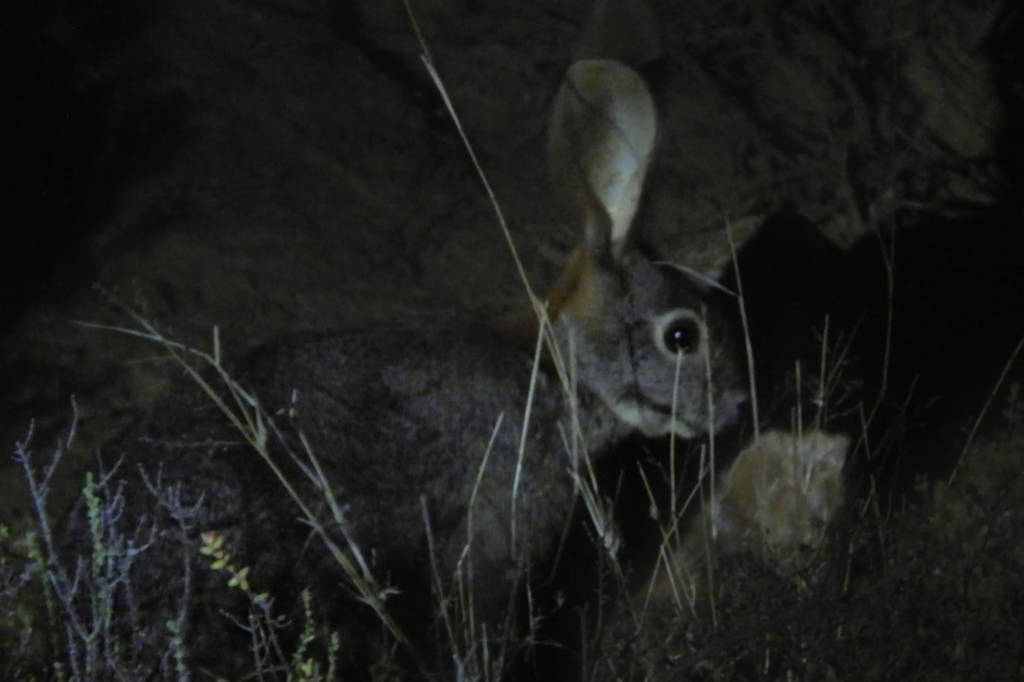
Rox Brummer, director of Green Dogs Conservation, an NGO based in Limpopo province, trains dogs for a wide range of wildlife conservation tasks, including keeping wild cheetahs away from livestock and helping survey a landscape for endangered riverine rabbits (Bunolagus monticularis).
“Dogs have no biases,” Brummer tells Mongabay. “They follow scent without prejudice. While researchers start with hypotheses about where animals might be, dogs simply follow the scent, which can reveal unexpected patterns.”
Aliénor Brassine, an ecologist who also works with Canines for Nature, has used detection dogs alongside camera traps to locate riverine rabbits in the Karoo. “Combining methods improves the results and allows us to make better decisions,” she says. Confirming the rabbits’ presence in areas proposed for wind-energy developments helped identify critical habitat and prevent projects that could harm it. “It’s much easier to convince a developer that a habitat is sensitive if you have evidence that the species is using it.”
These researchers agree that the potential for using detection dogs to locate other endangered species, invasive species or rare plants is enormous and remains largely underutilized in Africa. To make it a more established tool, more scientific evidence and, above all, more funding is still needed, they say.
Beyond the work and the relentless pace of fieldwork, Schroeder, Brassine and Brummer share a common sentiment: Dogs are not just service animals or team members; they are also companions for life, and when they’re not finding species hiding among the grasslands, they also know how to simply be dogs.
“We look for animals with an almost obsessive motivation to play — usually with a ball, sometimes with a Frisbee — because that drive is key to the work,” Brassine says. “But just as important is that they have an ‘off switch’: They can relax at home and live alongside people and other animals.”
Banner image: Michelle Schroeder and her dog, Lyka, in the Benfontein Nature Reserve. Image courtesy of Veer Bills.
Rodent burrows offer unusual sanctuary to Africa’s smallest wildcat
Feedback: Use this form to send a message to the author of this post. If you want to post a public comment, you can do that at the bottom of the page.
Cite this article
María de los Ángeles Orfila (2026). From small cats to pangolins: Detection dogs help track elusive species. Mongabay Conservation news. DOI: https://doi.org/10.66709/news-325496

