

Close Menu
NCIJ Network NCIJ Network
    What's Hot

    The United States Is Betting the House on Winning the Artificial Intelligence Race With China

    August 5, 2026

    US stock market hits record high amid hopes for Strait of Hormuz reopening | Financial Markets News

    August 5, 2026

    Palantir funnels earnings to US to avoid European taxes, report finds – POLITICO

    August 5, 2026
    Facebook X (Twitter) Instagram
    Trending
    • The United States Is Betting the House on Winning the Artificial Intelligence Race With China
    • US stock market hits record high amid hopes for Strait of Hormuz reopening | Financial Markets News
    • Palantir funnels earnings to US to avoid European taxes, report finds – POLITICO
    • Labour members ‘have tougher view on welfare than you might think’, poll suggests | Labour
    • AIPAC Spending Dominates the Michigan Democratic Senate Primary
    • This Android launcher made my home screen fun again – and I’m using the free version
    • Weaponized Email AI Assistants Could Help Attackers Hijack Accounts
    • This Bitcoin Bridge Shut Itself Down Because AI Was Finding Bugs Too Fast
    • About
      • Our Team
      • Editorial Policy
      • Editorial Independence
      • International Support
    • Trust & Standards
      • AI Usage Policy
      • Conflict of Interest Policy
      • Corrections Policy
      • Ethics Policy
      • Fact-Checking Policy
      • Source Protection
    • Get Involved
      • Guide for Sources
      • Support Independent Journalism
    • Legal
      • Cookie Policy
      • Privacy Policy
      • Terms of Use
    Facebook X (Twitter) Instagram
    NCIJ Network NCIJ Network
    Wednesday, August 5
    • Home
    • World
    • Ai
    • Business
    • Politics
    • Health
    • Crypto
    • Science
    • Technology
    • Cybersecurity
    • Defense & Security
    • Economy
    • Energy
    • Europe
    • More
      • Fact Check
      • Investigations
      • Opinion & Analysis
      • Environment
    NCIJ Network NCIJ Network
    Home»Science

    NASA’s PUNCH Sharpens Solar Storm Forecasting in First Test

    NCIJ NETWNCIJ NETWORKBy NCIJ NETWNCIJ NETWORKAugust 4, 2026 Science No Comments4 Mins Read
    Share
    Facebook Twitter LinkedIn Pinterest Email

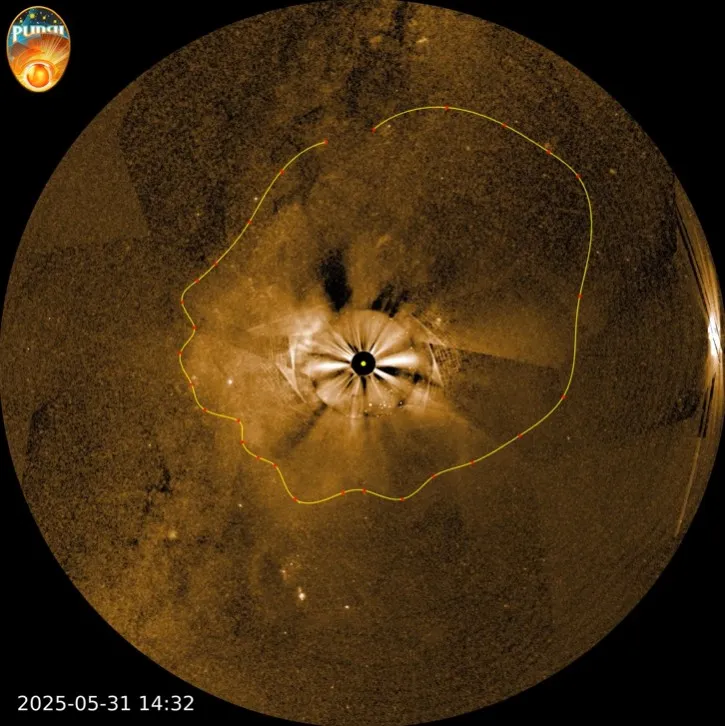
    Using continuous imagery from NASA’s PUNCH (Polarimeter to Unify the Corona and Heliosphere) mission, scientists predicted the near-Earth arrival of a solar eruption to within 30 minutes in an initial proof of concept test. The results, presented Tuesday at the Committee on Space Research Scientific Meeting and under review at the journal Space Weather, could revolutionize the way Earth-impacting storms are forecasted.

    “We thought PUNCH would be good at this, but it’s a stunning result,” said Craig DeForest, principal investigator for PUNCH at Southwest Research Institute’s Solar System Science and Exploration Division in Boulder, Colorado. “To put it in perspective, this could be the space weather equivalent of going from a steam engine to a modern internal combustion engine.”

    Solar storms are caused by huge explosions of material off the Sun called coronal mass ejections. Forecasting when the ejections will reach Earth is key for mitigating their impacts on power grids, satellites, and astronauts. However, until recently, coronal mass ejections could not continuously be tracked for much of their journey across the solar system.

    That changed in 2025 with the launch of the PUNCH mission, which uses four spacecraft in low Earth orbit to make continuous 3D observations of the inner solar system. Before PUNCH, coronal mass ejections could only be seen as they traversed one-fifth the way from the Sun to Earth, leaving scientists to guess what happened over the rest of the distance. With PUNCH’s wider field-of-view, scientists can now routinely track the solar explosions nearly all the way to Earth, capturing a new image every four minutes.

    Scientists used data from a coronal mass ejection that left the Sun on May 31, 2025, to retroactively test if they could improve forecast modeling. Scientists input the images into a computer model, which analyzed the leading edge of the coronal mass ejection over time. As it moved and evolved across the inner solar system, the model used the coronal mass ejection’s speed and geometry to calculate when it would reach Earth.

    Twelve hours after the coronal mass ejection left the Sun, the model settled on a final prediction showing the storm would arrive eight hours later. That predicted arrival time was ultimately accurate to within a half hour, making it 10 times better than currently used methods, which only provide a 5-hour window. In addition, the model itself revealed when the estimate had stabilized, so that a space weather forecaster would be able to predict the arrival time with confidence.

    “We accomplished an order of magnitude better result than the state-of-the-art method with a really basic process, just informed by the fact that the coronal mass ejection could be tracked continuously across the solar system,” DeForest said.

    These first results demonstrate the power of PUNCH’s wide-field imagery to track the solar events as they travel out from the Sun. Ultimately, the scientists think that with more refined PUNCH data and better models, they could be able to forecast coronal mass ejection arrival times even further in advance.

    Beyond space weather forecasting, the images also help scientists glean new insights on coronal mass ejections. The high-resolution images allowed the scientists to see new structures in coronal mass ejections, revealing that the clouds of material are clumpier than previously thought and continue to evolve as they cross the solar system.

    The PUNCH data is also helping scientists better understand how plasma, the solar material launched by coronal mass ejections, moves across space. This information can help astrophysicists better understand plasma’s behavior across the galaxy, such as in star-forming regions where it is nearly impossible to study on small scales.

    Southwest Research Institute, based in San Antonio, leads the PUNCH mission and operates the mission’s four spacecraft from its facilities in Boulder. The mission is managed by Space Science Mission Operations at NASA’s Goddard Space Flight Center in Greenbelt, Maryland, for the Science Mission Directorate at the agency’s headquarters in Washington.

    By Mara Johnson-Groh
    NASA’s Goddard Space Flight Center, Greenbelt, Md.

    Forecasting NASAs PUNCH Sharpens solar Storm test
    NCIJ NETWNCIJ NETWORK
    • Website

    Keep Reading

    DNA on the Shroud of Turin reveals centuries of hidden history

    August 2026 Satellite Puzzler – NASA Science

    NASA Will Attempt to Observe Rocket Part’s Lunar Impact

    Strange quantum experiment shows “negative time” is more than an illusion

    These underwater bones could solve a mystery about extinct giants

    This hydrogen turbine turns controlled explosions into electricity

    Add A Comment
    Leave A Reply Cancel Reply

    Editors Picks

    The United States Is Betting the House on Winning the Artificial Intelligence Race With China

    August 5, 2026

    US stock market hits record high amid hopes for Strait of Hormuz reopening | Financial Markets News

    August 5, 2026

    Palantir funnels earnings to US to avoid European taxes, report finds – POLITICO

    August 5, 2026

    Labour members ‘have tougher view on welfare than you might think’, poll suggests | Labour

    August 5, 2026
    Latest Posts

    Oil prices hit $100 for the first time since May

    July 23, 2026

    Pew Survey: China May Be Liked More, but It Is Celebrating a Race It Never Ran

    July 23, 2026

    Yinson Production and PTSC’s FSO heads off to Southeast Asian oil project

    July 23, 2026

    Subscribe to News

    Get the latest sports news from NewsSite about world, sports and politics.

    NCIJ Network is an independent digital news platform delivering trusted investigative journalism, European and global news, in-depth analysis, and fact-based reporting with accuracy, transparency, and integrity.

    Facebook X (Twitter) Instagram Pinterest YouTube

    The United States Is Betting the House on Winning the Artificial Intelligence Race With China

    August 5, 2026

    US stock market hits record high amid hopes for Strait of Hormuz reopening | Financial Markets News

    August 5, 2026

    Palantir funnels earnings to US to avoid European taxes, report finds – POLITICO

    August 5, 2026

    Subscribe to Updates

    Get the latest creative news from FooBar about art, design and business.

    Type above and press Enter to search. Press Esc to cancel.