


- Mennonites have become some of the most prolific land buyers in Belize, acquiring large properties and making bids faster than competitors. But who owns what land isn’t always clear.
- To better understand the land management process, a Mongabay investigation gained access to records in deforested and degraded areas in and around Mennonite communities throughout Belize.
- The documents show that the communities use trusts and churches to acquire and collectively manage land, allowing them to transfer property internally and tap collective resources to purchase more.
- At the same time, Belizeans living in and around Mennonite communities often occupy much smaller plots of land, surviving off subsistence crops or working at Mennonite-owned businesses.
SPANISH LOOKOUT, Belize — When the Mennonite community here purchased a property four years ago in the middle of the Maya Forest Corridor, a government-recognized stretch of land designed to connect forests in the region, conservation groups were concerned.
Community members began clearing land before completing an environmental impact assessment, resulting in fires and pollution, according to one report. In addition, Mennonites beat a conservation coalition that had also wanted to purchase the land for the corridor.
The battle for that piece of real estate is just one example of how Mennonites conduct business in Belize, and how those moves have led to extensive deforestation. The small Central American country, flanked by Mexico, Guatemala and the Caribbean Sea, is about the size of the U.S. state of New Jersey, but its dense jungle is now much smaller than it once was. The nation lost around 20% of its forest cover between 2001 and 2025 — more than 350,000 hectares (865,000 acres), similar to the U.S. state of Rhode Island.
Much of the deforestation in Belize has been tied to Mennonites, the conservative and largely insular Christian denomination that began migrating to Belize more than six decades ago, cutting down the rainforest to establish new colonies.
While reports documenting Mennonites and deforestation are common, far less understood is the corporate machinery they’ve put in place for this expansion. Mongabay conducted extensive interviews and reviewed dozens of land records to better understand the way Mennonites became one of the most prolific land buyers in the country, often outbidding small farmers, conservation groups, and other competitors.
Mongabay focused on deforested and degraded tracts around Mennonite communities throughout Belize. Instead of individual church members buying land, the documents show how Mennonites establish trusts and churches to buy and manage their properties, essentially acting as a corporation with extensive subsidiaries and affiliated businesses.
“[Mennonite communities] pride themselves on being more autonomous,” Elma Kay, chair of the Maya Forest Corridor Trust, a conservation group in Belize, told Mongabay. “They’re very efficient at managing their finances, harnessing those to acquire more land as a community, as a collective.”
This business approach has also given Mennonites easier access to money from banks and other lending institutions. The communities have their own credit unions for financing land deals and established credit history that makes it easier to obtain conventional bank loans.
Once the land is purchased, they move quickly, sometimes cutting down trees before completing the required environmental impact assessments.
A series of interconnected entities and lending institutions show how Mennonites overall are able to maintain control of land across generations. None of this is improper, and Mennonite leaders contend that, despite deforestation, they are good stewards of the land they own.
At a time when communities are looking to expand in the country and into other parts of the region, including Suriname and Peru, the documents in Belize help explain the communities’ business tactics for acquiring land and clearing it for farming.
Into a ‘dark and forbidding jungle’
To better understand how Mennonites acquire and manage their land, Mongabay went to communities throughout the country, including Spanish Lookout near the Guatemalan border, and Blue Creek, farther north and near Mexico.
Mennonites are a Christian denomination with more than 2 million members around the world. Their roots go back to the Protestant reformation that broke from the Catholic Church about five centuries ago in Germany and the Netherlands. Even today, many of them speak a Germanic dialect, and their dress and customs reflect those roots.
They first arrived in Belize in 1958, hoping to establish settlements where their traditions would survive the influences of the outside world. One community member at that time described Belize as a “dark and forbidding jungle” full of “jaguars and giant snakes.”
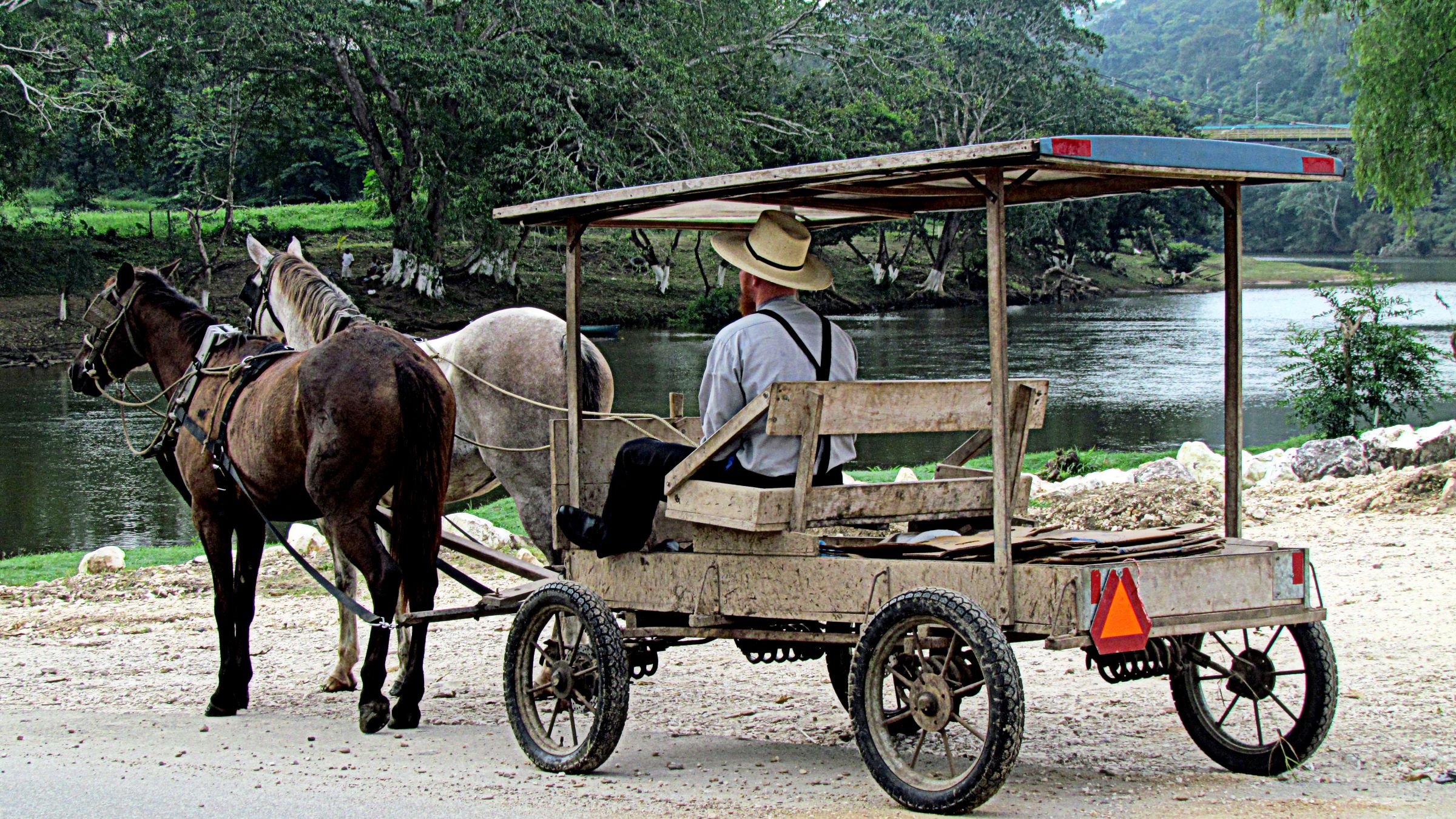
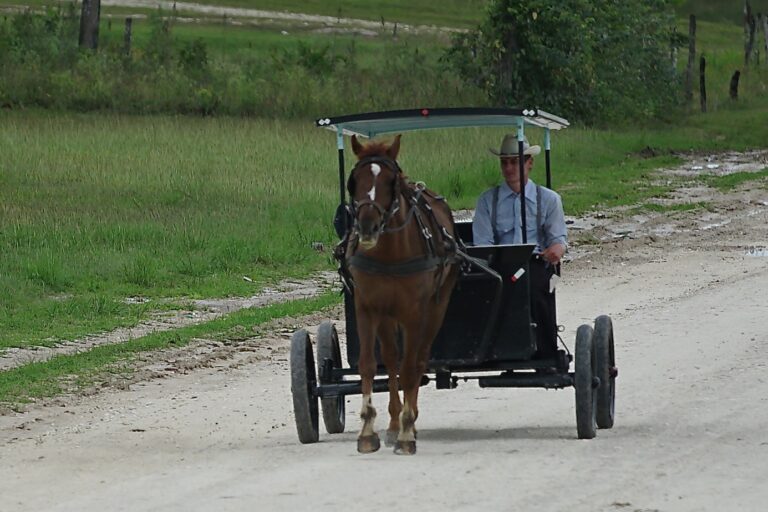
Today, many Mennonites largely try to live without modern conveniences. They travel by horse and buggy, live by candlelight, and go without cellphones or computers. Many women wear long, flowing dresses and bonnets, staying at home to raise children, cook and clean.
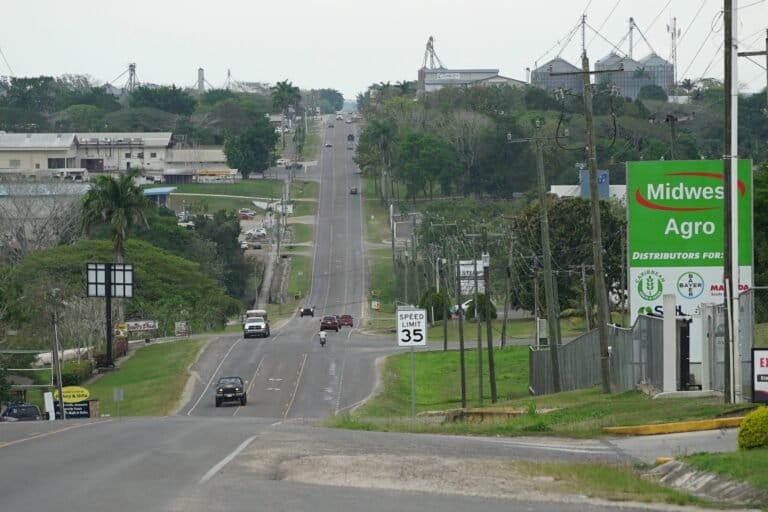
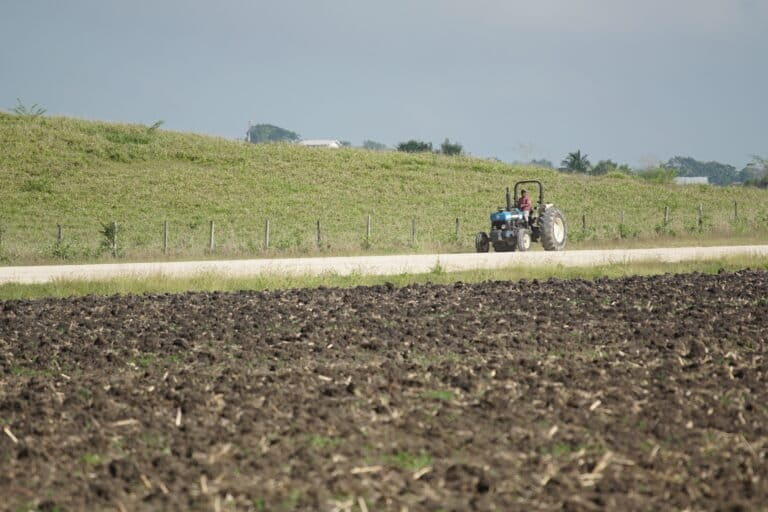
Over time, some Mennonites began to modernize, using tractors and even operating industrial combines and silos. In Spanish Lookout and Blue Creek, two of the most progressive Mennonite communities, many members drive cars, text on WhatsApp, and use tractors, silos and industrial combines.

Instead of individual church members buying and owning land, Mennonites have largely opted to pool their money. When Mennonites purchase land, the title is often officially in the name of the church.
In recent decades, more modern Mennonite communities have begun to separate church operations from the business of land development. They moved titles out of church control and into private corporations overseen by church leadership, usually an elected body of three people, called a Vorsteher, which roughly translates as “manager.”
In the 2000s, for instance, the Spanish Lookout community began transferring land from the church’s Klein Gemeinde Trust Corporation Ltd. to Spanish Lookout Community Trust Corporation Ltd. In one case, a land record shows approximately 1,600 hectares (4,000 acres) transferred in 2008 from the church to the trust.
Today, the Spanish Lookout corporation manages around 42,100 hectares (104,000 acres), community leaders said.
There are a series of business benefits to this approach. One is convenience.
“People move away. People die. And then there’s all that work of maintaining current trustees [of the land],” Blue Creek Mayor John Krahn said. “It takes a long time. So we’re consolidating that all into one title so that it’s less hassle keeping it up to date.”
To delve into Mennonite land deals, Mongabay examined records maintained by the National Estate Section of Belize’s Ministry of Natural Resources, where government leases and purchases are recorded. The section has limited digital records before around 2008. Officially, physical copies can technically be requested in person, but the process lacks transparency and often depends on personal connections, according to a land consultant who works in the office but requested anonymity due to fear of professional repercussions.
The records obtained by Mongabay show an example of that consolidation: a 2,980-hectare (7,366-acre) transfer by the Evangelical Mennonite Mission Church to the Blue Creek Mennonite Church in 2023.
Krahn said the process of separating land acquisitions from church operations is still underway in Blue Creek because the community’s several religious entities make consolidation more complicated. Land belonging to each titled church is being put under a single holding company called Blue Creek Mennonite Church.
The mayor said this approach also makes it easier for the community to plan for the future. It can consider expanding for later generations, manage resources more efficiently, and better secure legal rights for land, Krahn said.
“All we need is the vision to say that somewhere in 20 years, we will need the land,” Krahn said. “Now we have to put some real pressure on ourselves to buy.”
Special certificates give Mennonites an advantage
While Mennonites own land collectively through large corporate entities, their members — the families and individuals who farm the land — are given a unique document that creates the impression of having a stake in a particular piece of property.
This certificate to occupy is not an official government document, but rather an internal record administered by community leadership. Those who aren’t Mennonites are ineligible to obtain the certificate. It would carry little weight in a Belize court in the event of a land dispute, according to attorneys consulted by Mongabay.
To get a certificate to occupy a piece of land, Mennonite families request the document and make a one-time payment to Mennonite leadership, who review the request before approving the application.
The system ensures the land remains under Mennonite control, community leaders said. Families can’t put their land on the public real estate market because they don’t really own it.
Outsiders who might try applying for a certificate would be rejected because they aren’t community members, the leaders said.
“If somebody wants to sell 2 acres of land to the neighbor, that’s awesome,” Blue Creek Mayor Krahn said. “They come into the office, apply for a land transaction. It costs them $100. And all that paperwork is done internally.”
If a Mennonite family want a bank loan to buy farm equipment or modernize their operation, the certificate may be part of that request. They may use the community-issued certificate as part of their application, and the larger Mennonite business entity that actually owns the land would effectively co-sign for the borrowing, according Krahn.
Many banks trust the certificates if they’re accompanied by a letter showing that community leadership is aware of the deal, he said. The individual buyer is trustworthy because they have the “backing of the whole community,” with the understanding that it would step in before there’s a problem paying back the loan.
Several banks in Belize didn’t reply to requests for comment for this article.
One result of this approach is that while a Mennonite family may claim to possess a farm, it doesn’t show up on government land records.
Large land titles, cheap prices help beat out the competition
In 2022, the Spanish Lookout community purchased a 2,719-hectare (6,719-acre) stretch of land colloquially known as Tiger Sandy Bay, in the middle of the Maya Forest Corridor.
For years, the Maya Forest Corridor Trust, which includes the Wildlife Conservation Society Belize, the Foundation for Wildlife Conservation, the Belize Maya Forest Trust, and Re: Wild, had been trying to buy as much of the land as possible, viewing the approximately 37,000-hectare (91,000-acre) corridor as central to protecting the connection between the Great Belize Maya Forest and the Maya Mountain Massif, areas rich in biodiversity.
Kay, the Maya Forest Corridor Trust chair, told Mongabay, “I think we’ve been outmatched by them [in some cases].”

Developing private property in the area requires an environmental impact assessment, but the Spanish Lookout Mennonite community began clearing the land before one was completed, resulting in fires, pollution, and the creation of roads, bridges and farming plots, according to the environmental impact assessment and subsequent public consultation, in which residents and officials met to discuss the parameters of the project.
In recent years, Mennonites have met with the conservation groups to discuss a compromise that would allow development without threatening forests.
But Mennonites “aren’t in the business” of keeping land for conservation, Spanish Lookout community leader Norman Reimer told Mongabay. He said environmental groups are too demanding. They don’t consider the country’s demand for food, which requires land.
He said the Mennonite approach to land use is not based on religion — it’s business. In the process of seeking a simple life, Mennonites have become excellent farmers who understand how to produce at scale, constantly expanding.
“It’s what we know,” Reimer said.
Holding large, collective land titles gives Mennonite communities significant advantages for growth.
In addition, pooling financial resources creates access to large amounts of capital that can allow them to purchase land quickly, without having to work with lenders.
“[Mennonites’] savings are in their land,” Abram Dyck, former mayor of Blue Creek, told Mongabay. “If they earn money, if they make a profit at the end of the year, they buy more land. That’s what they do.”
Land sellers can find it more attractive to sell to Mennonites because they have the resources to pay for large parcels, and pay reliably. A seller with a large property doesn’t need to worry about slicing the land into smaller plots to make deals.
As a result, Mennonites can sometimes buy at a cheaper price, according to Julian Sherrard, director of Green Real Estate Belize, an agency in the district of Cayo, where Spanish Lookout is located.
“When you have that kind of buying power, that’s where you can make huge gains because you’re essentially buying wholesale,” he said.
If financing is needed, communities often go through Mennonite credit unions, such as Blue Creek Credit Union and Spanish Lookout Credit Union.
That puts Mennonites at an advantage over other individual Belizean buyers, who are often seen by banks as riskier and with poorer credit.
Small-scale farms fall behind
As Mennonite communities grow, a gap has widened between them and other rural Belizeans living nearby, who tend to occupy smaller plots with far less ability to compete.
Land records obtained by Mongabay show that Belizeans living near Mennonite communities occupy less than 20 hectares (50 acres), and have spent years navigating various bureaucratic processes to formalize their presence on the land.
“Not all of us have the same luck” as Mennonites, said Evelin Ventura, who lives in Duck Run, a rural community next to Spanish Lookout. “Those of us who start on the bottom know how hard it is to get land, to make something of yourself.
“It’s hard to get by,” she added, “and even more so if there’s no stable work or opportunities.”
In communities like Duck Run, many residents fled armed conflicts in Guatemala and El Salvador during the 1980s and ’90s. They received plots of land, sometimes as small as an acre, or less than half a hectare, through a government refugee program.

Residents living near Mennonite communities often survive on subsistence crops, small-scale farming, and livestock. Some work in Mennonite communities, operating machinery, transporting goods to market, and attending to customers in Mennonite-owned stores.
Some non-Mennonite residents have businesses of their own, but they’re less common. If they engage in farming, making furniture, or developing prefabricated homes — professions Mennonites dominate — they sometimes struggle to compete.
“You [can] become dependent on their system,” said Boris Arevalo, the Wildlife Conservation Society’s terrestrial conservation director. “There’s no way out of that system unless you sell your little business or your piece of land back to the Mennonites.”
Arevalo said Belize already has laws on the books to regulate rapid land expansion, but the country’s culture needs to shift so the laws are actually enforced. Groups with money and influence can too easily find ways to expand unregulated, he said.
Many Mennonites said they find the perception of them as uncaring about the environment and nearby communities unfair and not in line with their recent actions. Blue Creek Mayor Krahn said the community is cooperating with the government, and always aims to comply with the law.
Mennonites have learned from past mistakes and recognize the importance of environmental responsibility through collaboration with officials and nearby communities, according to Krahn.
“It’s a two-pronged effort,” he said in a written statement to Mongabay. “Stay in place but expand by buying neighboring land and making better use of the land we already possess.”
For Mennonites, an uncertain future awaits
Mennonites continue to expand within Belize, and are also eyeing moves elsewhere in Latin America.
Krahn said Blue Creek is interested in purchasing several plots of land on the outskirts of the community. He declined to share details, saying he wanted to avoid compromising future negotiations. The plots, reviewed by Mongabay, could total more than 16,200 hectares (40,000 acres).
Blue Creek also sits beside Aguas Turbias National Park, approximately 3,600 hectares (8,800 acres) of lowland swamp forest that runs along the Mexican and Guatemalan border, as well as the Rio Bravo Conservation and Management Area to the south.
The Belize Forest Department didn’t respond to a request for comment about potential threats that Mennonite communities may pose to those protected areas.

Conservationists said while it would be alarming if Mennonite communities tried to buy a protected area, it would also be difficult and unlikely.
“There are mechanisms in place to protect existing protected areas,” said Nicole Auil Gomez, the Wildlife Conservation Society’s Belize country program director. “Our laws don’t just allow you to come and say, ‘I’m going buy that.’”
Some Mennonites told Mongabay that environmental concerns are preventing expansion in Belize, but that they still have certain properties marked for potential future opportunities.
Other Mennonites told Mongabay there isn’t much land left to buy in Belize, and that they’re looking for opportunities abroad.
Henry Penner, one of the leaders of Indian Creek, near Spanish Lookout and Blue Creek, said he’s considering moving to Suriname because his Mennonite community has become too advanced.
“They want more technology,” he said. “I want to keep on with that — what I committed myself to.”
Banner image: Mennonite cart San Ignacio – Santa Elena Cayo Belize. Image by bobistraveling via Flickr. CC BY 2.0
Citation: Roessingh, C. (2007). Mennonite communities in Belize. International Journal of Business and Globalisation, 1(1), 107-124. doi:10.1504/IJBG.2007.013722
See related from this reporter:
Another controversial land deal in Suriname threatens the Amazon Rainforest
FEEDBACK:Use this form to send a message to the author of this post. If you want to post a public comment, you can do that at the bottom of the page.
