


Welcome back to World Brief, where we’re looking at Spain’s migrant crisis, a possible breakthrough in Gaza, and backlash over FIFA’s decision to sell minority stakes.
‘Absolutely Unsustainable’
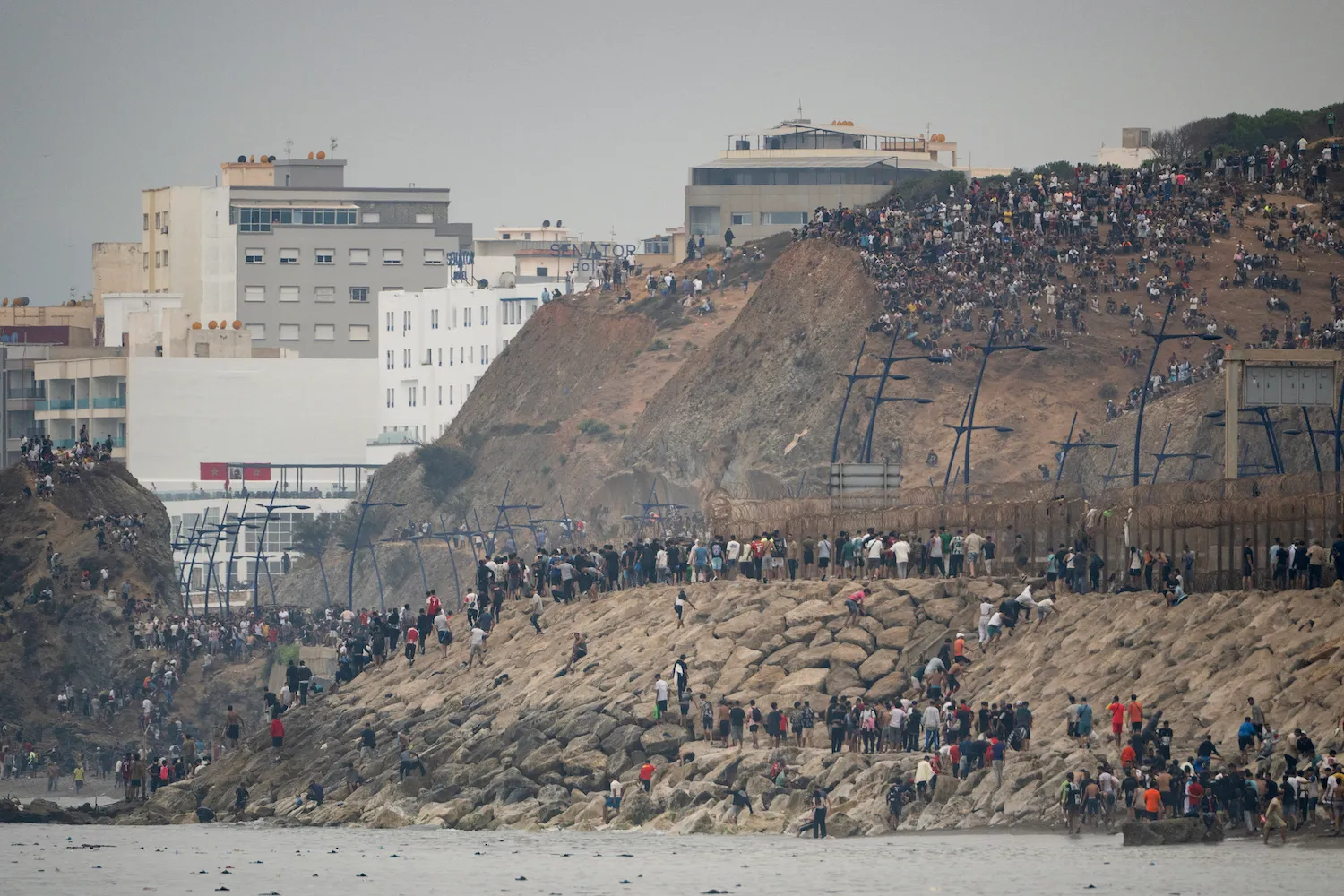
In the past 24 hours, around 60,000 migrants in Morocco crossed the border into the tiny Spanish exclave of Ceuta, Spanish authorities reported on Friday. Although Madrid claims to have largely reversed the mass crossing, with an estimated 48,300 people returning to the North African country later that day, the migrant rush has inflamed far-right concerns that Spain is too lax on immigration.
Welcome back to World Brief, where we’re looking at Spain’s migrant crisis, a possible breakthrough in Gaza, and backlash over FIFA’s decision to sell minority stakes.
‘Absolutely Unsustainable’
In the past 24 hours, around 60,000 migrants in Morocco crossed the border into the tiny Spanish exclave of Ceuta, Spanish authorities reported on Friday. Although Madrid claims to have largely reversed the mass crossing, with an estimated 48,300 people returning to the North African country later that day, the migrant rush has inflamed far-right concerns that Spain is too lax on immigration.
Ceuta has long been viewed as a gateway to the European Union. Containing one of only two EU land borders with Africa, the Spanish territory is no stranger to African migrants seeking a better life. But this week’s crossings appear to have reached an unprecedented scale, overwhelming local immigration services.
“The situation that Ceuta is going through is absolutely unsustainable,” Ceuta President Juan Jesús Vivas said on Friday, with Spanish Prime Minister Pedro Sánchez calling it “an attack on Spain’s territorial integrity.” The total number of migrants who entered Ceuta on Thursday and Friday was roughly equal to 70 percent of the territory’s entire population of around 85,000 people.
As Spain deployed armed forces to Ceuta to try to restore order, Moroccan security forces violently clashed with migrants hoping to cross the border by sea and land. Some individuals reported swimming several miles before being told to turn back, with local authorities firing tear gas, water cannons, and warning shots. At least 57 people died, including from drowning or stampedes.
“It’s a situation of absolute humanitarian and social emergency,” Vivas told local media, urging Madrid to declare a national emergency in Ceuta. Morocco has also urged its citizens to return home.
The incident has sparked fierce outrage from EU lawmakers who have accused Spain of being an outlier in European immigration policy. Unlike many EU countries, whose rising far-right parties have cracked down on migration, left-leaning Sánchez has taken a different approach. This year, Madrid announced a law allowing more than 1 million undocumented migrants in the country to apply to formalize their status. Sánchez argued that the policy would bolster Spain’s economy and address its aging population. But conservatives have criticized the prime minister for being too lenient, and they are now pointing to Ceuta as proof.
The government of far-right Italian Prime Minister Giorgia Meloni ordered Rome on Friday to temporarily suspend its Schengen agreement with Spain over the migrant crisis, halting free movement across their air and sea borders. Sánchez denounced the decision, writing on X, “Solidarity and empathy are optional. Respect for European treaties and the facts is not.”
Some countries have defended Spain’s policy decisions. “This crisis in Ceuta has nothing to do with the regularization of migrants adopted by the Government of Spain, as is being falsely claimed by some,” French Interior Minister Laurent Nuñez said, though he noted that France will increase its border protections with Spain.
Yet many EU nations have taken Italy’s side. “Spain has completely failed to protect the external border of the Schengen area from incursions. This cannot continue,” Finnish Interior Minister Mari Rantanen wrote on X. “All European countries must support Meloni’s proposal. Countries that do not fulfill their obligation to protect the external border cannot be members of Schengen.”
Today’s Most Read
What We’re Following
Board of Peace progress. U.S. President Donald Trump announced on Thursday what has the potential to be a major milestone in Israel-Hamas peace talks. According to the White House, Hamas has agreed to completely disarm its forces, while Israel has vowed to withdraw its troops from Gaza. “This agreement is a critical step towards Gaza finally being governed by a new Palestinian government that will work closely with the Board of Peace to help the Palestinian people,” Trump wrote on Truth Social.
The agreement will be carried out in “carefully structured phases,” Trump added, to allow the International Stabilization Force, a United Nations-mandated peacekeeping unit, to take responsibility for Gaza. Officials did not specify a timeline for Hamas’s disarmament or Israel’s withdrawal, both of which were key conditions of Trump’s 20-point peace plan.
Actually taking the first step, though, may not be as easy as Trump’s suggests. A senior Hamas official told Reuters on Friday that the militant group will only disarm if Israel first commits “to stopping the killing and ending its attacks.” Israeli forces have continued to sporadically target Gaza over the past year. Meanwhile, an Israeli official said that the country will not withdraw its troops “unless Hamas undergoes a genuine disarmament.”
FIFA’s implosion. A senior advisor to FIFA President Gianni Infantino resigned on Friday to protest the organization’s decision to sell stakes in future World Cup profits to private investors. “It is a bad deal for FIFA’s Member Associations, a bad deal for football, and a bad deal for the long-term future of the game,” Carlos Cordeiro, who represented FIFA on the White House task force for the 2026 Men’s World Cup, said in a statement.
On Tuesday, FIFA—soccer’s global governing body—unveiled plans to allow private equity groups to buy minority stakes in the World Cup and other soccer-related events, such as the Club World Cup. The investment group would be led by Thrive Eternal, a permanent capital holding firm founded by Joshua Kushner (brother of Jared Kushner, Trump’s son-in-law).
UEFA and Concacaf, the organizations governing European and North and Central American soccer, respectively, quickly denounced the proposal. “The World Cup cannot be treated as an investment product,” UEFA said in a statement. “No part of it should ever be surrendered to private investors. The World Cup is not for sale.” The European branch voted on Thursday to boycott future FIFA events, including World Cups.
A long-dormant court. The U.S. Justice Department convened a hearing of the Alien Terrorist Removal Court on Thursday for the first time since the obscure body was created 30 years ago. The court was initially created to expedite the removal of noncitizens suspected of terrorism. Its use this week signals the Trump administration’s efforts to explore new avenues to crack down on immigration.
Prosecutors are seeking to deport Nazira Haji Zada, an Afghan woman and lawful permanent U.S. resident living in Texas. They have accused Zada of supporting the Islamic State and helping to conceal a failed Election Day mass shooting in 2024. Although Zada’s son and son-in-law pleaded guilty to related charges last year, she has not been charged with any crimes.
The Justice Department maintains that it cannot disclose the evidence against her, as much of it is classified. The FBI wrote in a July 15 memo that the “underlying information is classified because disclosure would enable terrorists and terrorist organizations to avoid preventative or detection measures or would reveal FBI or other U.S. Intelligence Community sources.”
However, Matthew Farley, Zada’s attorney, argued during Thursday’s hearing that “this entire scheme is in violation of due process and unconstitutional,” and he asked the court’s chief judge to dismiss the case and release Zada. The judge denied the request.
What in the World?
Why did Brazil’s Ministry of Foreign Affairs recall its ambassador to Argentina on Sunday?
A. Argentine President Javier Milei threatened Brazil with tariffs.
B. Argentine troops entered Brazilian territory without permission.
C. Milei ridiculed the Brazilian men’s soccer team at the World Cup.
D. Milei insulted Brazilian government officials.
Odds and Ends
During an international AIDS conference in Brazil this week, a senior health official with the U.S. State Department presented a map depicting places in Africa where Washington might direct future health grants. One problem: The map mislabeled several African countries. Among other issues, the coastal nations of Nigeria and Mozambique became landlocked in the Sahara and Horn of Africa, respectively; the Ivory Coast moved from West Africa to southern Africa; Malawi and Uganda received new borders; and Cameroon, despite being listed on the document’s legend, was missing from the actual map.
The “unfortunate error” was the result of a team member who “hastily altered” a slide before the presentation, the State Department said, adding that it takes “full responsibility” for the misprint.
And the Answer Is…
D. Milei insulted Brazilian government officials.
Milei’s actions are the latest example of the perils of the recent rise in populist governments, which often sideline traditional diplomacy, Christopher S. Chivvis, Milan Vaishnav, and Rohan Mukherjee argue.
To take the rest of FP’s weekly international news quiz, click here, or sign up to be alerted when a new one is published.
