


Unlock the Editor’s Digest for free
Roula Khalaf, Editor of the FT, selects her favourite stories in this weekly newsletter.
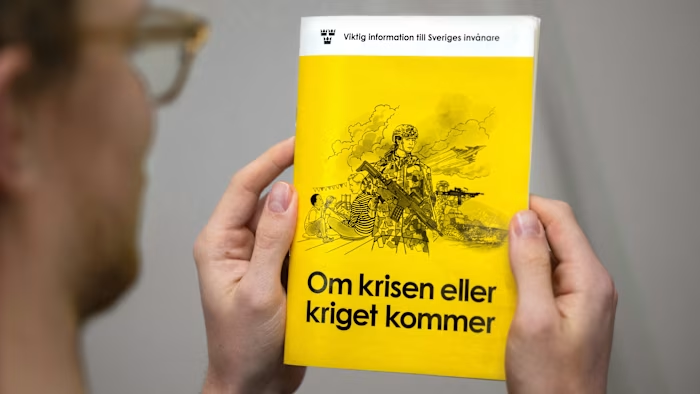
The age of prepping is upon us. In Sweden, a brochure instructs citizens to keep at least a week’s supply of water and food “in case of crisis or war”. Similar leaflets have been issued to Norwegians, Danes and Finns, and are online in the UK. Even without Russian aggression, cyber attacks and extreme weather mean such precautions are no longer the preserve of doomsday survivalists hoarding baked beans and duct tape. But in such a crisis, social solidarity would also matter. So it’s worrying that we seem increasingly suspicious of one another.
A good deal of public discourse now feels framed as zero sum: the assumption that one group must lose in order for another to gain. It’s common to suggest that immigrants are taking our jobs, the wealthy are getting even richer at others’ expense, or that female workers are hurting employment prospects for men.
It’s as if we are stuck in a game of musical chairs, with too few seats and some players doomed to miss out. The idea that we can expand the circle, that entrepreneurs can spread prosperity, is getting lost. And, worryingly, there is evidence that this kind of thinking undermines willingness to co-operate.
Zero-sum thinking is not new. But it seems to be on the rise, especially among the young. An analysis of English language books finds the use of “zero-sum” terminology has leapt since 1990, pulling far ahead of “positive-sum” descriptions.
Economists Stefanie Stantcheva and Sahil Chinoy have found that American Gen Z and millennials are far more likely than Gen X and baby boomers to imagine the world is a fixed pie, and not just if they’re poor: those making $100,000 a year feel aggrieved, and postgraduates even more so. Residents of big cities displayed the highest tendency for zero-sum thinking: mayor Zohran Mamdani was elected by New Yorkers who see themselves as losing out. Older people tend to have a more expansive mindset — apart from Donald Trump, whose zero-sum tariffs are making US consumers poorer.
Stuttering economic growth since the 2008 crash and anxiety about a precarious world can make the young more likely to see resources as scarce. Researchers suggest this may be down to very real competition in job markets, university admissions and housing.
There is also evidence that beliefs about social mobility can be self-fulfilling. When presented with a fictional company where highly rated employees got bonuses and low-rated ones didn’t, young people in a recent University of Chicago experiment tended to assume the staff were ranked against each other, rather than that everyone could get a high rating if they were good enough.
Such mindsets are not always irrational. The postwar international order was built on the idea that interdependence would boost opportunities for all, and so it did. But, as the century ended, the tide of globalisation was not lifting all boats.
Moreover, across the west, pensions have strained the social contract, charging dwindling numbers of working-age people to support growing numbers of retirees. In big cities where Harvard found the strongest zero-sum mindsets, planning restrictions are a major constraint on housing supply. A reckoning is due, but inequality will not be reduced by penalising success.
If we are not careful, we are heading for a future that is poorer both economically and culturally.
In a study of 37 nations, those who agreed that “if someone gets richer, it means somebody else gets poorer” also tended to be more cynical about institutions and less likely to volunteer. This bodes ill for the social fabric. Inadvertently, this also increases the pressure to expand government. According to Stantcheva and Chinoy, zero-sum thinking is strongly associated with support for government redistribution as well as calls for immigration restrictions: cutting across partisan lines, yet an ever-expanding state is likely to entrench managed decline.
How do we move from a conversation about “who gets the biggest slice” to “how do we increase the pie”? It’s easier for politicians to indulge in the politics of grievance than to build voter confidence that we can grow our way out of this. It’s especially challenging when trust is falling in authorities and employers, belief that leaders lie to us is at an all-time high and large majorities think the wealthy take more than their fair share, according to the Edelman Trust Barometer.
Confidence comes from effective policy. We can build affordable housing that is attractive and doesn’t upset the neighbours. We can tackle climate change while also creating jobs, and welcome entrepreneurs, not drive them abroad.
The Swedish leaflet on emergencies emphasises “we must all help each other”. The British equivalent says to “find out if you are eligible for a priority service register”. There’s nothing wrong with extra help for the vulnerable in a crisis: it was vital in the pandemic. But I can’t help feeling that someone in authority has already given up on us trusting one another.
