


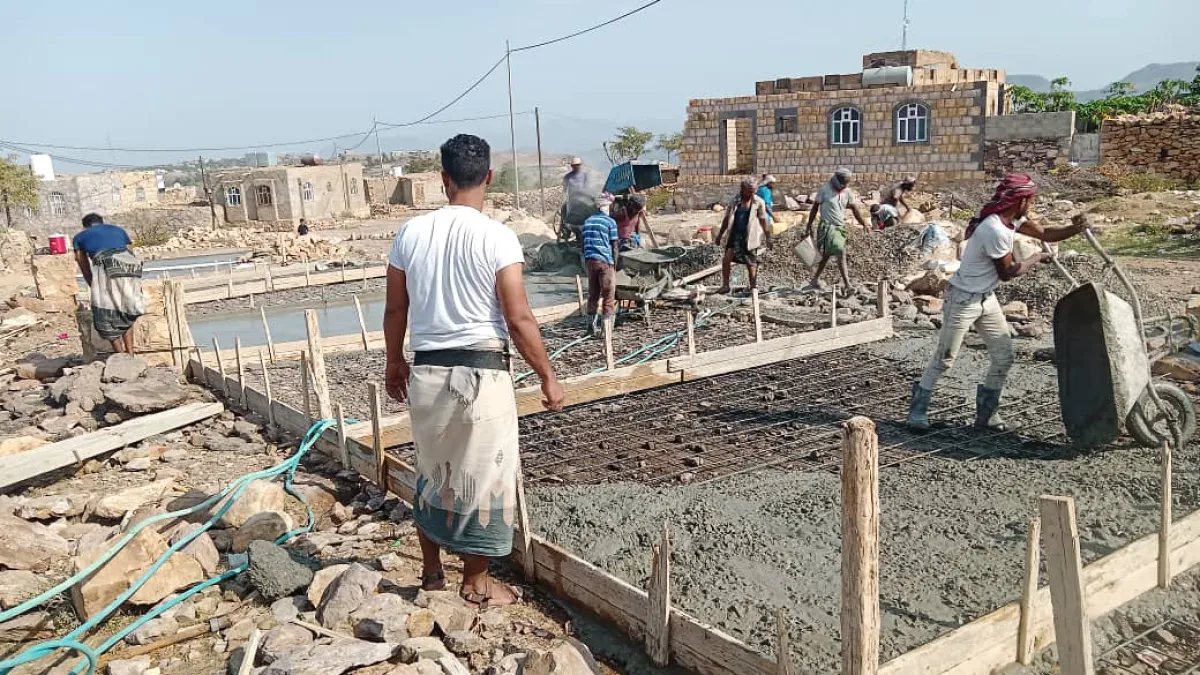
Taiz, Yemen – Hiring a minibus to the Ragem village market, 70km (45 miles) from Taiz, has become a daily challenge for commuters from outlying areas.
Drivers routinely decline trips to these rugged areas due to unpaved roads, which make them impossible to reach for any vehicle bar larger four-wheel-drive cars.
Hiring one of these costs more than triple a bus fare, forcing many residents to make a difficult 6km (4-mile) trek to the market by foot.
“We offer them double the regular fare, but they still refuse. Only drivers from our village agree because they understand our suffering,” Abdullah al-Azazi, 31, told Al Jazeera.
“Imagine workers and students who have to leave the village every day. They either walk daily or spend a fortune on transportation.”
The 7,600 people who live in Ragem and its surrounding hamlets routinely face difficult transport decisions, while there are also challenges transporting supplies – including water – to these settlements.
Authorities in Taiz responsible for infrastructure said they lack the resources to pave these roads. After appeals to humanitarian organisations for help went unheeded, members of the community took matters into their own hands, and three years ago, a grassroots initiative was launched to repair the region’s crumbling infrastructure.
“Three years ago, a group of young people in the village decided to begin paving the road themselves, relying on donations from residents and vendors at the nearby market,” Ahmed Fuad, 26, a lead volunteer on the project, told Al Jazeera English.
Volunteer work
Volunteers prioritised the most treacherous sections of the road first, but roughly 500 metres (550 yards) of steep, difficult terrain still needs to be covered with concrete.
“Our focus has been on widening and paving the road. We’ve accomplished a lot, but we won’t stop until the entire stretch from the village to the market is complete,” Fuad said.
After three years of volunteer work with the project, Fuad took on a central organising role two months ago. To streamline fundraising, he and other residents set up a WhatsApp group to track contributions from community members and local business owners.
“Donations started at just 1,000 Yemeni riyals [$0.64], but the momentum grew. Eventually, single donations reached as high as 1 million riyals [$640],” Fuad said.
Villagers who cannot contribute financially instead offer their time, drastically cutting labour costs in renovating the roads.
“In under two months, we widened and paved over 124 metres [135 yards],” Fuad added from a worksite. “As soon as the concrete sets, we will open this section and move to the next phase. Once people saw minibuses actually reaching the village, it gave everyone a surge of hope and encouraged more donations.”
He was confident the young people of the village could pave the entire road to the market by themselves, but assistance from the government or aid groups would make the task far easier.

Water resources
According to the United Nations Office for the Coordination of Humanitarian Affairs, 14.4 million Yemenis remain in dire need of basic water and sanitation assistance. Unpaved roads make it difficult to transport water to remote villages, forcing Yemenis to expend time and energy reaching these water sources by foot.
Before volunteers stepped in, securing clean water used to be a daily ordeal for the more than 200 families living in the al-Rahaba displacement camp in Taiz’s Jabal Habashy district.
Women and children would have to make gruelling 3km (nearly two-mile) treks to reach water supplies while carrying heavy jerrycans. The 20 litres (5.3 gallons) of water they returned with was not enough to sustain a family for a single day.
“Fetching water consumed most of their time. They would leave early in the morning, head out again at noon and make a third trip before sunset,” 44-year-old al-Rahaba resident Abzulaziz Shamsan told Al Jazeera. “As displaced people, we lack basic services across the board, but water is our top priority.”
For months, Shamsan pleaded with the local government and international aid organisations for help but received no response. The turning point came when social activist Mohammed Mahyub visited the site.
“When Mahyub visited us two years ago and saw our condition, he didn’t hesitate,” Shamshan recalled. “The very next day, he returned with engineers to survey the land. They drilled a well and fully equipped it with a solar power system, water tanks and distribution taps.”
Shamsan was struck by how much a single individual or community could achieve when official channels have failed. Residents of the camp and nearby villagers are also deeply grateful for the lifeline provided by the volunteers.
“It isn’t just our camp. Mahyub has funded and installed wells across several surrounding areas,” Shamsan added. “This single well near our camp now serves around 300 displaced and neighbouring families.”
![Abdulaziz Shamsan stands beside water tanks near the camp for displaced families where he lives [Courtesy of Abdulaziz Shamsan]](https://www.aljazeera.com/wp-content/uploads/2026/08/28-1785655322.jpg?w=770&resize=770%2C513&quality=80)
Making a difference
When Mahyub, a teacher and social media activist from Taiz city, visited a rural village in Taiz governorate two and a half years ago, he witnessed hundreds of residents from three neighbouring villages crowded around a single open well.
Moved by the sight of the locals lowering buckets into the well, Mahyub set out to support marginalised communities in hard-to-reach rural areas where access to clean water remains a daily struggle.
“I shared a post on Facebook detailing the situation, and the response from friends and followers was overwhelming,” Mahyub told Al Jazeera. “Their support enabled us to begin digging and fully equipping water wells for these communities.”
Through his social media network, Mahyub has crowdfunded the construction of 20 manual water wells across three remote districts in Taiz. This has brought vital relief to thousands in need and saved them valuable time they can now use for school and play, earning money and daily tasks.
“There is no feeling quite like seeing people gain access to water. Seeing the joy of children who no longer have to walk miles every day because clean water is right beside them is reward enough,” Mahyub said.
He continues to manage well-digging initiatives and credits his success to the donors who support his efforts.
Similar grassroots campaigns are now emerging across Yemen, such as in Hodeidah governorate, where activist Abdullatif al-Zailaai has spearheaded the drilling of several artesian wells for neglected communities.
Budget constraints
Yemen’s economy has been devastated by war since 2015, leaving the government with little to no funding for essential public works in rural communities.
In the absence of state support, grassroots movements, aid groups and philanthropic individuals have become the main lifelines for marginalised populations.
An official in the Taiz governor’s office said that due to limited resources and competing urban priorities, local authorities currently have no plans to expand public infrastructure into remote rural areas, such as Ragem. As long as the conflict persists, state revenues will remain insufficient to cover basic municipal development, he added.
But he did praise local activists and private donors for stepping in and said such community-led projects serve as an important model for local civic engagement.
“Taiz is like any other governorate in Yemen. The needs are immense across the board, and while we want to assist everyone, our limited budget forces us to prioritise,” the official explained. “We work closely with humanitarian agencies on rural initiatives, but aid budgets are shrinking year after year, making it impossible to cover every district.”
