


Over the past two months, the United States has made financial commitments that hint at a limited return to global health and humanitarian assistance partnerships, after the abrupt severing of many of those relationships a year and a half ago.
Last week, the State Department notified Congress that it would send $600 million to Gavi, the organization that helps low-income countries buy essential childhood immunizations, a year after Health Secretary Robert F. Kennedy Jr. withdrew American support.
It was the latest in a series of financial commitments from the U.S. government to international organizations, working on issues such as hunger and tuberculosis, totaling nearly $2 billion.
In most cases, these payments move money that had been appropriated by Congress but which had been stuck since the Trump administration took office in January 2025 and instituted a freeze on foreign aid.
It was not yet clear whether the disbursements represented a lasting shift, or how close any further commitments would bring the total to what the United States used to spend on aid and global health. People who have been part of talks with the State Department about this funding said that there were at least two motivations behind the money flowing to resumed partnerships.
First, recent health threats including, most notably, the ballooning Ebola outbreak in the Democratic Republic of Congo, reinforced the need for funding multilateral agencies that work on global health security.
Second, with the Trump administration’s dismantling of the United States Agency for International Development and absorption of a skeleton crew of its staff into the State Department, there was no longer the infrastructure or staff for the United States to move humanitarian assistance on this scale by itself, making these large international agencies necessary partners.
“What may be happening here is that reality is sinking in for decision makers,” said Mark A. Green, who served as administrator of U.S.A.I.D. during President Trump’s first term and who is president of ONE, an advocacy organization for foreign assistance. “The good news is that Secretary Rubio clearly realizes that global health is what we do, and we’re really good at it. That’s why you’re starting to see more money moving.”
He added, “I think there’s a realization that global health security is also American national security, too.”
Eighteen months ago, the freezing of assistance was perceived internationally as a significant U.S. retreat from multilateralism. It created immediate financial crises for many aid institutions, leaving gaping holes in budgets such as that of the World Food Program (WFP), which provides emergency food aid in war and disaster zones. And it presented an existential crisis for a humanitarian assistance and global health architecture that had long been predicated on bedrock U.S. support.
Jeremy Lewin, the top official for foreign aid at the State Department, said his team continues to be focused on remaking foreign assistance to be leaner and more efficient and to end recipients’ dependence.
“These international organization relationships, we can use them tactically where they’re important, but it doesn’t mean we need to fund them year after year after year when they don’t have that same nexus to something that we care about,” Mr. Lewin said.
In addition to the money for Gavi, recent major funding announcements from the State Department include:
-
$800 million for the World Food Program to fight malnutrition in countries including Ethiopia, Myanmar and Ukraine
-
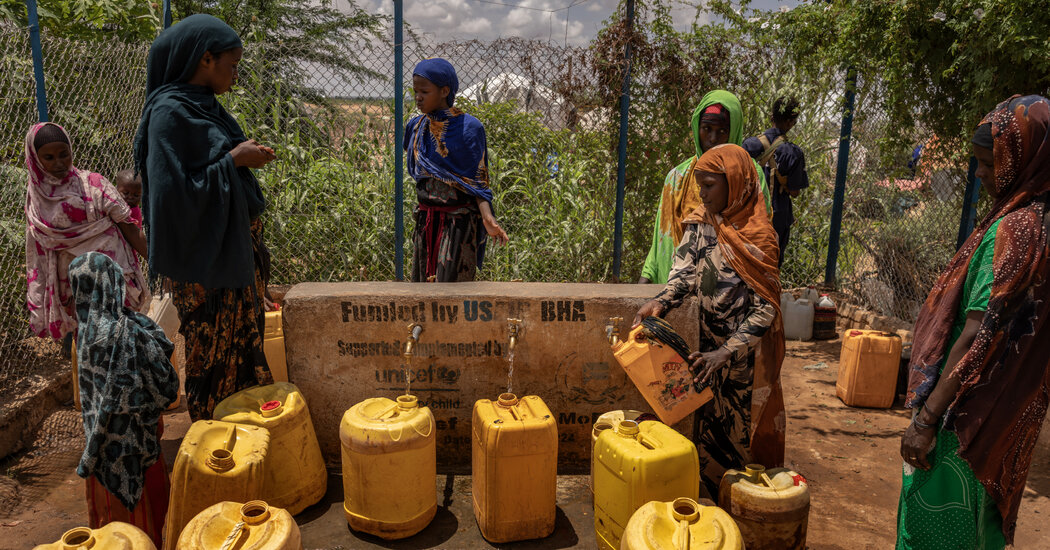
$218 million for Unicef to work improving child health through nutrition, water and sanitation projects
-
$100 million to Operation End Starvation, a new public-private partnership working to lower child mortality from malnutrition
-
$50 million to the Coalition for Epidemic Preparedness Innovations for the development of new Ebola vaccines
-
$203 million to the International Committee of the Red Cross and the International Federation of Red Cross and Red Crescent Societies for disaster response and humanitarian assistance
-
$220 million for the Ebola response in the Democratic Republic of Congo and $350 million in new humanitarian funding to the affected region, as of June 12
-
$661 million to the Global Fund to Fight AIDS, Tuberculosis and Malaria, a payment against what was owed from prior year appropriations
“I’m hoping we’re back to a regular order of payouts that are consistent with the Global Fund being an important partner,” said Chris Collins, the president of Friends of the Global Fight, an advocacy group that lobbies for support of the Geneva-based health organization.
Gavi’s chief executive, Sania Nishtar, also expressed relief about the restoration of U.S. support this week. “This new funding is vital,” she said. “It will help us maintain emergency vaccine stockpiles for Ebola and other deadly diseases and help countries turn the tide on malaria.”
At the outset of Mr. Trump’s second term, he and his officials were sharply critical of most of the big international organizations the United States used to disburse assistance, calling them bloated and wasteful, and saying American participation in large U.N. agencies was an ineffective use of funds.
Secretary of State Marco Rubio was historically a champion of some of the institutions that were crippled by the foreign aid cuts he oversaw last year, including those to the President’s Emergency Plan for AIDS Relief (PEPFAR), for which he repeatedly cosponsored bills for new funding while he was a senator. He also pushed a number of global health security measures in the Senate, including the establishment of a permanent global health security coordinator position at the National Security Council. He advocated funding for efforts to lower maternal mortality and fight neglected tropical diseases.
But by June, the last month for which data is available, the State Department had obligated $2.5 billion less to PEPFAR in 2026 compared with what the program had received at the same point in 2024. A recent invitation from the department sent to dozens of organizations that deliver PEPFAR programs inviting them to submit proposals for more work — and funding — suggests that more money will likely flow to PEPFAR by the end of September.
Mr. Lewin said the international agencies receiving State Department funding have made significant changes to their operations to align with the administration’s priorities. He said U.N. agencies were charging lower rates of overhead than they did for U.S.A.I.D. contracts, and providing more accountability to U.S. auditors and more transparency into their operations.
A former senior Rubio aide, who worked on foreign assistance reform and was not authorized to speak publicly, said that the Trump administration’s engagement had produced meaningful changes at the United Nations but added that these large awards also reflect a scramble within the department to move money and a realization that it would take excessive time and cost to set up a separate system.
But despite the recent announcements, large amounts of congressionally appropriated funding for global health and foreign aid remain unspent, or marked for likely rescission.
The Office of Management and Budget, headed by Russel T. Vought and charged with shutting down U.S.A.I.D., in April notified Congress of a plan to use $2 billion of global health money for “closeout costs” for grants from the dismantled U.S.A.I.D. — costs such as severance to employees and terminating leases for office space around the world.
Since that notification, about $650 million of those funds have been redirected for the Ebola response and other global health security efforts. But $1.35 billion, which has to be used by Sept. 30, remains marked by the O.M.B. for closeout costs.
Organizations working to support health programs in low-income countries are watching the closeout budget with alarm. Vincent Lin, associate director of health policy and advocacy at Partners In Health, said the fear was that the budget office was running down the clock, so that the funding allocations would expire at the end of the fiscal year in September.
Mr. Lin noted that while the budget office has not provided Congress with a breakdown of those closeout costs, many of the canceled U.S.A.I.D. awards were already closed. He said it would be hard to understand how the remaining costs could register in the billions of dollars.
“We can prevent a tremendous amount of suffering from TB, malaria, malnutrition and deaths of mothers and babies in childbirth by using these funds as Congress intended,” he said.
