


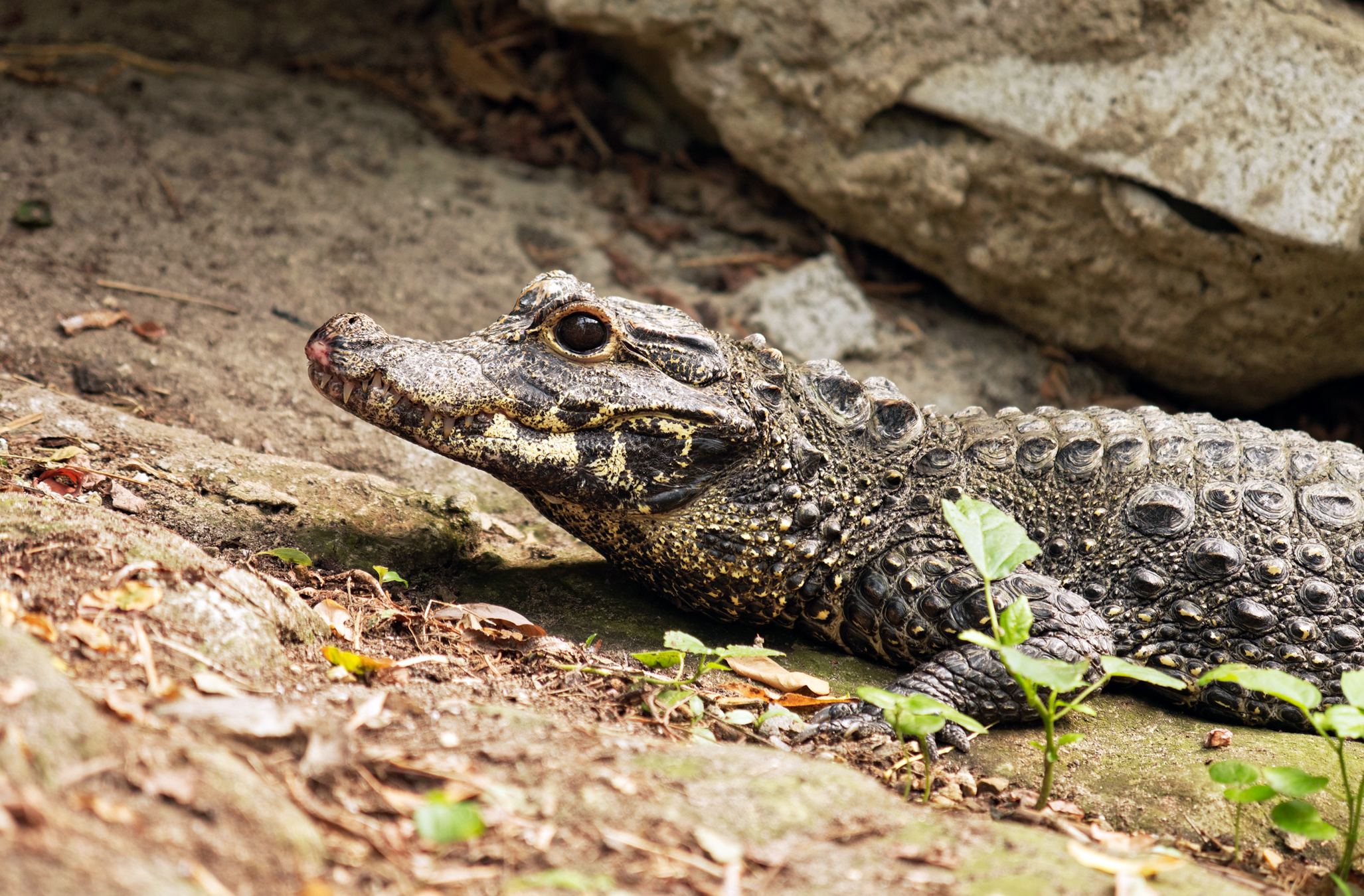
- The African dwarf crocodile is found in dense swamps and flooded forests across large parts of West and Central Africa.
- Experts say these reptiles, which are widely hunted and sold, are under pressure from overexploitation and loss of habitat.
- A recently published study set out to assess how many of the reptiles were sold in three bushmeat markets in the Niger Delta.
The African dwarf crocodile is the world’s smallest living crocodile. These reptiles, nocturnal predators of crabs, gastropods and the occasional fish or small mammal, can reach 2 meters (6.6 feet) in length. They are found in dense swamps and flooded forests across large parts of West and Central Africa.
Despite being listed as vulnerable on the IUCN’s Red List, the African dwarf crocodile (Osteolaemus tetraspis) has not been assessed by the conservation organization for 30 years. Anecdotal evidence suggests the crocodile’s numbers have declined sharply in many places where they were formerly common due to over-harvesting and destruction of their habitat.
“The dwarf crocodile is particularly well-suited for the commercial trade,” ecologist Mitchell Eaton wrote in 2008. “Its small size and slow metabolism allow it to be captured and transported live over long distances without the need for refrigeration.” These unfortunately convenient characteristics have made the species a prized target for hunters across the reptiles’ range and conservationists fear this is putting crocodile populations under unsustainable pressure.
For a study published in August in the journal BMC Zoology, conservation biologist Israel Ogorode and colleagues surveyed sales of African dwarf crocodiles at three markets in the Niger Delta, aiming to collect data about how many of the reptiles are sold — and who is doing the selling.
Ogorode and the researchers visited three bushmeat markets in the Niger Delta region — Edumanon, Ogbe-Ijaw and Uwa — every other week between October 2021 and April 2022 to count the number of crocodiles for sale, randomly selecting 30 vendors at each site for their survey. In six months, the researchers recorded 158 crocodiles, roughly 80% of these were young or fully grown adults, while around 20% were juveniles less than 60 centimeters (24 inches) long.
Despite the small sample size, the researchers hypothesize that hunting for crocodiles is easier during the dry season, between October and February. These months roughly coincided with the highest number of crocodiles they counted in the three markets.
As well as gathering summary profiles of the sellers they surveyed — all “middle-aged”, mostly married, roughly half with only a primary school education — the researchers noted that the majority of crocodiles reaching the market were relatively large, reproductively mature individuals. They suggest that this may compromise populations’ ability to reproduce.
According to the researchers, the low level of education amongst the sellers interviewed signals a limited availability of alternative livelihoods. It’s unclear from the study, however, if bushmeat vendors’ educational attainments differ from the wider population and how people around the markets studied make their living.
Ogorode, the study’s lead author and a lecturer in biological sciences at the University of Africa, Toru-Orua, told Mongabay that in the delta, dwarf crocodiles are sold for their meat and to make traditional medicine. He noted that market demand for the species is high.
“Among the animals traded for sale, the smallest one, which is the one we call juveniles, the least price they will tell you is 10,000 to 15,000 [naira, $7-$10],” he said. “When I mean small, I’m talking a little above 10 centimeters.”

All of the bushmeat sellers Ogorode surveyed were women. This aligns with the customary division of labor in the region: Men hunt for wild meat, but women handle any trade. Many of the vendors also sold other wild meat such as snails, porcupines, pangolins and antelopes, but there were several who specialized solely in crocodiles.
Daniel Jacob, a wildlife ecologist who has studied the stress on this species in the Niger Delta caused by human activities, said dwarf crocodile populations are under pressure from several sources.
“I would actually identify three major threats to the African dwarf crocodile, and they are all interconnected,” he told Mongabay in an interview. “Number one is direct exploitation, number two is habitat degradation, and the third one is weakness in wildlife trade governance.
“Hunting removes the crocodile directly from the population. At the same time, deforestation, agricultural expansion, logging, infrastructure development, and even oil and gas activities can degrade or fragment this habitat where these crocodiles inhabit.
“This species, especially, is dependent on wetlands and the forest areas. If you put these together, the problem becomes more serious when these pressures occur together. A population experiencing habitat degradation may have less capacity to withstand sustained harvesting.”
Jacob said the study’s findings usefully move discussion beyond anecdotal reports of hunting towards actually assessing how many crocodiles are being sold in this region. He added, however, that surveys of O. tetrapis numbers in the wild over time are needed.
“[A] market survey gives a good idea about the location where the threats are,” he said. “But it doesn’t actually give the actual number of the animals in the bush or in the wild.
“I would recommend a coordinated national monitoring and conservation program for the African dwarf crocodile, beginning with the Niger Delta where it occurs. We cannot manage effectively what we have not adequately measured.”
Information gathered from such a program would guide habitat protection, market enforcement and community-based conservation, he added.

Ogorode said popular education to raise awareness of the ecological consequences of overharvesting crocodiles and degradation of their habitat is needed. He says there is currently no relationship between government authorities, conservationists and local people. “[T]he conservationist will let the locals know the importance and the implication that this organism or this species will have on the ecosystem if they are being removed or harvested,” he said.
Wildlife ecologist Jacob added that sustainable alternative livelihoods need to be available for the women selling bushmeat and the hunters who supply them. Previous initiatives by nonprofits did not live on beyond the end of the supporting NGOs’ projects, with participants then going back to exploiting and trading vulnerable resources.
“We need something sustainable,” Jacob said.
Banner image: African dwarf crocodile (Osteolaemus tetraspis). Image © Eric de Redelijkheid via iNaturalist (CC BY-SA 4.0).
Slender-snouted crocodile savior: Q&A with Whitley Award winner Emmanuel Amoah
Côte d’Ivoire’s tree-climbing crocodile needs to be protected, scientist says
Citations:
Ogorode, I. O., Ito, E. E., Oriakpono, O. E., Vincent-Akpu, I. F., Babatunde, B. B., & Sikoki, F. D. (2026). Relative abundance of Osteolaemus tetraspis in Uwa, Edumanom and Ogbe-Ijaw bushmeat markets in the Niger delta region, Nigeria. BMC Zoology, 11(1). doi:10.1186/s40850-026-00281-3
Efenakpo, O. D., Jacob, D. E., & Goodnews, N. N. (2025). Population status and anthropogenic threats to the African dwarf crocodile (Osteolaemus tetraspis) in the Niger delta, Nigeria. Journal of Sustainability and Environmental Management, 4(1), 1-8. doi:10.3126/josem.v4i1.89868
Feedback: Use this form to send a message to the author of this post. If you want to post a public comment, you can do that at the bottom of the page.
Cite this article
Amir Sadiq (2026). World’s smallest crocodile in high demand for bushmeat trade in Nigeria. Mongabay Conservation news. DOI: https://doi.org/10.66709/news-330046

