


- A potentially historic El Niño is gathering strength and likely to peak between Nov. 2026-Jan. 2027. Latest projections suggest the event could become the strongest ever measured. Countries around the world are bracing for impacts.
- Past very strong El Niño events, with record heat, drought, precipitation, floods, and wildfires, have taken a toll in human lives, human health, national and community economies, and ecosystems. Some effects can linger as much as a decade, after these events.
- While some nations, such as Peru and Sri Lanka, are preparing for a record El Niño, many are unable to, with the United Nations now making a $202 million El Niño Joint Anticipatory Action Appeal to aid 22 high-risk countries in Asia, Oceania, Africa and Latin America.
- In this story, experts outline some lessons that can be learned from history’s most powerful past El Niño events and the preparations that will be required to protect vulnerable populations during the potentially unprecedented 2026-27 event.
Countries across the world are bracing for what is increasingly certain to be a historic El Niño, with latest modeling suggesting the 2026-2027 event will be the strongest ever measured, possibly breaking records by a considerable and dangerous margin.
International bodies including the World Health Organization (WHO), World Meteorological Organization (WMO) and World Food Programme (WFP) are urging nations to prepare for extreme weather and ensuing impacts to health, food and energy systems.
Some nations are already acting: Brazil has hired record numbers of firefighters to tackle expected Amazon blazes. Peru, hit by disastrous rains, floods and landslides in past El Niños, has declared a state of emergency across 40% of the country. Sri Lanka has arranged water deliveries to nearly 72,000 people across seven districts threatened by drought, and India is focusing on 300 drought-vulnerable districts, setting up agricultural contingency plans and boosting irrigation provisions. The African Union is calling on member states to implement early-warning systems to protect “lives, livelihoods and economies in the months ahead.”
But many countries aren’t ready: The WFP has made an urgent $202 million El Niño Joint Anticipatory Action Appeal to aid 22 high-risk nations with safety measures.
Experts warn that as climate change fuels increasingly frequent and severe El Niño events, more and better preparations will be needed. “We have not learned enough from our experience with previous strong El Niños,” Lachlan McIver, health advisor at the WHO-WMO Climate and Health Joint Office, told Mongabay in an interview. “That is evidenced by the illnesses and deaths … recorded in the most recent ones.”
El Niño “is contributing to climate variability and climate extremes, and this makes human existence and performance on this planet more unsafe,” Hans-Otto Poretner, a marine biologist at the Alfred Wegener Institute in Germany and former co-chair of the Intergovernmental Panel on Climate Change Working Group II, told Mongabay in an interview.

Past as prelude to a perilous present
Since the 1980s, there have been three very strong, so-called “Super” El Niños: In 1982-83; 1997-98; and 2015-16. Though no two are alike in impacts, every very strong El Niño supercharges weather systems, bringing heatwaves, intense drought and precipitation, flooding and wildfires. An El Niño is classified as very strong when sea surface temperature anomalies in the Central Pacific Ocean (known technically as the Niño 3.4 region) surpass 2° Celsius (3.6° Fahrenheit) above the long term average — a point reached by the current event in mid-July.
The world’s oceans store an estimated 90% of the excess heat energy trapped in Earth’s climate system by human-emitted greenhouse gases; El Niño redistributes some of that heat to the atmosphere, bringing extreme, often violent weather.
Based on the latest modeling forecast on August 13, there’s a 90% chance this year’s El Niño (which will likely peak between November and January) will be very strong, while there’s a 69% chance it will surpass all past records. Forecasts are “nothing less than deeply, deeply concerning,” Johan Rockström, director of the Potsdam Institute for Climate Impact Research in Germany told Mongabay in an interview: “We are already starting to see the impacts of this [event] across the world.”

Those early impacts include drought in Southeast Asia which has delayed the rice harvest, while parts of India still await the annual monsoon’s arrival. Drought also threatens passage through the Panama Canal, and rainfall is suppressed in Kenya and Ethiopia.
Rapidly intensifying climate change and stronger El Niños are “no longer something that’s happening sometime in the future, and it’s not something that’s happening far away,” Rockström said. “It’s hitting all of us, whether you’re sitting in a rich part of the planet in a very modern urban area, or whether you are in a poor country, out in a rural area.”
The message coming from experts is loud and clear: Nations, communities and households need to prepare for surprising, extreme, potentially dangerous weather in the coming months.
Food systems under strain
To see what happens in an unprepared world, one need only look back to 1877-1878, before formal records were kept, when one of the strongest El Niños known resulted in a catastrophic wave of drought that triggered famine across Asia, Africa and South America. An estimated 50 million people died.
Fortunately for people today, that El Niño struck a very different world: It had no warning or time to prepare. Today, El Niños are entirely predictable with the WMO first warning of a possible strong or very strong event back in May.
Fiona Clare Williamson, a historian at Singapore Management University who studies El Niño impacts, told Mongabay that the deadly 1877-78 event hit Asia particularly hard with failed harvests and drought causing “cascading effects” like water shortages and pollution.
“You had a situation of less resilience then. Today, we have better systems in place, especially in the global north, to manage these things,” she added. “But in developing countries and in rural areas, you’re still going to have a lot of the same problems.”

Food supplies remain a major concern. The U.N. WFP warns that the 2026-27 event could push an additional 49 million people into acute food insecurity in 45 nations, with southern Africa and Central America hit hardest.
A decade ago, the 2015-16 El Niño impacted around 60 million people already affected by food insecurity. Some 36 million people in eastern and southern Africa were impacted by a prolonged drought that devastated crops and killed off livestock.
That drought led to other water-related effects, with low river levels reducing hydropower output in Malawi, Zimbabwe and Zambia, and triggering a national crisis in multiple countries. This summer’s record European Union drought has already shuttered nuclear plants.
Tafadzwanashe Mabhaudhi, professor of climate change, food systems & health at the London School of Hygiene and Tropical Medicine, underlines a crucial lesson: El Niños not only bring hunger, “they cascade to energy, water security, human health and the environment,” he said in a Mongabay interview.

Acute and lasting health and economic harm
Strong El Niño events have both immediate and long-term effects on human health due to heatwaves and other extreme weather, air pollution triggered by wildfires, malnutrition due to drought, along with lack of clean water, Benjamin Horton, dean of the School of Energy and Environment at City University of Hong Kong, told Mongabay in an interview.
Though recent mortality has been far lower than the 1877-78 event, the 1982-83 El Niño directly caused an estimated 2,000 deaths; the 1997-98 event killed approximately 23,000; and the 2015-16 event more than 7,000 people. These figures do not account for the suffering of millions who contracted disease, were made food and water insecure, or lost their homes and livelihoods.
Drastic changes in rainfall amounts can trigger and amplify disease. The 2015-16 event’s wet, above-average rainfall in some locales was linked to increases in plague, Rift valley fever, and hantavirus; while chikungunya and dengue emerged in areas hit by high temperatures and drought, said Assaf Anyamba, senior scientist at NASA Goddard Space Flight Center and a professor at the University of Maryland, Baltimore County, in the U.S., in a Mongabay interview.
The current El Niño also brings concern over climate change-intensified diseases, such as outbreaks of cholera, yellow fever, dengue, and malaria, according to Francisco Luquero, head of High Impact Outbreaks at Gavi.
“The greatest risks are likely where extreme rainfall, flooding, drought or displacement intersect with existing disease transmission,” Luquero wrote in an email to Mongabay. A very strong El Niño could also increase the need for emergency vaccination responses, he added, placing strain on global vaccine stockpiles.
“For cholera, this could place additional pressure on an already constrained global vaccine supply and increase the resources needed to respond effectively to outbreaks,” he said. It’s also possible that the chaos brought by the El Niño could complicate the response to the near record ebola outbreak sweeping the Democratic Republic of Congo.
Another concern is record heat that strikes unprepared cities with vulnerable populations: Global temperatures ratcheted up by climate change, combined with urban heat island effects, along with hotter El Niño conditions could raise the likelihood of very dangerous heat events.

Many of these impacts could linger long after El Niño fades. Horton and his team published a paper earlier this year finding that the health impacts of the 1982-83 and 1997-98 events continued for years afterwards, reducing life expectancy in affected countries.
“The impact of a big El Niño on life expectancy can stretch over a decade,” Horton said. His team wrote that intensifying El Niños represent an “underrecognized and enduring threat to human health and socio-economic stability.”
These lasting health impacts also contribute to lingering financial impacts. In a 2023 paper, Christopher Callahan, a climate scientist at Indiana University, estimated that the 1982-83 El Niño led to losses of $4.1 trillion, and in 1997-98 to $5.7 trillion. A separate analysis found $3.9 trillion in losses tied to the 2015-16 very strong El Niño.
Economic growth reductions also linger after an event, Callahan told Mongabay in an interview, and they can be linked to El Niño-strengthened weather that damages critical infrastructure, disrupts agriculture and fisheries, and degrades long-term public health.
Experts are warning of potentially widespread impacts to rice, sugar, coffee and cocoa supply chains due to the current El Niño. That could cause a global price shock, hitting growers, intermediaries and consumers.
“Our hypothesis is that all of these different pressures on people and their economies are not immediately recovered and tend to produce these longer-term reductions,” Callahan said in a Mongabay interview. “It suggests that these events are not merely one-off shocks.”
Experts also note that El Niño impacts don’t happen in a vacuum: In 2026-27 they’ll be heaped atop the high prices and hardships brought by synthetic fertilizer and oil shortages as a result of the U.S.-Israeli war on Iran, grain shortages due to the Ukraine-Russia war; and near total loss of U.S. AID resources and deep cuts to EU development programs.

Ecosystems at risk
While human impacts generally get the headlines, climate change-fueled El Niños also present a growing threat to ecosystems. The 1982-83 El Niño triggered mass coral bleaching in portions of the Pacific Ocean, and the first planetwide bleaching occurred during the 1997-98 event which killed off 15-20% of the world’s reefs.
“That was correctly portrayed then as an ecological disaster,” Rockström said. El Niño was also linked to a global bleaching event in 2015-16 that pushed 75% of tropical reefs above the bleaching threshold. The 2023-24 El Niño is regarded as the most extensive and intense ever recorded. Reefs have had almost no time to recover since, and it seems likely the 2026-27 event will again cause massive bleaching.
“We are not far away from losing the richest marine ecosystem on the planet because of these human-reinforced mass bleaching events caused by these El Niño events,” Rockström said. “It’s part of the same original problem, namely that we’re turning up the global mean surface temperature on Earth.”
Damage to reefs has knock-on effects on marine life, food security, shoreline protection, and local economies based on tourism and fisheries. “It is a big ecological and economic and humanitarian problem when coral reefs have significant mortality,” said Helen Fox, director of Conservation Science with the Coral Reef Alliance, in a Mongabay interview.

Conservationists are also warning that the current El Niño poses a serious threat to embattled terrestrial ecosystems. The 2023-24 El Niño, for example, led to one of the most severe droughts in the Amazon biome, feeding fires that ripped through millions of hectares of rainforest, devastating wildlife.
“Stronger El Niños inducing severe droughts really push the Amazon even closer to the [rainforest to savanna transition] tipping point,” Carlos Nobre, with the University of São Paulo and one of Brazil’s leading climate scientists, told Mongabay in an interview. He anticipates this El Niño triggering more drought and fire.
Research shows that El Niño-driven drought not only leads to tree mortality but also has a lingering effect on forest ecosystems lasting several years, inducing stress and requiring time for forest recovery. It can also temporarily convert tropical forests from acting as carbon sinks into being carbon sources, worsening climate change.
The UN notes that global funding to protect global ecosystems from extreme climate events has so far fallen well short of what’s needed.

Lessons from the past
Analyzing and understanding the health and economic impacts that past very strong El Niños have wrought is essential to humanity’s ongoing learning and adaptation. Experts underline that impacts can be successfully confronted with the right preparation.
“This coming El Niño is predicted to be a very strong one,” McIver with the WHO-WMO Climate and Health Joint Office said. “So we need to anticipate and prepare to the best of our ability for some of the worst health impacts that previous strong El Niños have brought.”
To start with, nobody needs to die in a heatwave said, Jan Semenza, a public health expert at Sweden’s Umeå University. That’s “entirely preventable if you do the right thing,” he said. This includes proactive community heat-health action plans targeting those most at risk, while also adapting urban infrastructure to reduce temperatures. It’s known that the elderly, particularly older women, socially isolated people, and outdoor workers are among the most vulnerable, and that’s where social and medical services need to focus.
Other health impacts like disease can be mitigated as well, Luquero added. “The extent to which communities are affected depends largely on their level of preparedness, resilience, and access to effective public health interventions,” Luquero wrote. “Countries should also identify locations at highest risk and strengthen water, sanitation and hygiene measures before extreme weather occurs.”
Experts emphasize the need to support vulnerable communities, develop early warning systems, improve medical laboratory capacity, and put response teams at the ready as the El Niño advances. Mosquito controls and vaccination stockpiling are needed too in at-risk areas.

Mabhaudhi, a professor of climate change, noted that many African countries have learned to deal with drought from past events, and are working to improve irrigation, switch to drought resistant crops, and provide support to farmers. Though, he added, preparations still need to account for the risk of cascading threats to energy and water.
“Everyone is focused on water and drought and thinking about food and agriculture, but [El Niño has] much broader effects on energy, the environment, and health,” he said. “Ideally, you want an integrated cross-sectoral response that considers the preparedness of all those sectors.”
For Rockström, the potential for an off the charts El Niño serves not only as an urgent call to prepare, but also to urgently address climate change.
“What this year’s El Niño should be telling every political leader loud and clear is that we’ve reached the end point of a fossil fuel-driven global economy,” he said. “Take this El Niño year as a warning of an example of the world that we’re heading towards, not in 100 years’ time, not in 50 years’ time, but in the next 10 years. [Without action] it will just continue to get worse.”
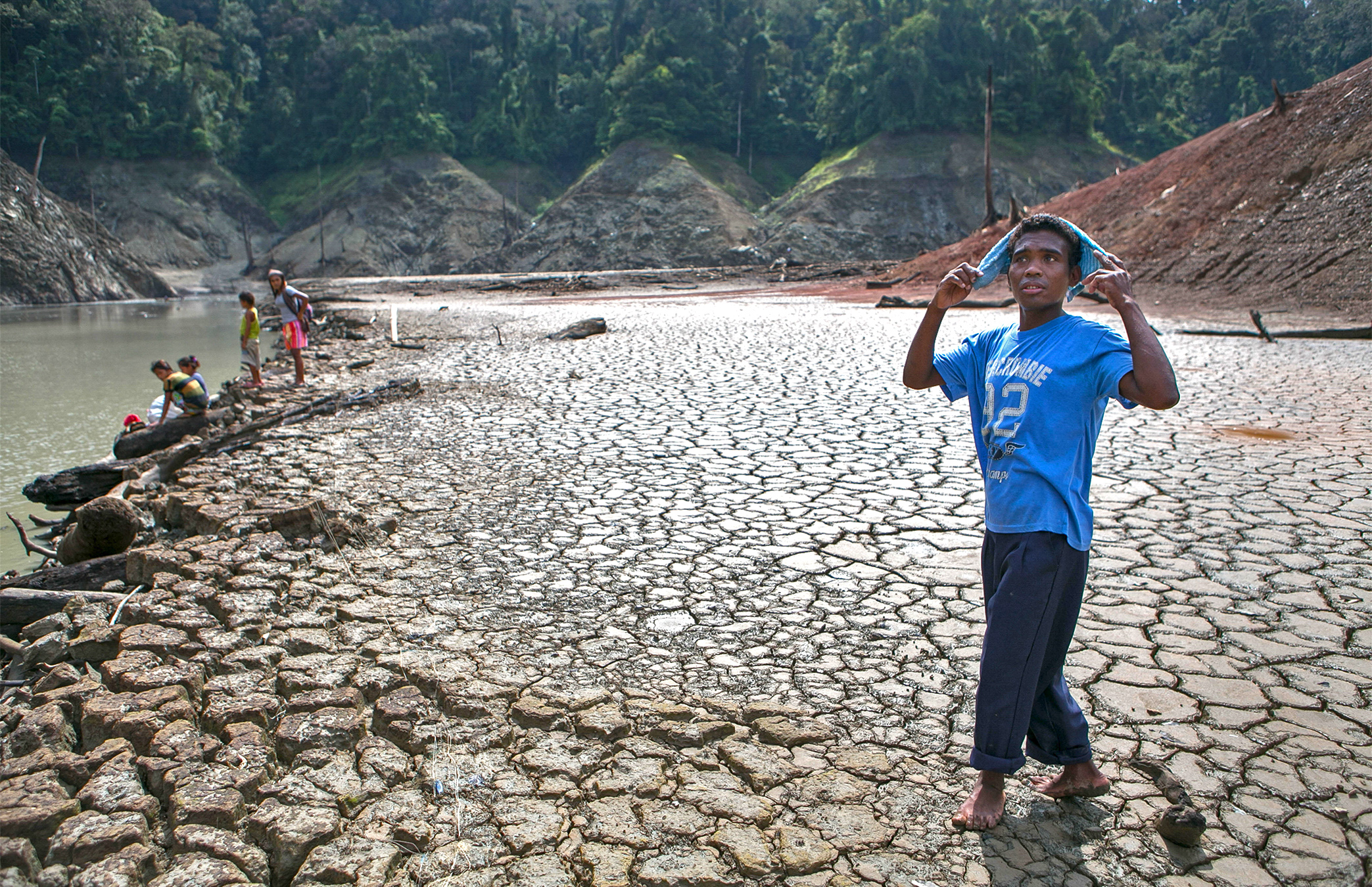
Banner image: An Indigenous man walks on a dried-up tributary of the Angat river in the Philippines. Rising temperatures and El Niño conditions have impacted the level of the Angat Dam, which supplies water to the capital city of Manila. Image by Gigie Cruz/GHHIN-EJN Extreme Heat Photo Contest 2025 via Flickr CC BY-NC-ND 4.0).
Six things to know about Asia’s heatwave and the health impacts
Tropics take the brunt as hotter oceans drive large-scale humid heat waves: Study
Citations:
Anyamba, A., Chretien, J., Britch, S. C., Soebiyanto, R. P., Small, J. L., Jepsen, R., … Linthicum, K. J. (2019). Global disease outbreaks associated with the 2015–2016 El Niño event. Scientific Reports, 9(1). doi:10.1038/s41598-018-38034-z
Tian, Y., Xu, Y., Liang, Y., Zhou, Z., Susong, K. M., Chen, Y., … Tian, H. (2025). Rising dengue risk with increasing el niño–southern oscillation amplitude and teleconnections. Nature Communications, 16(1). doi:10.1038/s41467-025-63655-0
Zhang, K., Li, J., Guo, Z., Liu, S., Zhu, G., Shang, S., … Wu, J. (2025). Heatwaves on the rise: The role of el niño‐southern oscillation and local water‐energy exchanges in shaping global patterns. Journal of Geophysical Research: Atmospheres, 130(17). doi:10.1029/2024jd042446
Xu, Y., Zhu, W., Samanta, D., … Horton, B. P. (2026). Enduring impacts of El Niño on life expectancy in past and future climates. Nature Climate Change, 16(2), 148-154. doi:10.1038/s41558-025-02534-4
Callahan, C. W., … Mankin, J. S. (2023). Persistent effect of El Niño on global economic growth. Science, 380(6649), 1064-1069. doi:10.1126/science.adf2983
Byron, J., Pugliese, G., Monteiro, C. D., Sc, J., Edtbauer, A., Gomes, E. A., … Williams, J. (2025). Intense El Niño provokes production of new reactive volatiles as stress defences in Amazon rainforest. doi:10.21203/rs.3.rs-8134079/v1

