


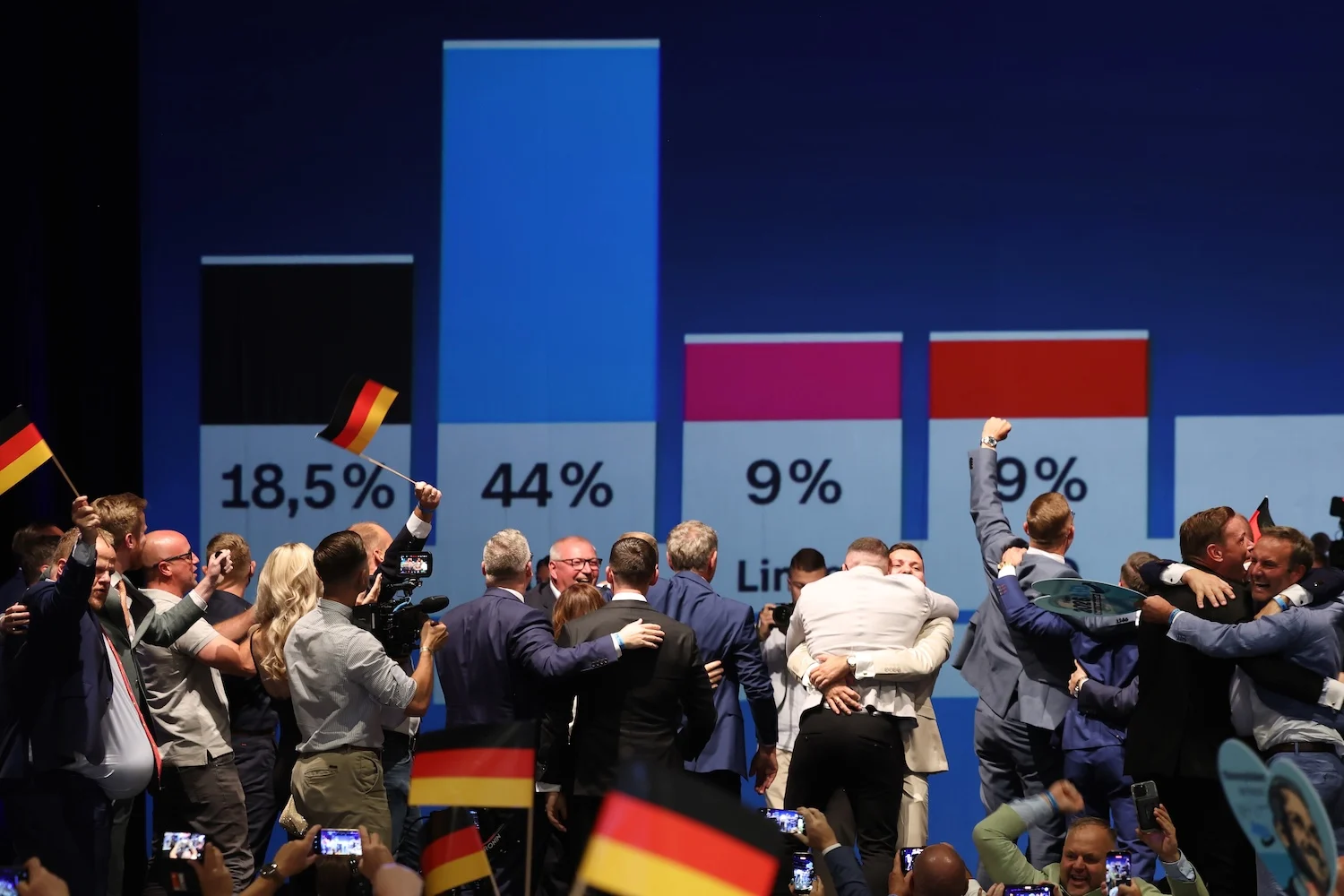
Has a small, largely elderly, left-behind pocket of Germany struck a fatal blow against its postwar liberal democracy? That is the question many are asking after Sunday’s election in the eastern state of Saxony-Anhalt, which saw the Alternative for Germany (AfD) trounce the mainstream parties to stand on the verge of power—the first time a far-right party would do so in Germany since the fall of the Nazi regime.
As has been the case when other tsunamis have struck—Donald Trump’s presidential election victories in the United States, Brexit in the United Kingdom, to name but two of many around the world—the response of those in the political center has ranged from fury to consternation to despair. But most of all, a sense of dumbstruck paralysis. They could see it coming; they took some action, but they were swept away. And now, as they face the consequences, so the recriminations begin.
Has a small, largely elderly, left-behind pocket of Germany struck a fatal blow against its postwar liberal democracy? That is the question many are asking after Sunday’s election in the eastern state of Saxony-Anhalt, which saw the Alternative for Germany (AfD) trounce the mainstream parties to stand on the verge of power—the first time a far-right party would do so in Germany since the fall of the Nazi regime.
As has been the case when other tsunamis have struck—Donald Trump’s presidential election victories in the United States, Brexit in the United Kingdom, to name but two of many around the world—the response of those in the political center has ranged from fury to consternation to despair. But most of all, a sense of dumbstruck paralysis. They could see it coming; they took some action, but they were swept away. And now, as they face the consequences, so the recriminations begin.
In Washington, the targets of opprobrium ranged from presidential nominees Kamala Harris and Hillary Clinton to Democrats in Congress to the entire party establishment. In the United Kingdom, they were many and varied, from then-Prime Minister David Cameron, who called the 2016 referendum, to then-London mayor Boris Johnson, who changed his mind at the last moment to lead the calls to quit the European Union, to the ever-present right-winger Nigel Farage, to Jeremy Corbyn, the left-wing Labour leader who campaigned half-heartedly to stay while purportedly preferring to leave.
In Germany, it’s simpler. All the guns are trained on Friedrich Merz, the chancellor of the past 16 months with the ignominious distinction of historic low opinion poll ratings. He is the man who boasted when first challenging for the leadership of his Christian Democratic Union (CDU) party in 2018 that he would halve the popular support for the AfD, only to see it double. He is the man who promised voters an “autumn of reforms”—he meant 2025, and yet they are still spluttering their way through parliament.
Merz spent years trying to become CDU leader, criticizing former Chancellor Angela Merkel, openly and behind her back, for taking the party too much to the center, for being too generous to welfare claimants and too welcoming to migrants. What Germans wanted, he insisted, was more genuine conservatism.
They’ve now got that, but they’ve decided they would rather eat their meat rare. They’re opting in droves for the AfD, a party that promises remigration for “non-Germans,” to prioritize “German” culture, to incentivize child-rearing, to restore traditional family values: a party that is tacitly supported by the Kremlin and is openly embraced by Trump, U.S. Vice President J.D. Vance, and Elon Musk. A party, which in the European Parliament many other right-wing groups won’t touch and whose chapters in Saxony-Anhalt and in neighboring regions have been declared extremist by the federal office to protect the constitution.
There are some, a dwindling number it must be said, who seek to play down the consequences. After all, they say, Saxony-Anhalt is small. Its 2.2 million people constitute but one-fortieth of Germany’s overall population. It is poorer, older, more surly than other parts of the country. And it belongs to the former communist east, where support for the AfD has, throughout the party’s 13 years of existence, always been stronger.
All that may be true, but the alarm expressed by most political players in Berlin and elsewhere—words such as “seismic,” “devastating,” and “earthquake” are thrown about with abandon—is grounded in the fear of not what’s happened, but about what’s set to come for the Germany’s established postwar parties.
The number-crunching in Saxony-Anhalt points to a crisis, the depth of which cannot be overstated. The CDU failed to win a single direct mandate in the election (its paltry 15 seats in the 83-strong parliament arising from the proportionate distribution of votes). This had been a stronghold for the party more than two decades. And there are more elections to come.
On Sept. 20, the state of Mecklenburg-Vorpommern (also in the east) and the city-state of Berlin also go to the polls. In both, the AfD is expected to perform strongly (though not to win). The CDU is likely to be trounced again.
The calls on Merz to step down are growing ever stronger. His initial response has been to stay the course until general elections in 2029, but in his first appearances after Sunday’s rout he seemed genuinely nonplussed about what to do.
He would like to go harder on public service reforms and welfare cuts, make even deeper inroads into immigration numbers than he has already done—in the hope that this might bring back some of the voters that have deserted the CDU.
The problem is that the junior partner in the ruling coalition, the Social Democrats (SPD), won’t let him go further than the compromises it has already agreed to. Merz’s personal relations with SPD co-leader Lars Klingbeil, who is vice chancellor and finance minister, are said to be good. But Klingbeil’s job is also on the line; the center-left SPD is also hemorrhaging support.
Both parties are pointing in opposing directions. The SPD needs to claw back voters who have deserted it for Die Linke (the Left party), the Greens, and the AfD as well. They all want different things, but what many of them don’t want are further spending cuts that are being introduced into the Bundestag, the federal parliament, this week.
There is a more optimistic scenario. Might the two ruling parties conclude from their cataclysmic performances that they have to speed up the reforms, show more radicalism? Most commentators in Berlin are not holding their breath.
While the domestic consequences are important, the greatest danger lies further afield. The one area where Merz could be seen to have led courageously is the overhaul of Germany’s military capabilities, and the commitment to meet the NATO target of 3.5 percent in military spending by 2029, far earlier than equivalent countries such as the U.K. or France. He has been uncompromising in confronting the Kremlin; only days before the election, he openly accused Moscow of a series of drone attacks.
Many voters appeared to go along with him; the mood shifted considerably, but perhaps more in the head than in the heart in a country that has long shied away from a hard posture in defense. What is perhaps most striking in Saxony-Anhalt is that a majority of voters opted for parties that are either avowedly pro-Kremlin—not just the AfD, but also for BSW, a breakaway left-wing group—or Die Linke, which argues for peaceful engagement with Russia. As one election poster in Magdeburg, the state capital, declared, with reference to the now-closed gas pipeline to Russia: “Nordstream. Turn it Back On. Sanctions against Russia are Making Us Go Broke.”
Merz pointed to the arithmetic himself. Exactly 57.7 percent of voters in Saxony-Anhalt, he said, backed parties “that question our unstinting support for Ukraine,” adding that he would “not deviate from his position one millimeter.” The pressure to shift away from his hawkish approach will only grow; within the SPD there are concerns, too, with many activists preferring the government to spend less on arms and more on public services.
For Trump and for Russian President Vladimir Putin, the events of the past few days in Germany are cause for celebration. Russian bots have been fueling disinformation for many years, particularly in the east of Germany; the number of so-called hybrid attacks is increasing. Meanwhile, last year’s U.S. National Security Strategy promised to support “patriotic” groupings across Europe to help prevent “civilizational erasure.” It came as no surprise that senior MAGA figures, not least Musk, congratulated the AfD, as did Kirill Dmitriev, one of the Russian president’s most senior officials.
The bigger immediate prize will be France’s presidential election next April and May; a victory for Marine Le Pen and the far-right National Rally is highly possible. European cohesion, within the EU and NATO, would then be extremely hard to sustain.
The AfD has now established itself as a major player, perhaps the major player, in German politics. For years, the parties of the center sought to exclude it and marginalize it through the Brandmauer, firewall, which stipulated they would not include it in any national or regional coalition. That exclusion order only added to the party’s sense of grievance and establishment stitch-up, arguably increasing its popularity among prospective voters.
Indeed, soon, the boot could be on the other foot. AfD co-leader Alice Weidel has declared that she wants her party to achieve an average 40 percent nationally and across the regions, echoing its performance in Saxony-Anhalt, thereby assuming the mantle as the one and only party of the right. In some countries, this takeover has already taken place. Sometimes the far right subsumes the traditional center-right party, as has happened with the Republicans in the United States. In others, it shoves its rival aside by being more attractive, such as in France. The battle for the soul of Germany is on.
