


President Trump went to war with Iran in part to force compliance with two longstanding American demands: Tehran must stop enriching nuclear fuel for at least two decades, and it must allow international inspectors to go anywhere and see anything to verify the country is not producing a bomb.
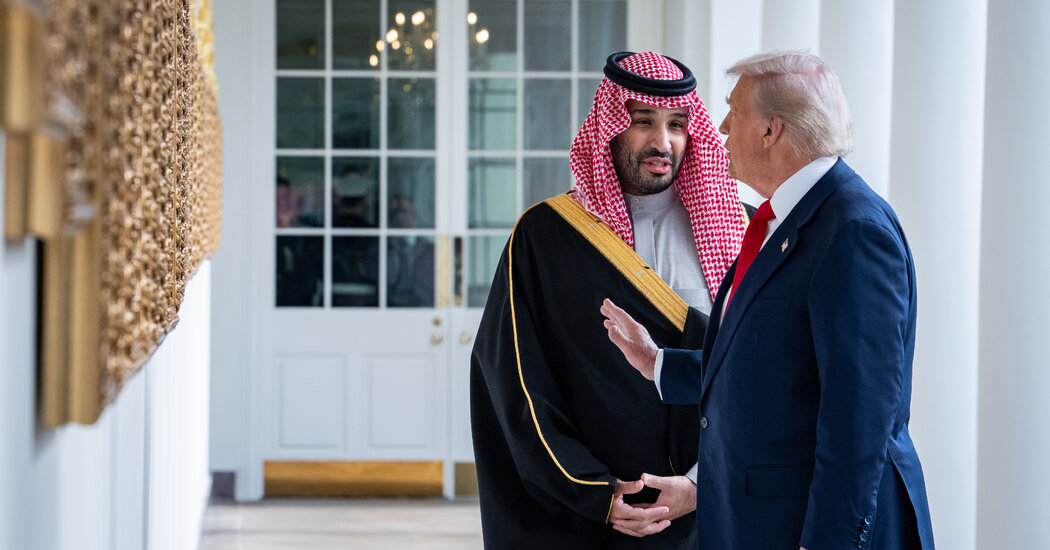
On Wednesday, Mr. Trump took the reverse approach to Saudi Arabia, its close ally in the region. To seal a deal for Westinghouse and other American companies to seize a big piece of the business in building two nuclear reactors on Saudi territory — and more to come — it opened the door to allowing the kingdom to begin enriching its own nuclear fuel after two years.
And it gave in to the kingdom’s demand that it not have to abide by an inspection agreement that applies to more than 140 other countries. Those rules, the Saudis said, are just too intrusive.
Now Mr. Trump will have to make the case to Congress, and to allies throughout the Middle East, that in loosening the nuclear standards for one close ally, he is not ushering in a new age of proliferation, especially in a region of the world already on fire. If the daily missile exchanges with Iran finally give way to resumed negotiations, there is no question Iran will seize on the concessions made to Riyadh and insist on the same.
Already on Wednesday, administration officials were arguing that there was nothing to worry about, and that the United States will be so engaged in Saudi Arabia’s nuclear future that there is no way the kingdom could divert its nuclear fuel and know-how to a secret bomb program.
They may prove right. But nuclear history is littered with examples of countries that pledged to obey the rules, and surreptitiously raced for a bomb.
Iran’s first research reactor was provided by the United States to the shah of Iran, complete with weapons-grade uranium — technology that fell into the hands of the mullahs who took over the country in 1979. India’s first nuclear test used plutonium from a heavy-water reactor that had been a gift from the Canadian government in the 1950s. Pakistan stole its centrifuge designs from a European firm that hired A.Q. Khan, now celebrated as the father of the Pakistani bomb. Taiwan and South Korea, stalwart American allies, had secret bomb programs of their own until American intelligence agencies discovered them and quashed the efforts.
Mr. Trump has many reasons to solidify the American relationship with Saudi Arabia these days. He can argue that if the United States does not provide the country with its best reactors and nuclear technology, Russia or China will. At a time when tensions have flared with the Saudis — for a while Crown Prince Mohammed bin Salman prohibited the United States from launching attacks on Iran from U.S. bases in Saudi Arabia — anything that draws the Saudis deeper into the American technology stack makes sense to the White House.
“Rest assured, these agreements uphold the highest standards of nuclear safety and nonproliferation,” Chris Wright, the secretary of energy, said in a statement on Wednesday announcing the deal, “while relying on the world’s best nuclear technology and scientists, designed right here in the United States.”
Mr. Wright signed the deal with the Saudi minister of energy, Prince Abdulaziz bin Salman, but the White House did not immediately release the text — or the two secret letters accompanying it. All of those will now go to Capitol Hill for congressional review. But as a practical matter, Congress would have to assemble a veto-proof majority to override Mr. Trump’s initiative.
It is a process that has been used many times under the Atomic Energy Act of 1954, a key element of Dwight D. Eisenhower’s “Atoms for Peace” program. The idea was to spread nuclear energy, with safeguards to assure that fuel is not diverted to bomb projects.
But Saudi Arabia poses a particular kind of problem, hard to imagine in Eisenhower’s time. It is a country that is racing to shed its petroleum-based past and eager to embrace nuclear energy to build data centers and power a future driven by artificial intelligence, yet fearful of what might happen if the Iranians get the bomb.
Saudi officials have made no secret of their determination to keep pace with Tehran’s apparent efforts to build a nuclear weapon, and to match them if they do. In 2018, Prince Mohammed pledged that his kingdom would try to develop or acquire nuclear weapons if Iran continued its work toward a bomb — despite the fact that Saudi Arabia signed on to the Nuclear Nonproliferation Treaty in 1988, after delaying for 18 years. Other Saudi officials have issued similar warnings in recent years, or talked about the need for Saudi Arabia to become a “threshold” nuclear state, a few screwdriver turns away from building its own weapon.
“I find this decision incredibly shortsighted,” said James M. Acton, a nuclear analyst at the Carnegie Endowment for International Peace. “It appears to provide a pathway to a country that really might want to proliferate. You cannot exclude the possibility that Saudi Arabia would nationalize this facility and use it make a bomb.”
It is hardly a new problem. President George W. Bush negotiated a similar deal with the United Arab Emirates, finalized by President Barack Obama in 2009, whose terms were so restrictive that it became known as the gold standard of nuclear agreements. In return for the technology, the U.A.E. agreed to forgo producing nuclear fuel forever, and it signed the “Additional Protocol,” as the International Atomic Energy Agency calls an agreement allowing intrusive inspections. The U.A.E. now has four civilian nuclear reactors, built largely with the help of South Korea, and there is little worry that the country is interested in anything other than electricity production.
When South Korea went down the same path, the United States won a 10-year moratorium on its making its own fuel. But when President Lee Jae Myung came to Washington late last year, he got an agreement from Mr. Trump to lift the restraints. (It appears that the restrictions are still in place, at least for now.)
“It was clear Saudi Arabia was going to be different than the Emiratis,” said Robert Einhorn, a nuclear expert at the Brookings Institution who negotiated many of the toughest nuclear agreements of the past few decades as a State Department official. “They felt the inspections were just too intrusive and they weren’t going to renounce enrichment forever.”
While the Saudis agreed to a two-year study of whether it was economically feasible to produce their own nuclear fuel, they seem determined to pursue an enrichment capability, even if they had to wait awhile.
Once the terms of the Saudi deal are made public, other nations may well insist on the same treatment. The U.A.E. has a proviso in its accord that allows it to demand “consultations” with the United States if a neighboring country gets a better deal.
Heather Williams, director of the Project on Nuclear Issues at the Center for Strategic and International Studies, a Washington think tank, said the Saudi accord puts more pressure on the Trump administration to decisively eliminate Iran’s ability to build an atomic bomb.
“Preventing a Saudi nuclear weapon now means getting a concrete and hard-hitting resolution on things like inspections, what to do with the stockpile and the status of nuclear sites, including Pickaxe Mountain,” she said, referring to a complex of deep tunnels in Iran thought to harbor atomic bomb-making gear. Failure to do so, Dr. Williams added, would raise the risk of a proliferation cascade in which many nations might race for the ability to make a bomb.
The Saudi push for a nuclear accord with Washington, she added, echoes “a hedging strategy we are seeing with other allies and partners. Their neighborhoods are increasingly dangerous,” in many cases because their old guarantor of security, the United States, “isn’t as reliable as it once was.” The result is that they seek alternative deals and arrangements to bolster their security.
Dr. Williams said the Saudi accord can be seen as a victory for the United States “because it maintains U.S. partnerships in the region when China is competing for them.” The problem, she added, is that its terms are weak. “We got the partnership, but not the guardrails.”
But to those who worry that the world is on the cusp of a new nuclear breakout — what John F. Kennedy warned about just before his assassination — the Saudi deal is a step toward that danger. Kennedy was wrong when he predicted there would be more than two dozen nuclear-armed nations by the 1970s. Today, there are only nine, but it may turn out he only got the timing wrong.
“There’s no happy ending if Saudi Arabia gets within several weeks or months of making a bomb,” said Henry D. Sokolski, a nuclear policy official in the Defense Department from 1989 to 1993 who now heads the Nonproliferation Policy Education Center, a Washington-based nonprofit organization.
“Everyone worries about a proliferation chain reaction. Granting the Saudis the right to make nuclear fuel after what Iran has done is like trying to put out a fire with kerosene. It’s a sad situation. It should never have gone this far.”
