


A democratic socialist. An insurgent campaign. America’s swingiest swing state.
A roller coaster of a primary race is crashing to a close this week in Wisconsin, where a chef-turned-state lawmaker has become the front-runner in the state’s Democratic contest for governor — much to the chagrin of a party establishment that has struggled to stop her.
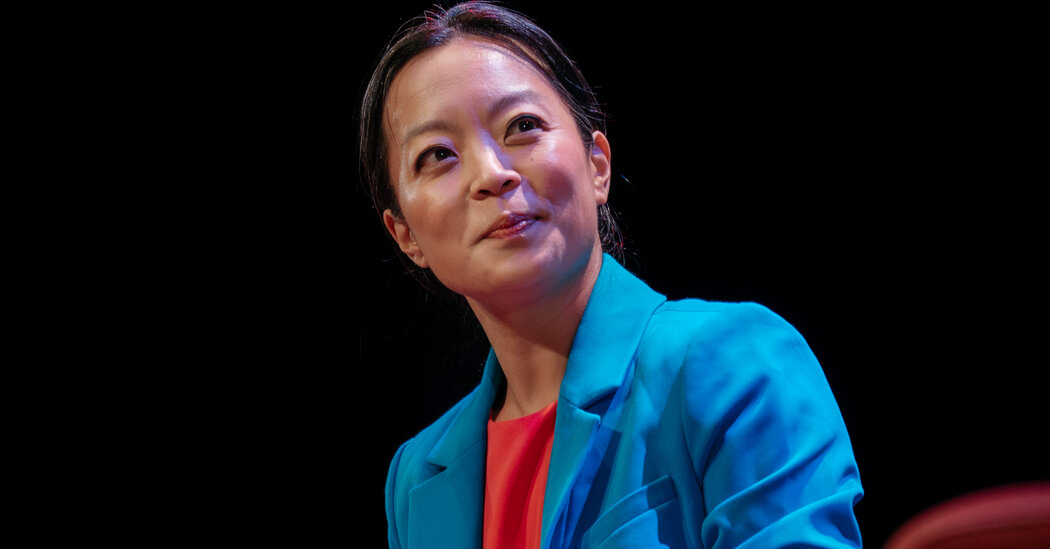
The progressive favorite, Francesca Hong, 37, is a democratic socialist who is betting that her populist pitch — she opposes the construction of data centers and unabashedly backs “Medicare for all” — will meet a moment of rising economic frustration.
Mainstream Democrats are deeply worried that Hong’s past support of far-left positions, like defunding the police, will put the governor’s seat at risk in the narrowly divided state. But their attempts to coalesce around an alternative have played like a messy game of reverse Whac-a-Mole, as one option after another dropped out or failed to catch fire.
Tonight, let me guide you through what could well be the most surprising high-profile primary of a surprising summer.
Who is Francesca Hong?
The former owner of a ramen restaurant that closed in 2024, Hong was elected to the State Legislature in 2020. She has made her economic struggles central to her political identity. Her restaurant closed because of financial challenges, and she was sued this year over the $30,000 she owed in credit card debt.
Over the years, she has made a series of statements that Republicans are eager to turn into campaign fodder, including calls to defund the police — something she’s backed away from somewhat in recent weeks — as well as her online derision of Thanksgiving, among other holidays.
The Times’s Julie Bosman explained four of Hong’s most provocative positions.
What do polls say about the race?
That Hong is the clear favorite. A survey taken by Marquette Law School late last month found her ahead of her nearest competitor by 25 percentage points. (That poll didn’t capture the latest changes in the field, though — read on!)
How did she become the party’s front-runner?
The story of her rise is a tale of timing as well as politics. Here are a few factors:
-
The biggest names stayed out. Last summer, Gov. Tony Evers of Wisconsin, a Democrat, announced that he wouldn’t run for a third term. In October, Josh Kaul, the state attorney general, a potential front-runner in the governor’s race, said he would run for re-election instead.
-
A bunch of candidates jumped in. The field swelled with mainstream Democrats, including Lt. Gov. Sara Rodriguez, former Lt. Gov. Mandela Barnes and State Senator Kelda Roys. With such a big field, major donors stayed on the sidelines, said Joe Zepecki, a Democratic strategist in Wisconsin who is not involved in the race, while Hong worked to pump up her name recognition.
-
Hong broke through. She crisscrossed the state, galvanized volunteers and staked out positions that helped her make a name for herself, including when she was the only candidate at a Democratic forum this summer to call for a moratorium on data centers. “It’s not a gimmick to say she’s different,” said Zepecki. “She is actually different.”
Is there an establishment favorite?
Well, Democrats have struggled to pick one.
Earlier in the summer, Rodriguez was seen as a leading mainstream alternative to Hong. In mid-July, though, she dropped out after disclosing that she had discovered a shortfall of more than $1 million in her campaign funds and fired her campaign manager.
That led David Crowley, the Milwaukee County executive, who had dropped out of the race earlier in the year, to re-enter, and he quickly secured the support of Evers. Crowley was a distant third in that Marquette poll.
Barnes, who ran for U.S. Senate in 2022 and lost to Senator Ron Johnson, a Republican, has consistently come in second to Hong in polls. But he dropped out on July 30, saying it had become clear whom the nominee would be.
Are Democrats nervous?
Some certainly are. Wisconsin is a battleground state where moderate Democrats tend to succeed, and some of them believe Hong is simply too far left to appeal to voters in the middle.
“This is not the year to test a democratic socialist,” Joe Wineke, a former chairman of the Wisconsin Democratic Party, told my colleague Kellen Browning this summer. “This isn’t New York.”
Are national progressives supporting Hong?
Not many. The biggest names in progressive politics, like Bernie Sanders and Alexandria Ocasio-Cortez, have said they’re staying out of this one, citing their focus on Senate and House races instead.
That could be a way of escaping blame in case Hong wins the primary but struggles in November.
Who is lending Hong outside help?
Republicans, for one. A super PAC tied to the Republican Governors Association has spent $2.2 million on ads that appear to be aimed at helping her.
what else we’re watching tomorrow
Between $100,000 and $1 million
That’s how much Ken Paxton, the Republican nominee for Senate in Texas, made about every 18 months from a cell tower at a hospital whose board he served on, according to an analysis by my colleague Lauren McGaughy.
Paxton has been trailed for years by questions about his finances, and the cell tower report sheds light on how he has made some of his money.
QUOTE OF THE DAY
“It’s, like, the most popular political podcast in Norway.”
That’s Anthony Scaramucci. You might remember him from the 11 days he spent as Trump’s communications director in 2017. These days, he’s reinvented himself as the host of a politics podcast with a huge international following. The Times’s Matt Flegenheimer tells the tale.
ONE LAST THING
Darline Graham and the gift of gab
Lindsey Graham, the South Carolina senator who died last month, was famously a chatterbox who loved to gossip with reporters.
His sister, Darline Graham, who inherited his seat, is not nearly as much of a talker, my colleague Michael Gold reports — leaving open many questions about her political views and positions as she seeks a six-year term of her own.
Taylor Robinson and Ama Sarpomaa contributed reporting.
