


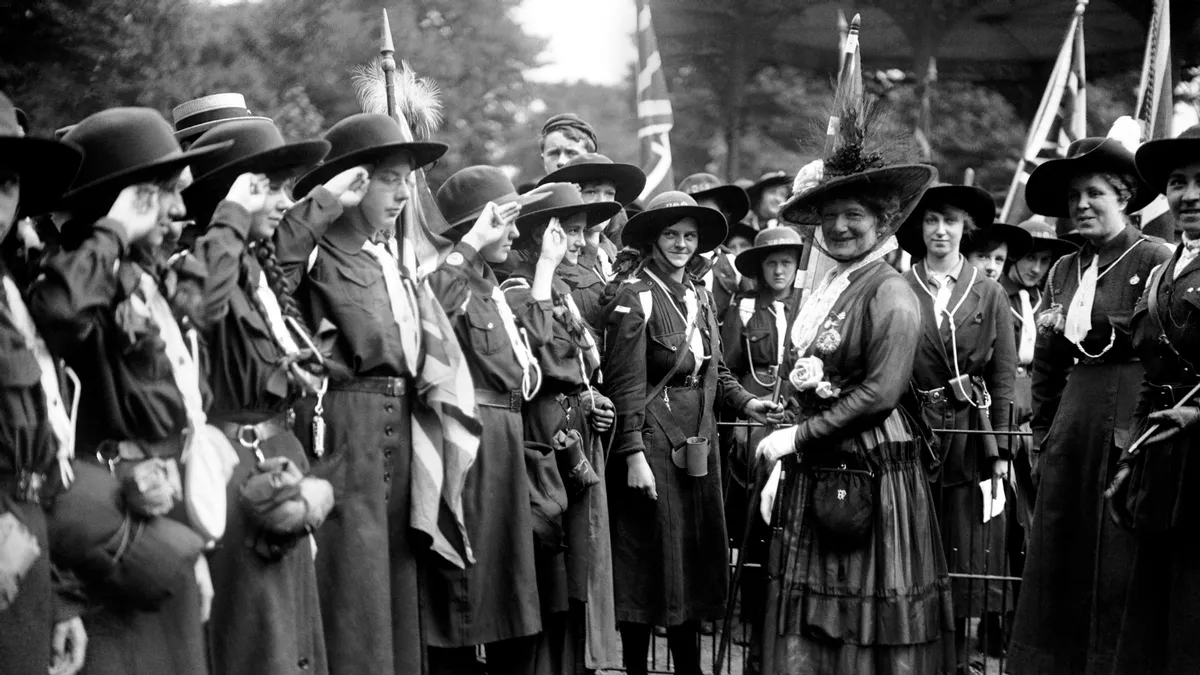
MI5, the U.K.’s internal and domestic security agency, used Boy Scouts as messengers during World War I but replaced them with Girl Guides because the Boy Scouts were too noisy and less reliable.
For years, a claim has circulated online that MI5, the U.K.’s internal and domestic security agency, used Boy Scouts as messengers during World War I but replaced them with Girl Guides because the Boy Scouts were too loud and less reliable.
Girl Guides are a similar organization to the Girl Scouts in the United States.
For example, one Instagram profile posted a graphic featuring text that reads (archived), “The Boy Scouts were too noisy for British intelligence, so MI5 trusted its secret messages to teenage Girl Guides instead.”
Other iterations of the claim have previously circulated on X, Facebook, Bluesky and Reddit.
According to an MI5 report about its “Organisation and Administration” between 1900 and 1919, the agency employed Boy Scouts to carry messages between officers starting in October 1914. However, the agency found the boys “very troublesome” because they would get into “mischief” during downtime on the job (Page 40) and instead hired Girl Guides, who proved more “amenable” than the boys (Page 41).
In a speech in October 2009, Jonathan Evans, who was the agency’s director general at the time, described those same Boy Scout messengers as “feckless and noisy” and the Girl Guide replacements as “more reliable.”
Given b
The MI5 report that mentions Girl Guides working for the agency is dated 1921 (Page 3). It is unclear when the agency released the report to the U.K.’s National Archives.
The section about Boy Scouts and Girl Guides says the agency sought out Boy Scouts because it needed messengers for in-house communication. However, the report adds (Page 40-41):
Boys were, however, found to be very troublesome. The considerable periods of inactivity which fell to their share usually resulted in their getting into mischief. When, therefore, the system of employing boys as coast watchers was introduced by the Admiralty, the boys employed by M.0.5. were advised to take up this work; outdoor work being much more fitted to their energy. Arrangements were then made to replace the Boy Scouts with Girl Guides and the results were most satisfactory. The girls proved more amenable and their methods of getting into mischief were on the whole less distressing to those who had to deal with them than were those of the boys.
MI5 was called M.O.5 until 1916.
According to the report, Girl Guides worked in the agency after September 1915 until January 1920 (Page 41).
Girl Guides in the U.K. commemorated the guides that worked for MI5 with a custom badge in 2023. The Girl Guides website says 90 guides, aged 14 to 16 years old, worked for the agency during World War I.
In “How the Girl Guides Won the War: An Extraordinary True Story and Social History of WWII Britain,” author Janie Hampton described the Girl Guides’ workday at MI5. Hampton wrote (Page 26-27):
Before a Guide could start work at MI5, she had to sign a contract confirming that she had permission from both of her parents and the Guide Captain who had recommended her. She pledged with her honour not to read the papers she carried, and was paid ten shillings a week for fifty hours of work, with only a short lunch break. The Guides’ working day began at 9 a.m. and finished at 7 p.m., and as well as carrying messages they were responsible for keeping inkpots filled. Some were also trained to clean and repair typewriters.
The ten shilling note fell out of circulation in 1970 (Page 10) and was replaced by the 50 pence coin. A weekly pay of 50 pence in 1915, the first year the Girl Guides started working for MI5, was equivalent to £45.91, or roughly $62, in July 2026, according to the Bank of England.
The War Office also took Girl Guides to the signing of the Treaty of Versailles, which ended the state of war between Germany and the Allied Powers. Speaking about their work regarding the treaty, Hampton wrote (Page 29):
When the First World War ended, Guides were considered so reliable by the War Office that a contingent was taken with the British delegation to France. British Guides ran errands at the Palace of Versailles for the Paris Peace Conference in June 1919, and sixteen Ranger Guides were invited to witness the signing of the treaty.
For further reading, Snopes has previously investigated claims about Scouting America and the Girl Scouts of the USA.
