


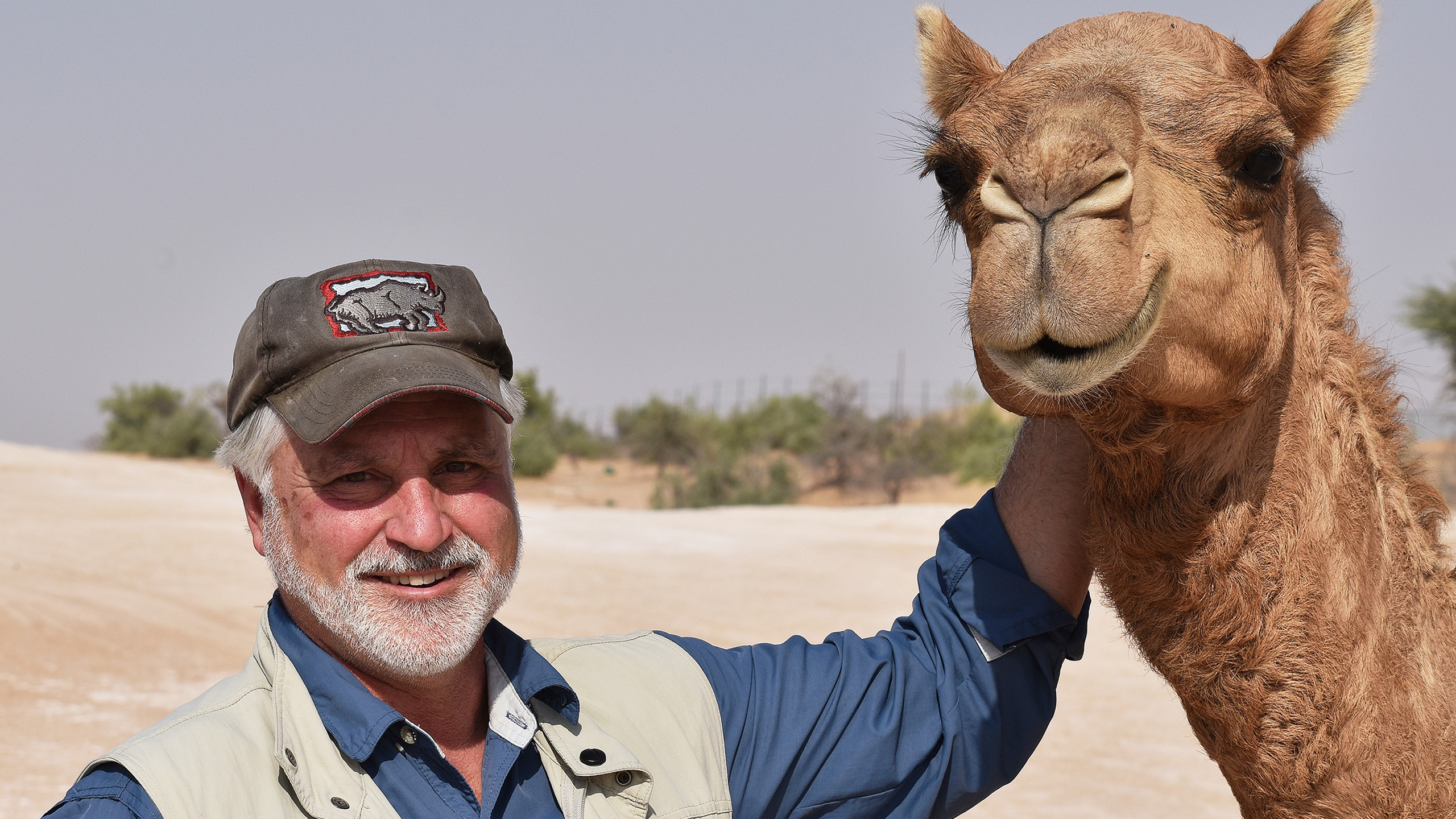
- Wildlife conservationist Bill Konstant has spent more than four decades helping build species-conservation programs, connect field biologists with funding, and support threatened wildlife around the world.
- Konstant argues that successful conservation often depends on strong local leadership, committed species champions, diverse teams and relatively small, strategically targeted grants that can launch or sustain field projects.
- He sees the growth of career biologists and conservation organizations in primate range countries as one of the field’s most encouraging changes, even as habitat loss and wildlife population declines remain persistent problems.
- Konstant spoke with Mongabay founder Rhett Ayers Butler in August 2026 about his career, his memoir Wrestles With Wolves, and what decades of species conservation have taught him about how conservation succeeds.
Russell Mittermeier has a running joke about Bill Konstant. The two have worked together, off and on, for more than four decades, and Mittermeier writes in the foreword to Wrestles With Wolves that Konstant seems to have a tolerance of roughly five years working directly for him before departing for another organization.
Konstant has an explanation for that pattern. He has never been much interested in becoming a “company man.” Instead, he has compared his role to that of a catalyst in a chemical reaction — something that helps raise the energy of the system but need not remain once the reaction is underway.
There have been plenty of reactions.
Konstant has worked for the World Wildlife Fund and Conservation International, built conservation programs at zoos, and helped direct grants to field biologists working on threatened species. Much of his career has centered on primates, although the animals in his 2023 memoir range from golden frogs and rhinos to wolves, elephants and a squirrel his family raised when he was young.
The route into professional conservation was less orderly than the résumé makes it look.
At Cornell University, Konstant became an undergraduate teaching assistant for ornithologist Tom Cade, founder of the Peregrine Fund, whose work helped restore peregrine falcons after DDT contributed to steep population declines. Later, at the State University of New York at Stony Brook, Konstant took a job caring for and training chimpanzees. Jane Goodall had helped spark his interest in the animals, but it was Mittermeier — then a primatologist at Stony Brook — who helped turn that interest into a career.
Konstant went looking for him. In the memoir, he recounts learning that Mittermeier tended to work late and waiting outside his office until he appeared. Mittermeier eventually hired him at WWF, brought him to Brazil and introduced him to primatologists working in the field.
Konstant’s job was to help those researchers find the resources they needed to run their projects. That proved useful for what followed.

At the Houston Zoo, for example, Konstant worked with longtime colleague Rick Barongi to expand what he describes as a dormant, low-six-figure conservation program into one roughly an order of magnitude larger. In other roles, the sums have been much smaller. Konstant has spent years involved with grant programs in which a few thousand dollars can help a field biologist begin collecting data on a poorly known species, keep a project going between larger awards or demonstrate enough progress to attract additional funding.
He says small grants can fill gaps that larger conservation funding does not. The best field biologists, he says, often become adept at “cobbling together funds from multiple sources.”
Over the years, Konstant has seen a lot of successes — and failures — in conservation, many of which revolve around leadership. A zoo conservation program can languish if the director is not committed, he says; staff have to feel involved, boards need to support the work, and species need champions. The strongest efforts, in his experience, assemble what he calls a “motley crew” — people with different backgrounds and abilities who can be brought to bear on the same problem.
Konstant spoke with me during an August 2026 exchange.

An interview with Bill Konstant
Rhett Ayers Butler for Mongabay: You describe yourself in Wrestles With Wolves as someone drawn to animals from a very young age. What is your origin story as a conservationist?
Bill Konstant: I can remember beginning to think about working with wild animals as a career in my early teenage years. On Sunday afternoons, my family would watch Mutual of Omaha’s Wild Kingdom with Marlin Perkins and Jim Fowler and I could imagine myself lassoing an alligator or tranquilizing a bear.
When it came time to apply to college, Cornell University was my first choice. It had strong biology and wildlife conservation programs, and since I was a New York resident, I qualified for reduced tuition and a state scholarship.
I really lucked out when I was recruited as an undergraduate teaching assistant for Dr. Tom Cade’s vertebrate anatomy class.
Dr. Cade directed Cornell’s Laboratory of Ornithology and founded The Peregrine Fund. During my four years at Cornell the Fund developed the captive breeding and reintroduction program that helped save not only the peregrine falcon but osprey, bald eagle and brown pelican populations across the country.
Mongabay: Was there a particular animal, place, or person that first made you think this could become your life’s work?
Bill Konstant: In Wrestles with Wolves, I tell the reader right off the bat that my life can easily be summed up in just four words – “Mowgli meets Forrest Gump.” I have what I’d call an innate fondness for animals and a learned understanding of animal behavior, just like Mowgli the Man Cub in the Jungle Book.
Then there’s the fact that I just seem to stumble upon one opportunity after another to help save threatened wildlife and have somehow been able to weave these together into what I guess you could call a career.
If I had to credit a single species for making that possible, I’d have to say the chimpanzee. As for a place, I’d have to say the State University of New York at Stony Brook, where I was hired to care for and train chimpanzees.

As for a person, I’d have to name two. It was Dr. Jane Goodall who first inspired my interest in chimpanzees. We became good friends over the years and I wish Jane well on her next great journey, whatever that may be.
In the end, I credit Dr. Russell Mittermeier with putting me on a career course. Russ hired me as his assistant at the World Wildlife Fund, took me to Brazil, introduced me to a number of primatologists and told me it was my job to help them find the resources they needed to run their field projects. Pretty straightforward on-the-job training.
Mongabay: Why did you choose Wrestles With Wolves as the title of the book?
Bill Konstant: “Wrestling” With Wolves was my original choice. Even though there’s only one wolf story in the whole book, I’d play-wrestle with a gray wolf and my wife, Nannette, was able to snap a few shots of our “match”.
Then maybe I got “a bit too clever by half” and decided to piggy-back on William Blake’s and Kevin Costner’s Dances With Wolves. It’s one of my all-time favorites, but you’ll recall that neither the book nor the movie is really about wolves, so I figured that I’d follow their lead and perhaps share their success.

So, I imagined that a Native American who might be observing me could easily decide to name me Wrestles with Wolves. Readers will quickly figure out that the book is not just about wolves as they come upon stories of golden frogs in Panama, lemurs in Madagascar and rhinos in Indonesia.
Mongabay: What made you want to write the book after so many years in conservation, and what did you want readers to understand from its many species and stories?
Bill Konstant: I decided to write the memoir while taking an adult education course at a local library. Over the years, my work has required the preparation of grant proposals, project reports, scientific papers, magazine articles, books chapters and the like, not opportunities to tell stories, which I enjoy doing.
People quickly forget lists of facts but tend to remember the important points that are embedded in stories. I’d waited long enough to share the stories I’ve collected over the years and this was a chance to treat a serious subject with a touch of humor, because no one wants to be fed a steady diet of doom and gloom – habitat loss, illegal hunting, disease, human-wildlife conflict, global warming and the list goes on.
I’d like my readers to feel good when they pick up something I’ve written, to want to turn the page and learn that people not very different from them have found a variety of ways to enjoy nature and perhaps play a role in saving species. Folks whose favorite creatures might be lions, African elephants or mountain gorillas might be encouraged to go on safari and see these animals up close and personal, as I’ve been able to do.
Mongabay: Your next book appears to begin with “Accepting the Universe.” What did you still feel you needed to say after Wrestles With Wolves?
Bill Konstant: The next book, which I’m in the middle of writing and have yet to pitch to a publisher, will begin with a tribute to the late John Burroughs. A collection of his writings fill one of the bookshelves in my den.
Burroughs wrote prodigiously about nature and wildlife conservation. He “talked the talk” and “walked the walk” well into his golden years and as one of the most influential biologists of the late 19th and early 20th centuries.

I can imagine myself following in Burrough’s footsteps. Accepting the Universe, a stab at determining the meaning of it all, was one of his later books but not his last. He wrote it in Slabsides, the log cabin he’d built by hand in New York’s Catskill Mountains, the cabin where then President Teddy Roosevelt might stop by for lunch and a chat.
My writing nook isn’t quite so historic but I’m not hurting for tales that remain untold and it seems that new story ideas pop up all the time. For instance, the next book will tell about the time, many years ago, that two pythons bit me at the same time. And now, I have new anecdotes about manatees in Cuba and toads in Israel.
Mongabay: You write about climbing Kilimanjaro with Rick Barongi to mark your 70th birthdays. What did that experience make you think about at this stage of your life and conservation career?
Bill Konstant: Let’s be clear. Climbing Mount Kilimanjaro was Rick’s idea and he asked me to come along for the ride. Not that I didn’t want to give it a try but wouldn’t have thought up the adventure on my own. Rick was Bill Bryson in A Walk in the Woods and I was his sidekick, Matt.
That being said, summiting Kili was an incredibly enriching experience. It replenished my spirit and renewed my confidence in my own abilities. Despite being one of the older climbers to stand there at the top at close to 20,000 feet, I felt youthful for having met the challenge and anxious to tackle new ones.

During the climb, I began to reminisce and quickly realized that there were many tasks left unfinished, as well as people and places I needed to revisit.
I needed to prepare myself for the next adventure, the one after that and the one after that. But they need not involve mountains.
Basically, I began thinking about seriously attacking the bucket list I’d written just before the climb – the first item on the list. Why waste any time planning trips to see aye-ayes, tigers and other species that I’ve always wanted to see in the wild?
Mongabay: You have worked on primate conservation for much of your career. What has changed most in the field since you began, and what has not changed enough?
Bill Konstant: Yes, primates have been the major focus of my career in wildlife conservation. In most cases, endangered primates serve as flagship species for entire groups of plants and animals that may be under threat of extinction. This is especially true in many of the world’s tropical forest regions.
I’d have to say that the most important change I’ve seen over the last 40 years is the encouraging increase in the number of career biologists from primate range countries, as well as the emergence of primatological societies and small non-governmental organizations in those same countries and regions. Brazil, Colombia, Peru, Vietnam and a handful of other countries are good examples of where this is happening.

Armies of wildlife conservationists are being assembled and that bodes well for the future.
At the same time, we’ve not done as good a job of stemming habitat loss and population declines. But we can do better. The game isn’t over yet.
Mongabay: You’ve been involved with “Primates in Peril” for many years. What has that effort accomplished, and what are the limits of using lists and attention campaigns to help threatened species?
Bill Konstant: I was there at the beginning of Primates in Peril in the program’s earliest days and wrote about my involvement in the upcoming book.
This international effort convenes at bi-annual meetings of the International Primatological Society, bringing together the world’s leading primate conservation experts to list The World’s Top 25 Most Endangered Primates.
The original list was launched in January 2000, appearing on the front page of Time magazine.
Several of the original 25 species still make the list and may continue to do so unless they fall over the brink.
The list has become a major fundraising tool over the decades, not only drawing attention to the threats that continue to face these lemurs, monkeys and apes, but also to opportunities for supporting their conservation.
It’s difficult to put limits on the usefulness of lists like these. For example, a fair number of Primates in Peril species have been named as candidates for support from the Phoenix Species Project, a recently announced $200 million global initiative.
Mongabay: You have worked with organizations including WWF, Conservation International, zoos, Re:wild, and species-conservation funds. In your experience, what usually determines whether a species program succeeds?
Bill Konstant: In my experience, programs succeed because of good leadership that builds team strength and momentum.
For example, if a zoo director isn’t fully behind, excited about and willing to promote the institution’s conservation program, that program will languish. If the staff doesn’t feel involved, it will wither and die. If the institution’s board isn’t packed with movers-and-shakers who like to put on their conservation caps, get out into the field and get their hands dirty, then that institution’s conservation programs will be lackluster at best.
Then there’s the need for champions. Each species needs one at the very least.

In my opinion, the most successful species conservation programs are those capable of assembling a “motley crew” of players and supporters, people of various backgrounds and talents that can be brought to bear on the tasks at hand.
Diversity is not only important in biology.
I serve as an advisor to the Mohamed bin Zayed Species Conservation Fund along with close to a dozen colleagues whose collective expertise spans the world’s mammals, birds, reptiles, amphibians, fish, invertebrates, plants and fungi. The grants we’re able to award span the globe and are increasingly being received by young biologists from countries where critical resources are often difficult to come by.
Mongabay: You have helped support many small grants for species conservation. Why can relatively small amounts of money matter so much for endangered species?
Bill Konstant: Most species conservationists work in remote areas where, fortunately, modest amounts of funding can go a long way and have significant impact. Small, targeted grants can serve as important seed money for projects operating at the grass-roots level.
They provide funders with a better sense of how well grantees can manage field research efforts in combination with program administration.
The first grant received by an applicant for work on a species for which data is deficient can be very important, not only to get the ball rolling but to attract matching funds from other sources.
The most resourceful field biologists who become adept at cobbling together funds from multiple sources. In addition, small grants can very nicely fill in gaps in funding provided by much larger programs.
Even the most prominent sources, such as the Critical Ecosystem Partnership Fund, for example, can’t provide all the necessary resources, so a small grant here or there from other donors can actually make a big difference.
Mongabay: Zoos have played a role in parts of your career. How do you see the relationship between zoos and field conservation today?
Bill Konstant: Over the last quarter century, zoos have played an increasingly important role in species conservation worldwide. I’ve had the opportunity to help develop conservation programs, essentially from the ground up, at several US zoos and I continue to work closely with zoos, aquariums and botanical gardens internationally in different advisory roles.
Committing to Conservation: The World Zoo and Aquarium Conservation Strategy was published in 2015 and my Kilimanjaro climbing partner, Rick Barongi, was the senior editor.

A decade earlier, Rick, then director of the Houston Zoo, and Russ Mittermeier, then president of Conservation International, shared my services for a year so that I might help Rick revitalize the Houston Zoo’s wildlife conservation program. Together, we took what was a dormant, low six-figure program and built one an order-of-magnitude larger that had global impact.
Other zoos and aquariums have different models but, pretty much across the board, these institutions are committing a greater percentage of their budgets to field conservation.
Mongabay: Conservation often involves long timelines, setbacks, and uncertain outcomes. What gives you hope, and what advice would you give young people who want to contribute?
Bill Konstant: Yes, there’s no simple recipe, is there? In my first job as director of a small conservation organization, I was told by the late British naturalist and author, Gerald Durrell, that if I couldn’t commit to a project for the long term, I shouldn’t commit at all. Good advice.
If a species is endangered, it didn’t get that way overnight, so there’s not one grant, one person or one institution that has any chance of bringing it back quickly.
And, yes, trial and error will almost always factor into the equation but we tend to learn more from our failures than from our successes, at least initially.
Winston Churchill once said, “Success is going from failure to failure without loss of enthusiasm.” There would seem to be an element of hope in that statement, enough for me to bank on.
As for advice to young folks who want to contribute, I would say get in touch with people at your local zoo, aquarium or botanical garden and let them know what your interests are. These institutions represent a wealth of information and opportunity – a valuable resource to be sure.
I’ll give you an example. My wife, Nannette, is not a biologist. She’s a registered nurse-turned-quilter who shares my love of wildlife. A few years back she made a colorful quilt based on Albrecht Durer’s famous 16th century woodcut of an Indian rhino and donated it to the Houston Zoo. The Zoo auctioned it off for several thousand dollars, enough to help reintroduce one of these rare animals to Kaziranga National Park. Someday, I’ll take Nannette to India to see the results of her handiwork firsthand.

Banner image: Bill Konstant with a camel in the UAE. Photo by Jean-Christophe Vie

