


Since the first Industrial Revolution, goods and technologies have reached the farthest corners of the world, but the ability to design, build, market, and extract value from them has remained highly concentrated. Unless humanity can break this pattern, a sufficient response to climate change will remain out of reach.
BRASÍLIA—Suppose the global economy comprised countries roughly equally equipped with research institutions, technology development labs, and industrial production facilities. They might compete fiercely, build rival alliances, and vie aggressively for raw materials and natural resources. But one can also imagine a more optimistic scenario. Since each country would understand its own challenges best, it could devise solutions adapted to its own circumstances, building systems and equipment at precisely the scale required. And where competences complement one another, governments could engage in mutually beneficial collaborations, mobilizing scientists, technology, and manufacturing toward common goals.
Unfortunately, humankind has tended in the opposite direction. Since the first Industrial Revolution and the emergence of a truly global economy around the turn of the
19th century, goods and technologies have reached the farthest corners of the world, but the ability to design, build, market, and extract value from them has remained highly concentrated.
By the mid-1800s, steam locomotives were already operational in almost 60 countries or colonies, yet only Britain, the United States, and certain German states were fully capable of supplying them. Telegraphic lines followed a similarly uneven pattern, as did the auto industry, which emerged at the turn of the 20th century and became emblematic of globalization in the post-World War II era with the internationalization of manufacturing capabilities, especially in large developing countries in Asia and Latin America. But only two of these economies, Japan and South Korea, managed to join the exclusive club of so-called original equipment manufacturers.
With the end of the Cold War, the information-technology industry took this model—under the banner of “Designed in California, assembled in China”—to the next level, drawing a clear line between knowledge-intensive, well-remunerated activities and labor-intensive, low-paid operational ones.
Nonetheless, with the rise and spread of the clean-energy industry and other climate technologies, many thought that history could be written differently. When China started to gain global market share in the production of solar panels and wind turbines, some analysts suggested that “green windows of opportunity” could emerge across the rest of the developing world. Having successfully learned the inner workings of the new technologies through joint ventures and licensing agreements with advanced-economy providers, China seemed to have found a blueprint that others could follow.
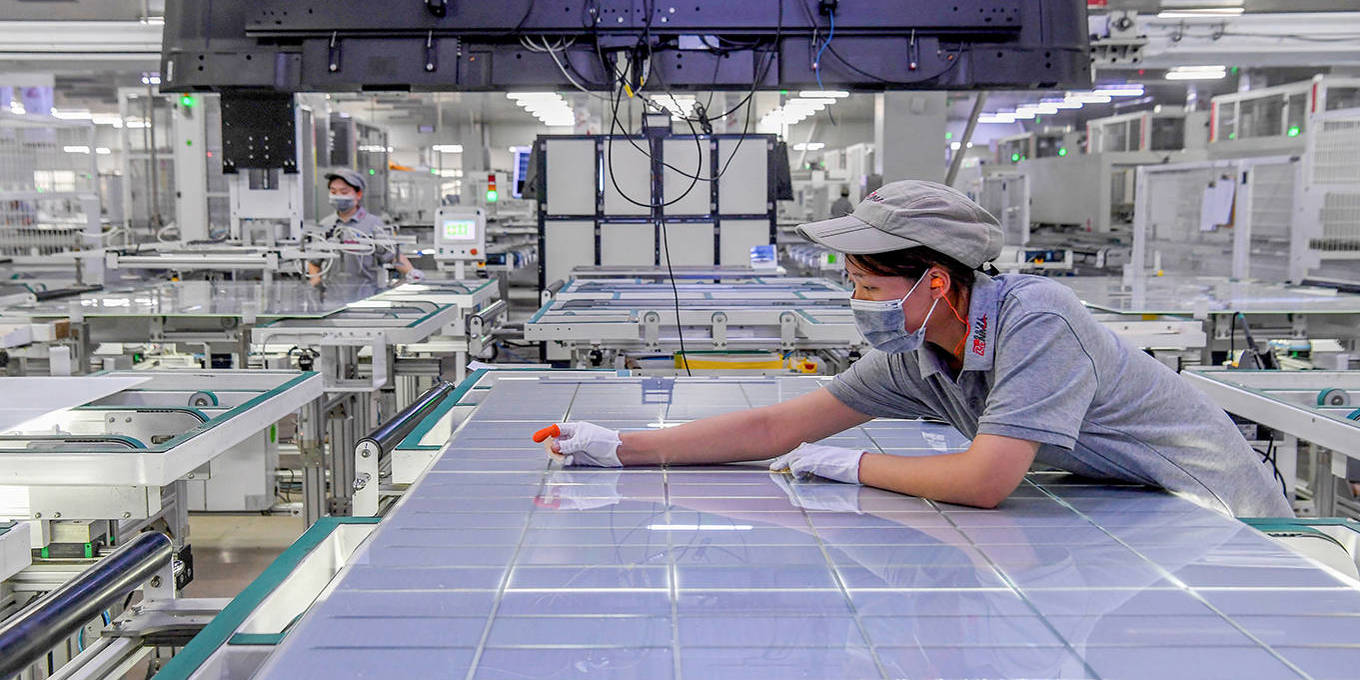
But the geographical diversification of technological innovation has remained more of a dream than a reality. The International Energy Agency finds that while clean-energy technologies are spreading fast, with solar capacity having increased tenfold since 2015, manufacturing capabilities remain highly concentrated. Across most clean-energy supply chains, 60-85% of production capacity is concentrated in no more than five countries, with some individual segments exceeding 95%. Despite mounting efforts to diversify production, no major shift in these supply chains’ geography is likely before 2030.
Worse, this trend is no longer confined to mature technologies such as solar panels, wind turbines, and batteries. Emerging sectors such as electrolyzers for low-emissions hydrogen and small modular reactors are already exhibiting similar dynamics. Data collected by the OECD show that about 92% of the patents for new environment- and climate change-related technologies in 2023 stemmed from China, Japan, South Korea, the United States, and the European Union. Rather than ushering in a more distributed industrial and technological landscape, the transition to a low-carbon economy appears to be reproducing a familiar historical pattern: adoption is global, but the knowledge, productive capacity, and value creation remain clustered in a remarkably small number of countries.
Closing this gap will not be easy. The Economic Commission for Latin America and the Caribbean argues that a “big push” will be necessary to mobilize the coordinated investments capable of transforming productive structures and building domestic technological and innovation capabilities in left-behind countries and regions.
Multilateral climate institutions are also fully aware of this challenge. Last year, parties to the Paris agreement, meeting under the UN Framework Convention on Climate Change, adopted the Belém Technology Implementation Programme, which aims to ensure that environmentally sound technologies are deployed in developing countries.
One pioneering feature of this program is that it frames domestic innovation as a must, rather than deeming the transfer of off-the-shelf technologies sufficient. It recognizes that locally conceived, developed, and produced technologies are the most suitable for addressing context-specific challenges and unlocking economic value.
To be sure, technology transfer remains a cornerstone; but it should take place within a framework that accounts for the whole technological cycle. This means recognizing that transfers can take place across multiple stages of the innovation process (from research and design to demonstration, deployment, and commercialization), rather than being confined to the diffusion of fully mature solutions. Such a change should expand opportunities for learning, adaptation, and innovation in recipient countries.
Implementation of the Belém program will face several obstacles, from geopolitical tensions and trade barriers to the diversion of financial resources toward security and defense. But we must not lose sight of the additional value that could be unlocked with a new approach. In developing his concept of “cosmotechnics,” the Chinese philosopher Yuk Hui reminds us that technologies are not universal. They carry the worldview and values of the places where they were conceived. To counter the legacy of colonialism, current inequality, and the ills associated with the industrial age, humanity must decisively embrace “technodiversity.”
A serious response to climate change requires more than deploying homogeneous clean technologies at scale. It calls for expanding the world’s capacity to understand problems, generate solutions, and build the systems needed to address them. The success of the low-carbon transition should not be measured only by the speed at which technologies spread, but also by how widely the capabilities to innovate, adapt, and produce them are distributed. In the end, a safer climate will depend both on decarbonizing the global economy and on democratizing the technological foundations that make such transformation possible.
The views expressed in this article are those of the author in his personal capacity and do not necessarily reflect the official views or positions of the institutions with which he is affiliated.
